Godagari water treatment plant nears completion
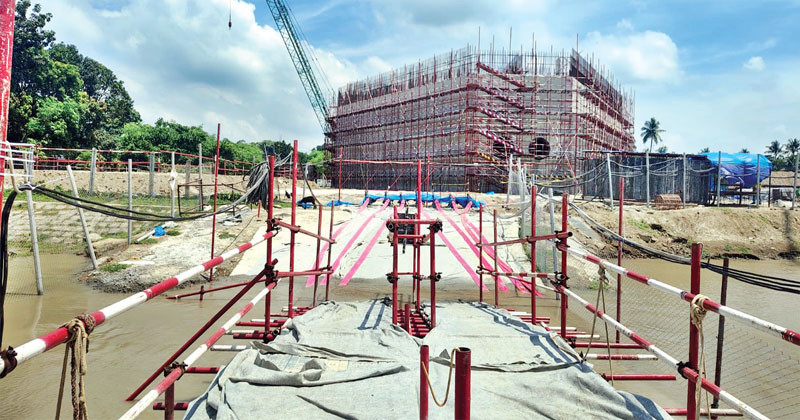
- China-Bangladesh joint project can treat 200 million liters of water daily
Md. Haider Ali, Godagari (Rajshahi)
Work is becoming visible on this project, being implemented in Godagari, Rajshahi, at a cost of Tk 4,062.22 crore. Engineers who inspected the site said the quality of the work — high-grade stone, brick, sand, rod, and cement, worker safety, use of advanced machinery, and neatly executed casting and construction — should give the structure a lifespan exceeding 50 years.
Of the 26.5-kilometer transmission main pipeline from Godagari to Kashiadanga in Rajshahi, 23.13 kilometers have already been laid. Of the 48-kilometer distribution pipeline in Rajshahi city, 12.8 kilometers have been completed. In the Jot-Gosaidas area of Godagari upazila, several multi-storey buildings, roads, pipe installations, pump houses, and Chinese workers’ residences are truly a sight to see. Once complete, Rajshahi WASA’s water-supply capacity will nearly double, which those involved hope will largely resolve the city’s long-standing safe-drinking-water crisis, benefiting hundreds of thousands of people. Officials and staff of the China-Bangladesh joint project have earned praise for rebuilding some roadside drains, homes, shops, and parts of a mosque in Godagari municipality that were damaged during pipe-laying work.
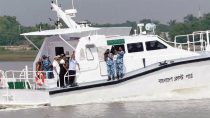
Rajshahi-1 MP and Jamaat Naeb-e-Ameer Professor Mr. Mujibur Rahman visited the project site on Friday, 24 July, at 11 AM, to inspect progress and exchanged views with the project’s chief officer. He said supplying safe drinking water is a highly important public-service initiative, and stressed greater coordination and communication to run the project more effectively and ensure easy access to safe water for local residents.
Work on the project is proceeding at full pace. WASA has begun setting up the water treatment plant using high-quality construction materials, and the public has responded positively. Surface water from the Padma at Godagari will be treated and supplied to Rajshahi city.
Although designed as a four-year project, about 85 percent of the infrastructure has been completed within three years of starting. Pipe-laying work alongside the Rajshahi-Chapainawabganj highway is proceeding at full speed, along with pipeline installation across the city. As Rajshahi’s population and urbanization grow, so does demand for safe drinking water; the city currently faces a shortfall of about 37 million liters of water per day. To address this, the surface-water treatment project in Rajshahi was approved by the ECNEC in October 2018, and implementation began in July 2023 in the Jot-Gosaidas area of Godagari upazila, jointly funded by Bangladesh and China.
This high-capacity treatment plant is being built in three stages: an intake point at the confluence of the Padma and Mahananda rivers; the main treatment plant nearby, with a capacity to treat 200 million liters of water daily; and a booster plant in the Haripur area of Paba upazila near the city. Those involved say all components are progressing according to plan.
Godagari municipality’s secretary and engineer, Mr. Sarwar Jahan Mukul, said the municipality’s drains from Mohishalbari to the C&B area were completely damaged during pipe-laying; some have been rebuilt, and the rest are under construction. He could not say how many meters of drain were damaged or how much the municipality has spent on repairs.
Rajshahi WASA’s assistant engineer, Mr. Abdur Rahim, said more than 3,000 workers are working daily, with visibly good progress — physical completion stands at almost 75 percent, and the work is expected to finish soon.
Rajshahi WASA’s chief engineer and project director, Mr. Pervez Mahmud, said the plant’s capacity was set based on projected water demand for the city through 2035. Of the 26.5-kilometer transmission main from Godagari to Kashiadanga, 23.13 kilometers have already been laid, and of the 48-kilometer distribution network in Rajshahi city, 12.8 kilometers have been completed.
According to the four-year project’s feasibility study, water will be available year-round at a depth of at least 30 feet at the Padma intake point, allowing the project, once complete, to supply 200 million liters of safe water daily. The structure is expected to last around 50 years, and urban planners believe the use of modern Chinese technology will bring positive changes to water quality and the supply system — some estimating its lifespan could reach as much as a hundred years.
This reporter toured various project sites last Sunday from 11 AM to 12:30 PM, accompanied by Rajshahi WASA assistant engineer Mr. Abdur Rahim and safety officer Mr. Saiful Islam, who showed various aspects of the project. Water levels in the Padma were found to be steady. WASA is setting up the roughly Tk 4,500-crore water treatment plant using Padma river water as its main source at Godagari; WASA says at least 30 feet of water depth will be available there year-round, with a daily supply capacity of 200 million liters. Rajshahi WASA and China’s Hunan Construction Engineering Group Company Limited are working jointly on the project, with total cost estimated at more than Tk 4,062 crore — of which the Bangladesh government is funding Tk 1,748 crore and Hunan Construction Engineering Group Company Limited Tk 2,313 crore. Though the project began in July 2018 and was originally slated to finish by July 2024, work is now proceeding around the clock. The Chinese company is using 80 percent local labor and technicians, employing several thousand local workers and drivers daily, and local sand traders are benefiting from the project, selling sand to the company, which pays its bills on time. Businesspeople and workers in Godagari, Rajshahi, and Chapainawabganj are benefiting, with about 3,000 jobs created.