
Missing children: we need to look deeper into the problem
Shahria Islam Shayla
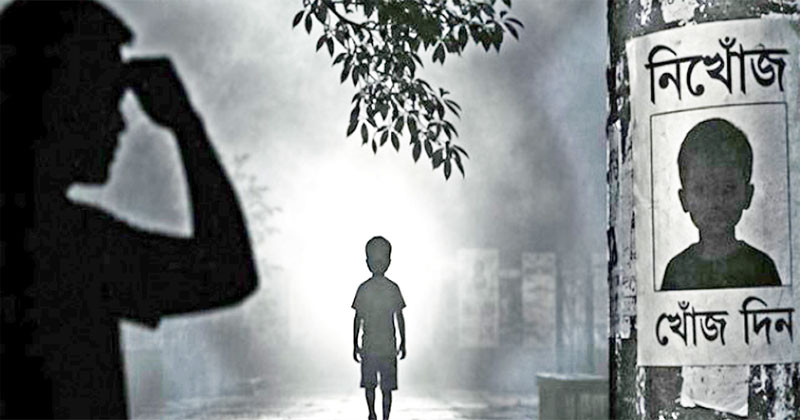
Whenever news of missing children in Bangladesh surfaces, parents naturally feel fear, and everyone becomes anxious about their own children. Recently, data showing 15,717 child-missing GD (General Diary) entries filed in the country between January and July this year has sparked fresh discussion. Police headquarters later verified that, of these, 13,679 children were recovered or returned to their families, while 2,038 remain untraced. Various newspaper reports on 3 September carried this police data. Simply saying that more than 15,000 children went missing does not give the full picture, nor can the cases of those still unaccounted for be treated lightly. Viewing this only as a law-and-order problem would leave a large part of the issue hidden. We must also ask why children go missing, which families are more at risk, where the parents work, what they do, and whether anyone is available to look after the child — because a child going missing is often not a sudden, isolated incident but is rooted in a family’s economic reality and gaps in social safety nets.
This becomes clear when looking at Bangladesh’s low-income families. A father may drive a rickshaw, a mother may work in someone else’s house or in a garment factory; some are day laborers, some run small footpath businesses. Every day of their lives is a careful calculation. If the father doesn’t go to work one day, that day’s income is lost; if the mother doesn’t go to work, another household need goes unmet. Such families cannot afford to hire someone separately to look after their child all day. So where does the child stay? Sometimes in front of the house, sometimes with an older sibling, sometimes under a neighbor’s watch. A small child playing can easily wander off, follow someone, go off with a stranger lured by food or a toy, or get lost in a crowd while out with family. If such a young child cannot even give their own name, address, or their parents’ address, finding them becomes even harder.
Recent police data also cites causes such as losing one’s way, being unable to state family members’ names and addresses, and wandering off while moving alone, particularly among children aged zero to nine. For this age group, it is not just the risk of crime but the matter of childcare and safety that must be taken seriously. There’s a difficult question here: should we tell poor parents not to go to work and instead watch their children all day? If they don’t work, how will food come to the household? If a rickshaw-driving father stays home every day to watch his child, how will his family survive? If a mother working in someone’s house quits her job, she may be able to keep her child close, but how will she then arrange for that child’s food? So placing the entire responsibility on parents alone will not solve the problem. What’s needed is a social system where parents can work and children can still remain safe. Another important point is that the reasons for disappearance among children and adolescents aged 10 to 17 are often different. According to police data, causes found include resentment, pressure of studies, family conflict, influence of friends or classmates, a desire for independent living, attempts to obtain money or other benefits from family, and leaving home out of shame or fear after becoming involved in some improper incident. Here too, families need to rethink their approach. It is not enough to simply send a child to school, feed them, and provide necessities — parents must talk to them, learn what they are thinking, who they are associating with, whether there is pressure at school, and whether something at home is troubling them. Especially during adolescence, listening carefully to a child can sometimes steer them away from a wrong decision.
In terms of solutions, safe childcare arrangements could be set up at the local level — particularly community childcare centers in slums, working-class areas, and densely populated neighborhoods, where children could stay in a safe environment for a set period each day. This would let parents go to work while easing their worries about where their children are. Schools could also be linked to this system. A child’s school hours don’t always align with their parents’ work hours, so introducing safe after-school care for a few hours could ease the burden on many families — children would not wander the streets after school, and parents could pick them up on the way home from work.
In this regard, some aspects of London’s social safety system may offer lessons for us. Having lived in London, I have had the chance to observe some of these systems firsthand. In the UK, eligible families receive support such as “Child Benefit.” From the 2026-27 academic year, free school meals in England have also been expanded to all children in families receiving “Universal Credit.” Such measures do not relieve families of their parenting responsibilities, but they do share some of the burden families face in difficult times. Of course, London and Bangladesh are not comparable realities — the UK’s economy, tax system, and social security framework differ greatly from ours, so it would not be realistic to suggest replicating any of their systems exactly here. But we should adopt the core idea: that a child’s safety and family welfare must be treated as part of state policy. To do this in Bangladesh, we must first build our capacity — those able to pay taxes must do so regularly, state revenue must increase, and it must be ensured that this revenue is properly used for the public good, since a strong economic foundation is needed to expand social security.
The current government could gradually work toward building such a social structure. Having lived in London for a long time, Prime Minister Mr. Tarique Rahman has seen much of its administrative and social systems firsthand and could draw on that experience. Public expectations of the new government are high — in education, health, social security, and employment, people want to see change everywhere. But changing a country is not the work of a single day. After a new government takes office, time is needed to draft plans, carry out administrative reform, build economic capacity, and implement those plans. So even as we demand action from the government, we must also give it the time and cooperation needed to implement good initiatives. There will be criticism, questions, and accountability — but there must also be a willingness to support effective initiatives in the country’s interest.
The solution to the problem of missing children thus does not lie in the hands of any single institution. Police must become faster and more technology-driven, families must become more aware, schools must become more responsible, local administration must become more active, and the state must gradually expand the scope of social security. Most importantly, we must build a Bangladesh where a rickshaw-driving father can leave for work in the morning confident that his child is safe, where a garment-worker mother knows she will find her child exactly where she left them when she returns home, and where a child from a poor family is not denied the right to grow up safely.
Development is not confined to big roads, bridges, or buildings. True development is achieved only when an ordinary person can raise their child safely. Finding a missing child is certainly urgent — but even more urgent is building a system that reduces the risk of a child going missing in the first place. Because when a child is lost, it is not just a child that a family loses — with them go a family’s dreams, security, and future. Protecting that future is a responsibility that belongs to all of us.
The writer is a politician and columnist.