
Hindutva in a century: How India’s future is sinking into darkness
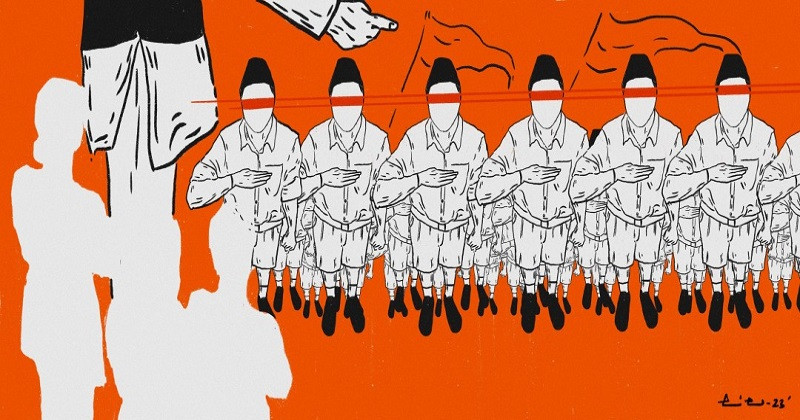
American political anthropologist and professor Angana P. Chatterjee has published an in-depth analysis of the rise of Hindutva and radical Hindu nationalist politics in India over the past century. The article presents a critical picture of the growth of Hindu nationalism, the creation of a parallel state structure and the pressure on India’s democratic and secular values.
The article says Hindu nationalists have built a vast right-wing network to promote a majoritarian state structure. They have used society, culture, history, education, morality and economics to build a broad cadre-based network. According to the analysis, this has weakened India’s secular character and contributed to the growth of what it describes as a dangerous “deep state”.
The history of Hindu nationalism goes back to before India’s partition and independence in 1947. Its early organisational form emerged in 1915 with the formation of the Akhil Bharatiya Hindu Mahasabha. Its aim was to unite Hindu communities across India’s different regions and cultures and oppose the Muslim League and Indian National Congress.
In 1923, Vinayak Damodar Savarkar, one of the founders of the Hindu Mahasabha, outlined the ideology of Hindutva in his pamphlet Hindutva. He wrote, “Hindutva is not just a word, it is a history.” The Sangh Parivar later emerged as an umbrella network of Hindu nationalist organisations.
The Rashtriya Swayamsevak Sangh (RSS) was founded in Nagpur in 1925. The Vishwa Hindu Parishad (VHP) was formed in 1964, while the Bharatiya Janata Party (BJP) emerged in 1980. The BJP, led by Indian PM Narendra Modi, is now the main political force associated with Hindutva.
The influence of the vast cadre army and the Nazi ideology
The article estimates the Sangh Parivar’s cadre strength at 50 to 70 million, with recruitment and training across villages, cities and suburban areas. It says some units train workers for public mobilisation, extremist movements and violent activities.
RSS ideologue M.S. Golwalkar praised Nazi Germany’s racial policies. He wrote, “Germany shocked the world by expelling the Semitic (Jewish) race to maintain the purity of its own race and culture. National pride was visible there at its highest level.” The article says Golwalkar argued that non-Hindus should live in India without equal rights or citizenship.
It further argues that the RSS has expanded its ideological influence into government administration, education, bureaucracy, law and other institutions, creating what the author describes as a permanent “deep state”.
Historical cycle of violence
The article highlights several episodes of violence involving activists associated with the Sangh Parivar since 1947.
1. Assassination of Mahatma Gandhi (1948): RSS member Nathuram Godse assassinated Mahatma Gandhi in January 1948. The government subsequently banned the RSS and arrested about 20,000 members. The ban was later lifted.
2. Anti-Sikh violence and Babri Masjid controversy (1984-1993): The VHP launched a campaign to demolish the Babri Masjid in Ayodhya and build a Ram temple. The Bajrang Dal was also formed in 1984. More than 2,733 Sikhs were killed in violence in Delhi following Indira Gandhi’s assassination. In 1992, Hindutva activists demolished the Babri Masjid, triggering widespread anti-Muslim violence.
3. Gujarat and Kandhamal violence (2002-2008): The article discusses the 2002 Gujarat violence following the Godhra train burning, during which hundreds of Muslims were killed, women were sexually assaulted and homes were destroyed. It also highlights attacks on Dalit and tribal Christians in Kandhamal, Odisha, in 2007 and 2008. According to the article, attacks on Christians in India increased by nearly 500 percent between 2014 and 2024.
4. Muzaffarnagar riots (2013): The article says RSS activists helped provoke the 2013 riots in Muzaffarnagar, Uttar Pradesh, in which many Muslims were killed and displaced.
Post-2014 political transformation and the ‘deep state’
After the BJP came to power with a single-party majority under Modi in 2014, the article says the Sangh Parivar network expanded rapidly. By 2016, the number of RSS shakhas had reached 56,859. In 2018, RSS chief Mohan Bhagwat claimed that the organisation could create a paramilitary force or army within three days if necessary.
In Uttar Pradesh, after Yogi Adityanath became chief minister in 2017, the government began the process of withdrawing 131 criminal cases against people accused in the Muzaffarnagar riots. The article says 23,612 incidents of violence were recorded in the state between 2017 and 2019.
India’s other regions also see similar strategies
Kashmir (2019): The government repealed Article 370, ending Jammu and Kashmir’s special constitutional status. The article argues that subsequent changes allowing greater access to permanent residency could alter the demographic balance of the Muslim-majority region.
Assam and NRC: The article raises concerns about the Citizenship Amendment Act (CAA) and the National Register of Citizens (NRC), arguing that these measures could affect minority Bengali communities.
West Bengal: The article alleges the involvement and support of extremist Hindutva groups in electoral politics and claims that large numbers of legitimate voters, many of them Muslims, have been removed from voter lists.
The endangered future of democracy and diversity
The article warns that “controlled anarchy” and “bulldozer justice”, along with “Love Jihad” campaigns, anti-conversion laws and anti-Muslim rhetoric, are weakening India’s constitutional and secular framework. It also criticises the use of mainstream and social media to spread propaganda and deepen social divisions.
Ms. Chatterjee argues that the Indian state and Hindutva extremists have increasingly become major drivers of political violence. She warns that India’s diversity, pluralism and secular democratic principles are at risk.
However, the article identifies resistance by students, young people and human rights activists as a source of hope. It argues that public opposition to injustice could help protect India’s democracy and human values from the influence of radical nationalism.
Angana P. Chatterjee is Chair of the Political Conflict, Gender and People’s Rights Initiative at the Center for Race and Gender at the University of California, Berkeley.