Hotel Vandalism in Inani Raises Investment Concerns, Signals Trouble for Tourism Development
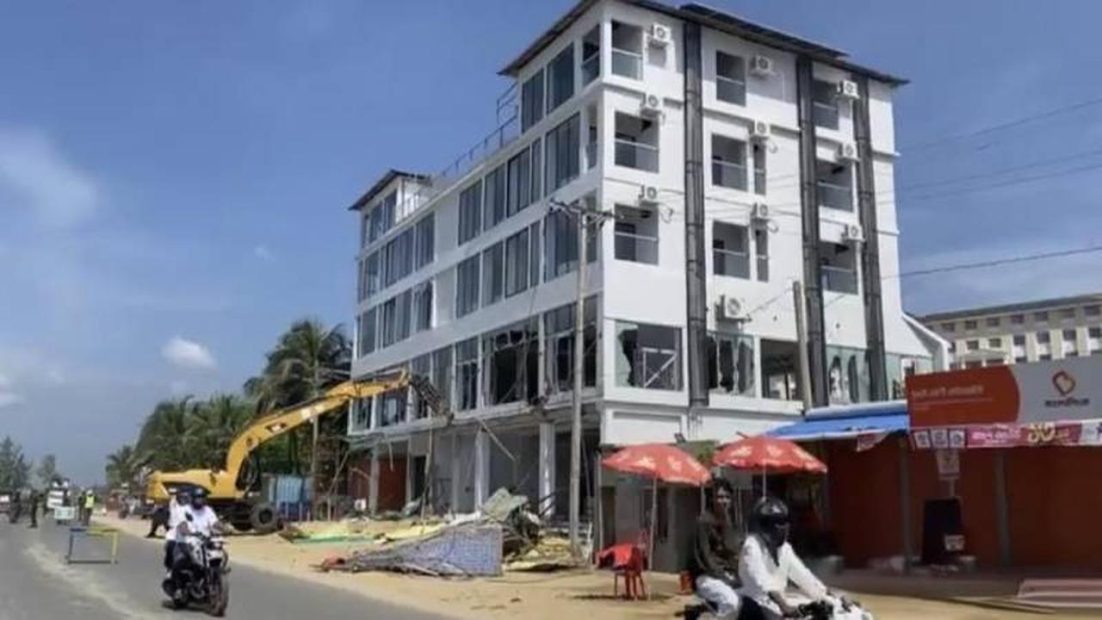
The vandalism of parts of the four-storey Bay Hilton Beach Resort in Inani, Cox’s Bazar, which was built with an investment of around Tk 6 crore, has sparked controversy over the role of the Cox’s Bazar Development Authority (CoxDA). Despite the owner’s claim that the resort has approved building plans and valid land documents, the vandalismt has led to allegations of bias, conspiracy and favouritism towards influential groups.
The owners say the action was taken without a proper hearing or an impartial review. They argue that the incident not only harms an individual investor but also sends a worrying signal about the investment climate in Cox’s Bazar’s tourism sector.
The allegations were raised at a press conference organised by the management of Bay Hilton Beach Resort, Inani, at the Cox’s Bazar Press Club auditorium on Monday, October 26. Jasim Uddin and Didarul Alam spoke on behalf of hotel owner Shahidul Haque. They protested what they described as a biased and conspiratorial eviction drive by CoxDA and called for an impartial investigation.
At the press conference, the owners alleged that Aminul Haque Shamim, owner of the neighbouring Royal Tulip hotel, had threatened them against building a hotel at the site when they first planned the Bay Hilton Beach Resort. They called for an investigation into whether personal interests or influence played any role in the subsequent action against their property. Shamim’s comments on the allegations could not be obtained.
Tk 6 crore investment followed by alleged vandalism
According to owner Shahidul Haque, around Tk 6 crore was invested in building the Bay Hilton Beach Resort near Marine Drive in Inani, a popular tourist area in Cox’s Bazar. He said the building was constructed on the basis of documents including land ownership deeds, mutation records, building plans approved by the local authority and construction permission.
However, CoxDA later identified the building as potentially risky and issued a show-cause notice. The owners allege that parts of the building were vandalised on the morning of October 26. The owners questioned why the action was taken without an independent engineering assessment, identification of technical defects and an opportunity for a lawful hearing. They acknowledged that action is necessary if a building genuinely poses a risk, particularly to tourists. However, they said the nature of the action, its legal basis and the process followed must also be transparent.
The incident raises questions about whether investors in Cox’s Bazar are being subjected to unnecessary harassment in the name of ensuring tourism infrastructure safety, or whether CoxDA has valid technical grounds for its objections. Resolving these questions requires the publication and impartial review of relevant documents, orders and engineering assessments.
Owner cites approval documents
In a written reply submitted to the CoxDA chairman on October 26, 2026, Shahidul Haque referred to several documents to support his claims of ownership and construction approval. According to his statement, the original owner of the land was Zakir Hossain. Kohinoor Shawkat acquired ownership through a registered deed dated April 4, 2001. On August 20, 2025, Kohinoor Shawkat sold the building and related property to Shahidul Haque through registered deed No. 1532. The written reply also states that the property was subsequently mutated in Haque’s name and that development taxes are being paid regularly.
The owners claim that the building plan was approved by Jaliapalong Union Parishad No. 1 on January 23, 2014, and construction permission was granted on December 31 of the same year. They say the building was constructed on the basis of these approvals.
Mr. Haque said that, following CoxDA’s instructions, he submitted the approved plan for verification. According to him, Jaliapalong Union Parishad confirmed the plan’s authenticity in writing on February 25, 2026. His written reply also states that a no-objection certificate was obtained from the Department of Environment on July 1, 2026.
However, the existence of these documents alone does not establish that all CoxDA approval requirements, applicable building regulations and structural safety standards have been met. Equally, the owner’s position cannot be dismissed before CoxDA’s objections are fully examined. An impartial review of the documents and a technical assessment are needed.
CoxDA notice raises structural safety concerns
In a show-cause notice dated September 28, 2026, CoxDA raised objections over the building’s construction approval and structural safety. The notice referred to an earlier notice to display the building plan issued on October 21, 2025, a show-cause notice dated November 19, and a final notice issued on December 7.
According to CoxDA, an on-site investigation indicated that construction of the building had not started before 2018. The authority therefore stated that its approval was required under the relevant provisions of the Bangladesh National Building Code (BNBC) 2020.
On August 12, 2026, a team led by CoxDA’s member for engineering inspected the building. The notice stated that visible structural defects, deviations and other irregularities had been found in different parts of the structure.
Expressing concern over the building’s durability, safety and suitability for use, CoxDA asked the owner to submit a specific technical explanation, structural analysis or assessment report, certification and other necessary documents within 14 days.
Thus, the owner is relying on approval documents to defend the building, while CoxDA is questioning compliance with construction regulations and structural safety standards. The dispute should be resolved through an impartial engineering assessment, applicable laws and a proper hearing.
However, a show-cause notice, a final decision declaring a building unsafe and an order to demolish it are separate matters. Each step must have its own legal basis.
Vandalism before hearing raises procedural questions
The owners allege that parts of the building were vandalised on October 26 while their written explanation and hearing process were still pending. They say that if a hearing had been scheduled for October 28, taking action before that date raises serious questions about due process.
Key issues remain to be verified through official documents: what kind of demolition or removal work was carried out, which written order authorised it, and whether the owner was given an effective opportunity to respond to that order.
The law may permit emergency action if a structure poses an immediate threat to public safety. However, the urgency, technical grounds and legal validity of such action must be clearly established. If an investor’s property was damaged before disputed approval or safety issues were resolved, responsibility must also be determined.
Allegations against Royal Tulip owner; call for impartial investigation
At the press conference, the owners accused Royal Tulip owner Aminul Haque Shamim of threatening to obstruct the hotel’s construction. They called for an investigation into whether his objections and subsequent events were connected. The allegations of threats, personal interests or the use of influence are serious. However, Mr. Shamim’s response was not available.
The reporter also received information that allegations of accepting illegal benefits had been raised against CoxDA authorised officer Fazle Rabbai. However, these allegations could not be independently verified.
Investors see warning signs for tourism development
Cox’s Bazar’s tourism industry extends beyond hotels and resorts. It supports employment, transport, restaurants, small businesses, construction and local livelihoods. Tourism infrastructure along Marine Drive also offers opportunities for domestic and foreign investment.
If an investor faces uncertainty over the security of an investment despite claiming to possess the necessary documents, it is natural for other potential investors to become concerned. They fear that disputes over approvals and legal status arising years after construction could weaken the investment climate.
However, investment interests cannot justify ignoring building safety, environmental rules or construction regulations. Any irregularities along Marine Drive must be identified and addressed in accordance with the law. At the same time, each structure must be assessed separately based on its construction date, approvals, land status, structural safety and legal position.
A key question is what standards are being used to assess buildings in an area where numerous hotels and resorts have already been developed. There are claims that more than 500 hotels and resorts have been built along Marine Drive. Without a transparent and consistent policy applied equally to all properties, allegations of bias could grow stronger.
Safety inspections intensify after deadly fire at Tuptup Resort
The recent fire at Tuptup Resort in Patuartek along Marine Drive, which killed 10 people, has renewed concerns about the safety of tourist facilities in Cox’s Bazar. The tragedy highlighted the need for strict checks on fire safety, emergency exits, structural stability and compliance with approval conditions. However, safety inspections should not become indiscriminate drives following a disaster. Authorities should take planned and lawful action based on the level of risk.
If a building is dangerous, immediate measures must be taken to protect the lives of tourists and workers. At the same time, investors must have access to remedies if they are harassed in the name of safety enforcement. Tourism development and public safety are not opposing goals. A safe and investment-friendly tourism destination can be built through transparent administration, effective oversight and equal enforcement of the law.
CoxDA must explain whether the action was unlawful vandalism or enforcement
If the owners’ allegations concerning the Bay Hilton Beach Resort are true, the incident raises serious questions not only about damage to a building but also about the use of administrative power, investment security and the right to justice. On the other hand, if CoxDA’s concerns about structural risks or legal irregularities are justified, the authority should publish the relevant technical findings and legal grounds.
CoxDA is expected to answer several key questions: What action was taken against the building? Where is the written order authorising it? Which laws and technical reports formed the basis for the action? If the action was taken before the scheduled hearing, why was it necessary?
The authority should also clarify how it verified the approval documents and other records submitted by the owner. The allegations of threats against the Royal Tulip owner and the allegations of illegal benefits involving a CoxDA official should also be investigated impartially. If the allegations are proven, those responsible should face action. If they are unfounded, the individuals concerned should not be unfairly accused.
In his written reply, Bay Hilton Beach Resort owner Shahidul Haque said he was prepared to carry out necessary modifications as directed by CoxDA if the building was found to violate the fundamental objectives of the master plan. He also called for an independent engineer to be allowed to assess the building’s structural condition.
For the sake of Cox’s Bazar’s tourism industry, decisions must now be based on documents, the law and impartial investigation rather than emotion or influence. The administration has a responsibility to protect tourists while maintaining investors’ confidence. Otherwise, the controversy surrounding a single building could undermine trust in the wider tourism and investment sectors.