Huge Potential for Buffalo, Sheep and Garol Farming in Char Areas of Bogura-Sirajganj
Mohsin Raju, Bogura>
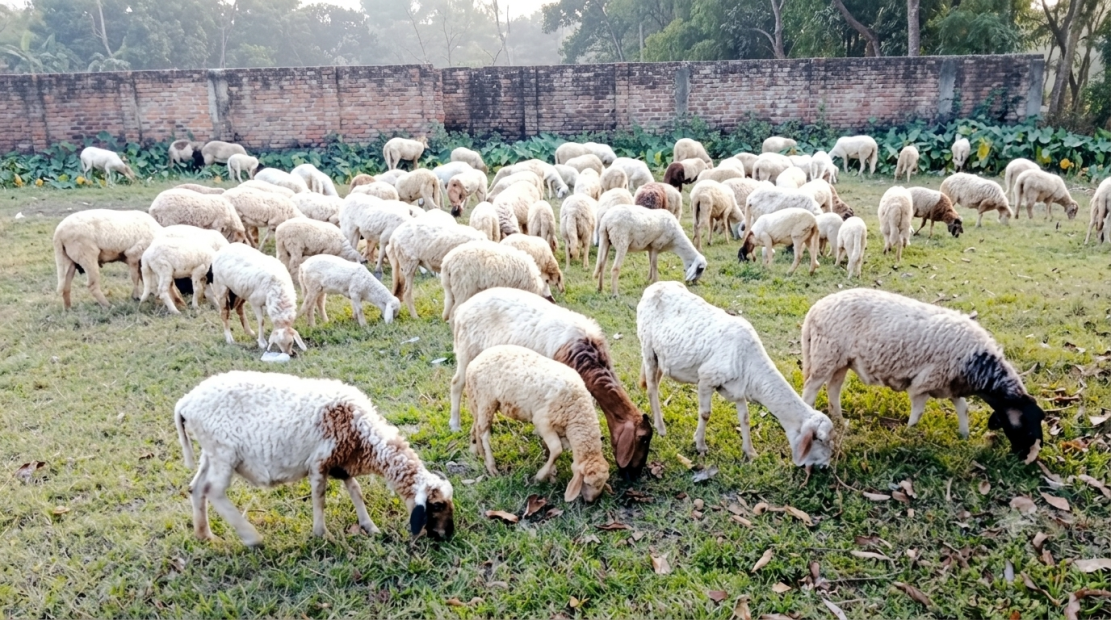
Alongside cattle and goat farming, farmers and livestock breeders in northern Bangladesh are increasingly becoming interested in raising buffaloes, sheep and garol sheep. The char areas of Bogura and Sirajganj, as well as large rural areas of Natore and Nandigram in Bogura, have particularly strong potential for raising these animals.
However, there are still no specific government statistics at the district or upazila level on buffalo, sheep and garol farming in these areas. Relevant stakeholders believe that if aware farmers and livestock breeders can be identified and brought under incentive programmes, this sector could make a significant contribution to meeting the country’s demand for meat.
According to the Department of Livestock Services’ data for the 2024-25 fiscal year, total meat production in Bangladesh was 8.954 million metric tonnes. During the same period, meat demand was estimated at 7.792 million metric tonnes. According to the government data, production was therefore around 1.162 million tonnes higher than demand. Earlier, daily per capita meat availability was 137.90 grams, while per capita demand was estimated at 120 grams.
However, these figures do not mean that every area of the country has an adequate supply of all types of meat. There are significant differences in meat species, regions, markets, purchasing power and seasonal demand. Recent data on the Qurbani market also highlights the issue.
According to available information, the demand for sacrificial animals in 2026 was 10,106,334, while 12,333,840 animals were prepared domestically. During Qurbani, a total of 4,864,158 cattle and buffaloes and 4,502,233 goats and sheep were slaughtered.
The char areas of Bogura and Sirajganj, which are prone to river erosion, have the potential to make livestock farming one of the key drivers of the rural economy alongside agriculture. Land use in these areas changes between the rainy and dry seasons. While permanent crop production is difficult in many places, raising livestock based on grass, straw and natural feed is relatively easier.
Buffaloes, in particular, have strong potential in char areas. They have high economic value for both milk and meat production. If planned measures are taken for buffalo breed improvement, artificial insemination, disease control and grass production, buffalo farming could play a major role not only in the Qurbani market but also in the year-round meat and dairy markets.
The activities of the Bangladesh Livestock Research Institute also include research and development on animals such as buffaloes, goats and sheep. The initial investment required for sheep and garol farming is relatively lower than that for cattle farming. Small farming families can start with a few female sheep or garol and gradually expand their flock. For families that do not have enough capital or land to establish a large cattle farm, small ruminant farming can be an excellent alternative source of income.
Training in garol farming is also available under government youth development programmes. The Rajshahi Youth Training Centre provides seven-day residential training, with 40 participants in each batch and two batches a year. This indicates that garol farming is being considered not only as household-level livestock rearing but also as a potential sector for developing entrepreneurs.
Buffalo, sheep and garol farming can be profitable, but profitability depends on the breed, feed costs, diseases, mortality rate, reproduction rate, market prices and the timing of sales. According to entrepreneurs and farmers, sheep and garol can reproduce quickly, allowing a small farm to grow into a larger flock within a few years. Buffalo farming, meanwhile, can generate income from both milk and meat.
The Employment Bank’s loan programmes include livestock activities such as cattle fattening, as well as goat, sheep and buffalo farming. However, simply purchasing animals does not guarantee profit. Improved breeds, timely vaccination and deworming, balanced feed, proper training and a reliable market system are essential.
Increased production of buffalo, sheep and garol would have an impact beyond farmers’ incomes. It could create employment for many people involved in animal feed production, grass cultivation, transportation, livestock markets, medicine and veterinary services, farm labour, meat sales, slaughterhouses, leather and other by-products.
A strong local value chain could thus develop around livestock farms.
Bangladesh has potential to export meat, but the sector has yet to develop into a large-scale export industry. The government’s Export Policy 2024-2025 includes halal meat among the exportable products. The Export Promotion Bureau (EPB) also lists companies that export sheep or goat meat.
However, entering the international market requires more than producing enough livestock. International-standard slaughterhouses, halal certification, disease-free animals, hygienic meat processing and compliance with international sanitary and phytosanitary (SPS) standards are also necessary.
If cluster-based production zones for buffalo, sheep and garol can be developed around the char areas of Bogura and Sirajganj, Natore and Nandigram, a strong foundation could eventually be created for processed meat exports alongside the domestic market.
Experts say the most important issue at present is to conduct a reliable upazila-level survey to determine exactly how many buffaloes, sheep and garol are being raised in different areas. After that, an integrated system should be developed in promising char and rural areas covering improved breeds, breeding centres, veterinary services, vaccination, feed production, training and low-interest loans.
Government data shows that the country’s meat production has already exceeded domestic demand. The main challenge now is to improve production quality, diversify livestock species, strengthen the market system and increase export readiness.
Buffalo, sheep and garol farming could be a highly promising way to diversify the livestock sector. If the char areas of Bogura and Sirajganj, Natore and Nandigram can be developed on a pilot basis as livestock clusters, new opportunities could be created to increase farmers’ incomes and further strengthen the local economy. In the long term, ensuring quality production and international certification could help Bangladeshi meat establish a stronger position in the global market.