
Nazrul showed people the path to freedom
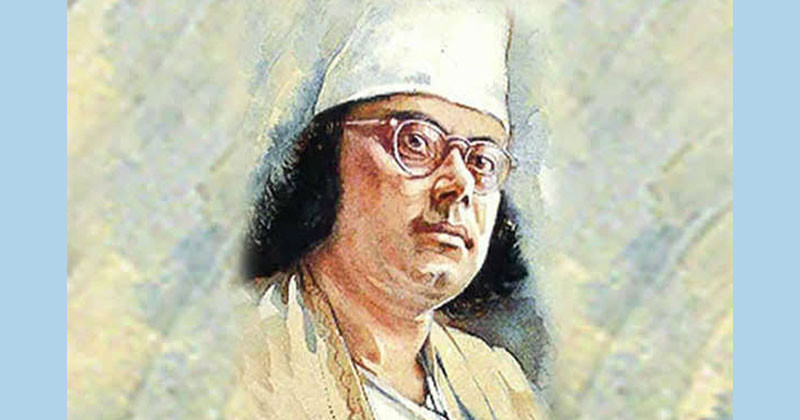
‘Let me sing the song of equality; there is nothing greater than human beings, nothing more glorious, there is no distinction of country, time or person, no distinction of religion or caste, in every country, in every age, in every home, he is related to humanity.’
Despite being a direct driving force in society’s power structure, marginalised communities are always subjected to marginalisation by exploiters who remain within the circles of power. The exploiters use their life force to keep them oppressed. Poet Kazi Nazrul Islam was deeply frustrated with crises, decadence, oppression and various levels of ruling groups. He became tired of seeing various irregularities and discrimination. Therefore, the rebellious tone gradually became brighter and brighter. ‘The great rebel, battle-weary’—when will he find peace? ‘The cries of the oppressed will not echo in the sky and air/The oppressor’s terrible sword and dagger will not resound on the battlefield.’ His writings have brought out powerful lines written during times of political instability or social disorder, which are used to portray public suffering, inspire people to seek freedom or resist injustice, and understand collective grief. The poetic speaker stands not as the spokesperson of any particular group or ideology, but as an autonomous moral witness.
In his poetry, Nazrul Islam used his art to stand for common humanity above communal identity during periods of social and religious conflict and to eliminate communal divisions. By exploring Kazi Nazrul Islam’s poetry, it is easy to understand how poets use a secular, non-communal platform to protest oppression and speak for marginalised communities. ‘Human’ is above all concepts. Welfare centred on ‘human beings’ is true welfare.
DU correspondent reports that the 50th death anniversary of National Poet Kazi Nazrul Islam was observed through various programmes. On the occasion, the Dhaka University administration, teachers, students, officers and employees, and leaders and activists of the Bangladesh Jatiyatabadi Chhatra Dal, Dhaka University unit, separately placed wreaths at the poet’s grave and paid tribute yesterday. In the morning, teachers, students, officers and employees of Dhaka University, led by Vice-Chancellor Professor Dr ABM Obaidul Islam, placed wreaths at the poet’s grave and recited Fateha. Later, a discussion meeting was held at the open stage on the grave premises, chaired by the vice-chancellor.
At the meeting, Vice-Chancellor Professor Dr ABM Obaidul Islam said Nazrul’s life and literary works teach people to protest against injustice and raise their voices against inequality, injustice, oppression and repression in society. His literary works also teach people to maintain mutual unity while upholding equality, harmony and peace. He called upon everyone to be inspired by patriotism, compassion for people, and moral and humanitarian values by learning from the life and literature of Nazrul. On the occasion of the death anniversary of the National Poet, a Quran recitation was held after Fajr prayers at Masjidul Jami‘a, the central mosque of Dhaka University, and later teachers and students of the Department of Music performed Nazrul songs. Pro-Vice-Chancellor (Education) Professor Dr Abdus Salam and Pro-Vice-Chancellor (Administration) Professor Dr Mohammad Almojaddeddi Alfesani addressed the meeting as special guests. Professor Dr Tariq Monzur, director of the Nazrul Research Centre, delivered the memorial lecture. The programme was conducted by Professor Dr Sirajul Islam (Siraj Salekeen), chairman of the Department of Bengali.