

Pakistan-China Reactivate Joint Border Commission; India Objects
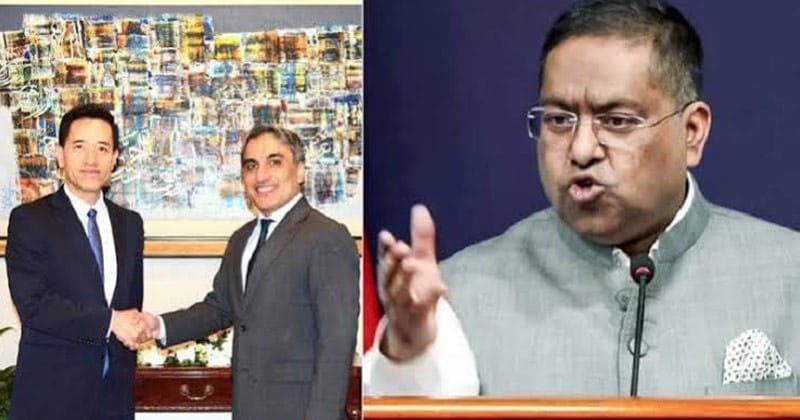
Pakistan and China have officially reactivated their joint border management commission to regularize bilateral coordination in border administration, joint surveys, maintenance of boundary pillars, trade, and cross-border connectivity. The inaugural meeting of the new framework, co-chaired by Mr. Bilal Mahmood Chaudhary, Director General (China) at Pakistan’s Ministry of Foreign Affairs, and Mr. Li Ya, Deputy Director General of China’s Department of Boundary and Ocean Affairs, was held in Islamabad. Pakistan’s Ministry of Foreign Affairs termed the initiative a significant milestone that will ‘foster closer cooperation in border administration while boosting trade flows and people-to-people contacts’.
The commission operates under the 2013 Pakistan-China border management agreement, specifically implementing Article 45, which mandates a joint mechanism for managing border arrangements. Under this mandate, both nations will cooperate on inspecting border markers, executing joint surveys, managing cross-border infrastructure, and resolving localized operational incidents. This institutional framework holds high economic value for projects linked to the China-Pakistan Economic Corridor (CPEC), particularly at the strategic Khunjerab Pass, which serves as a major logistical and travel conduit directly connecting both nations.
Unlike the 1963 joint boundary demarcation commission, which dissolved after fulfilling its specific mandate to survey, erect markers, and map the initial alignment, this 2013-based framework focuses on routine operational administration. The agreement details protocols for repairing or re-erecting damaged or displaced boundary pillars, allowing representatives to select alternative sites without altering the established border line. Through this functional approach, both Beijing and Islamabad regard the reactivated commission as an essential, non-political platform to maintain border stability and address ongoing logistical issues collaboratively.
However, India has strongly opposed the operationalization of the joint border commission, rejecting its legal legitimacy. Mr. Randhir Jaiswal, spokesperson for India’s Ministry of External Affairs, stated that India ‘does not recognize any established border between Pakistan and China’ and asserted that the mechanism lacks a legal basis. New Delhi reaffirmed its long-standing position on Jammu, Kashmir, and Ladakh, maintaining that bilateral arrangements concerning these sovereign territories, including the 1963 transfer of the Shaksgam Valley, are invalid, whereas Pakistan and China maintain the commission is purely routine administrative cooperation.