
Plan to Build New LNG Terminal in Deep Sea and Drill 150 Wells
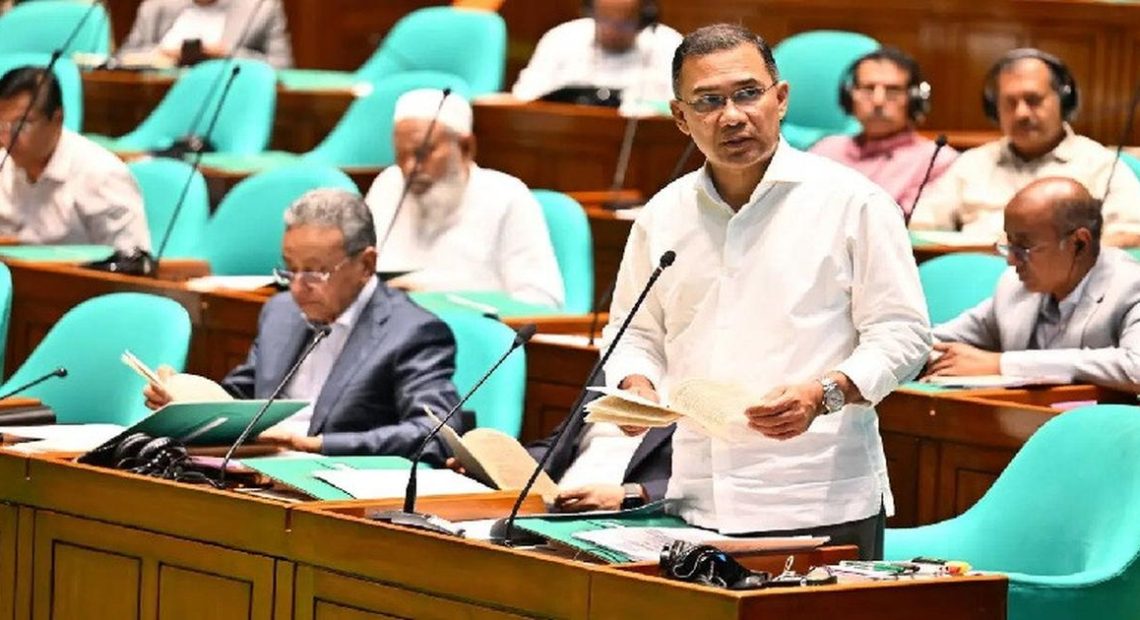
Prime Minister Tarique Rahman has announced plans to establish a new LNG terminal in the deep sea and drill 150 new wells by 2030-31. In Parliament, he outlined the government’s short- and long-term master plan combining alternative sources and renewable energy to ensure energy security and uninterrupted industrial production.
The Prime Minister disclosed the plans on Wednesday (September 9) while answering questions in Parliament chaired by Speaker Hafiz Uddin Ahmed. Responding separately to questions from Sultana Ahmed, a member of reserved women’s seat-17, and Meherpur-1 MP Md Tajuddin Khan during the question-answer session, the Prime Minister outlined the government’s short- and long-term measures.
In her question, Sultana Ahmed referred to a daily shortfall of around 450 million cubic feet in national gas supply and disruptions to industrial production after an LNG terminal was temporarily shut down in July 2026. She asked whether alternative gas supply sources, LNG reserve capacity, priority-based supply for industrial zones and emergency energy plans would be adopted to prevent major losses to the industrial sector during such unexpected crises.
In response, Prime Minister Tarique Rahman said the government plans to drill 150 wells by 2030-31 to ensure that the industrial sector does not face gas shortages during sudden or temporary crises. At the same time, 4,500 line kilometres of 2D and 4,200 square kilometres of 3D seismic surveys are being conducted to explore domestic gas sources. An international bidding round was also invited on May 24 to appoint international companies for oil and gas exploration and extraction in 26 offshore blocks, with the deadline for submitting bids set for November 2026. In addition, work is underway to formulate the “Bangladesh Onshore Model PSC 2026” to attract international investment in onshore oil and gas exploration.
Regarding future gas shortages and strengthening LNG infrastructure, the Prime Minister said the country’s two existing floating LNG terminals currently have the capacity to supply an average of around 935 million cubic feet of gas per day. To deal with sudden shortages in the future, work is underway to establish a new floating LNG terminal at Kutubjom in Maheshkhali and a land-based LNG terminal at Matarbari. According to the plan, the Kutubjom floating terminal will be able to supply regasified LNG in 2028, while the land-based terminal is expected to begin supply by December 2030.
A feasibility study is also underway to establish a floating terminal in the deep sea at a suitable location, considering the Payra or Mongla port areas or the southwestern coastal region. At the same time, an initiative has been taken to bring Bhola’s gas to the mainland in LNG form and supply it to interested industries, with planned industrial zones such as economic zones, EPZs and BSCIC areas receiving priority.
In another question, Meherpur-1 MP Md Tajuddin Khan asked about an integrated plan involving renewable energy, solar power plants and other alternative sources to meet the country’s future electricity and energy demand and ensure energy security.
Presenting the overall development and future targets for the renewable energy sector in Parliament, Prime Minister Tarique Rahman said initiatives have been taken to reduce dependence on imported fuels to meet the country’s rapidly growing electricity demand. To this end, environmentally friendly and sustainable renewable energy has been identified as the government’s highest-priority sector. To ensure transformation of the energy sector, the government has formally formulated the “National Renewable Energy Development Strategy” for 2026-2030.
According to the strategy, specific national targets have been set to generate at least 20 percent of the country’s total electricity from renewable sources by 2030 and at least 30 percent by 2040, considering the overall potential and current realities. As part of this target, plans have been made to gradually generate alternative electricity through various technologies by 2030.
Solar power has been given the highest priority as a single technology. Under the plan, provisions have been made to generate 5,500 megawatts from rooftop solar systems installed on residential, industrial and government buildings, and another 4,500 megawatts from large-scale ground-mounted solar projects. To meet the remaining demand, another 450-550 megawatts will be added to the grid through a combination of modern technologies such as wind power, waste-to-energy, hydropower, floating solar and agricultural agrivoltaics.
To achieve the ambitious electricity generation targets and encourage private investment, the government has introduced major positive changes to import policies and the tariff structure. Imports of essential components for renewable energy infrastructure—including solar panels, inverters, specialized batteries and structures—have been fully exempted from existing customs duty, regulatory duty, supplementary duty, advance tax and advance income tax exceeding two percent.
To further accelerate investment and involve ordinary consumers, a special tariff notification was recently issued. Under the new decision dated September 1, 2026, the cost of rooftop solar power generation, including batteries, has been capped at Tk 8 per unit. As a special government incentive, an additional 20 percent profit and an 11.25 percent premium have been calculated on the generation cost, setting the price of electricity supplied to the national grid at Tk 10.50 per unit.
Under this facility, ordinary or commercial consumers who install rooftop solar systems by February 28, 2027, in accordance with the Net Metering Guideline 2025, will be able to sell surplus electricity after meeting their own needs at the fixed rate of Tk 10.50 per unit for three consecutive years, until February 28, 2030.
The government has also implemented several important policies to bring public-private initiatives under a specific legal and policy framework. The “Guideline for Developing PPP Projects on Government-Owned Land 2026,” “Special Policy for Increasing Private Investment 2025,” “Renewable Energy Policy 2025” and updated “Net Metering Guideline 2025” have already begun being implemented at the field level.
In addition, the National Rooftop Solar Programme 2025, an integrated business model for waste-to-energy generation, the Onshore Wind Guideline and guidelines for carbon credit processing have been adopted to institutionalize a sustainable energy system. These initiatives are expected to serve as key drivers of the country’s future electricity security.