Ports, corridors and connectivity can become the centre of the regional economy
(Part of continued series)
Bangladesh must stay careful so that transit does not benefit only others. If neighbouring or regional countries use Bangladesh’s ports, roads, rail or waterways, Bangladesh must make clear what direct and indirect economic benefit it gets in return. It must settle this at the stage of agreements and policy. Income from port and transport fees is surely important. But the range of economic gain is much wider.
We must also check whether transit helps local transport firms, warehouses and storage, repair and maintenance services, insurance, financial institutions, goods processing, and small and medium businesses. We must count the cost of maintaining transit infrastructure, the effect on the environment, the extra pressure on roads and rail, security, and the possible effect on local communities. If connectivity does not benefit the country’s industry, jobs, port revenue, technology transfer and local economy, it will not bring the result we want. So any decision on transit and corridors needs a deep review of gains and losses, clear agreements, strong regulation and mutual benefit.
We often see a port as an infrastructure project. In truth, a port is part of a national development strategy. A working port does not only receive ships. It draws investment, builds industry, creates jobs, gives birth to new urban areas and raises a country’s global competitiveness. But these gains do not come on their own.
Port led development plans must ensure local people take part and must manage land well. They must protect the environment, plan the city, build skilled workers and coordinate public and private bodies. Without this, port expansion can add traffic jams, unplanned urban growth, pollution, pressure on land and regional inequality.
So we must judge a port’s success not only by the amount of cargo it moves. We must also ask how much new value it adds to the national economy, how much it raises productivity and how widely it spreads the gains of development. Bangladesh should aim to build a port and connectivity system that does more than ease regional cargo movement. It should also strengthen the long term base of the country’s own production, jobs and economic strength.
The Matarbari deep sea port holds special meaning for Bangladesh. If it can receive large ocean going ships, it can cut the cost of imports and exports. It can also make Bangladesh a bigger part of regional sea trade. Today, a large share of Bangladesh’s foreign trade depends on Chattogram Port. If big international ships can enter Bangladeshi ports directly, the country can depend less on foreign transshipment ports. It can also cut transport time and keep overall logistics costs in check.
The special feature of Matarbari is its deep channel and the plan to build infrastructure for large ships. The Japan International Cooperation Agency (JICA) funds and supports the project. Under it, builders are putting up terminals for containers and multi purpose cargo, jetties, a channel and related infrastructure. In 2025, a contract with a Japanese joint venture for construction took the project past an important step.
Still, we should not treat Matarbari as a full commercial deep sea port yet. Its main port infrastructure is still under construction. To judge its likely benefits, we must look separately at the project’s progress, construction timeline, operational readiness and future commercial capacity.
The value of Matarbari does not stop at taking big ships. It also holds the chance of a structural change in the country’s sea trade. Today, many big ships on international routes cannot enter Bangladeshi ports directly. So cargo depends on transshipment ports in other countries. If Matarbari works well, this dependence may shrink in some cases. Bangladesh may also take a more direct part in the international shipping network.
But a deep channel and jetties are not enough to gain this benefit. We need regular dredging, safe shipping, modern ship and container handling equipment, skilled port management and commercial coordination with international shipping lines. We also need smooth links between the port and the country’s main industrial and consumer centres. If cargo time and cost from Matarbari to Chattogram, Cox’s Bazar, Dhaka and other industrial areas cannot stay competitive, a big part of the deep sea port’s benefits will not materialise.
So the success of Matarbari will depend not only on how large a ship can dock there. It will also depend on how fast, safely and cheaply cargo loaded or unloaded from those ships can join the country’s production and trade system.
At the same time, growth in the capacity of Chattogram and Mongla ports, together with better rail and highway networks, can lift the whole economic structure to new heights. For Chattogram Port, we must urgently run modern terminals, manage containers, cut ship waiting time and ease cargo clearance. For Mongla Port, there is room to link it better with the industrial and farm economy of the south west. It also needs care for river depth, better rail and road links, and wider commercial use of the port.
Payra Port’s development must also match real commercial demand, river depth and connecting infrastructure, even as we build Matarbari for large ocean going ships. In other words, Bangladesh needs a working division of roles among its ports. Each port should play a special role based on its location and economic hinterland. If we ease the load on one port and use the capacity of others, the national trade system becomes more resilient. If one port stops work because of a natural disaster, a technical fault, labour unrest or a management problem, trade can continue through another port.
We must remember that building infrastructure is not the end. No port or corridor can reach the success we expect without skilled people, a modern customs system, digital trade facilities, a corruption free administration and steady policy. Running a modern port needs skilled people in marine engineering, marine safety, terminal management, container handling, information technology, customs clearance, cargo storage and international trade.
If we cannot build this skill at home, we may have to rely on foreign firms for a long time for key operations and technical ability. So along with building port infrastructure, we must build real cooperation among universities, technical institutions, training centres and port operators.
We also need to simplify customs processes, use risk based cargo checks, manage documents electronically, allow online duty payment and run a single window system well. This will cut cargo clearance time, reduce business uncertainty and raise administrative transparency. But digital systems alone will not end corruption and delay. We need accountability, steady enforcement of rules, strong supervision and predictable service for traders.
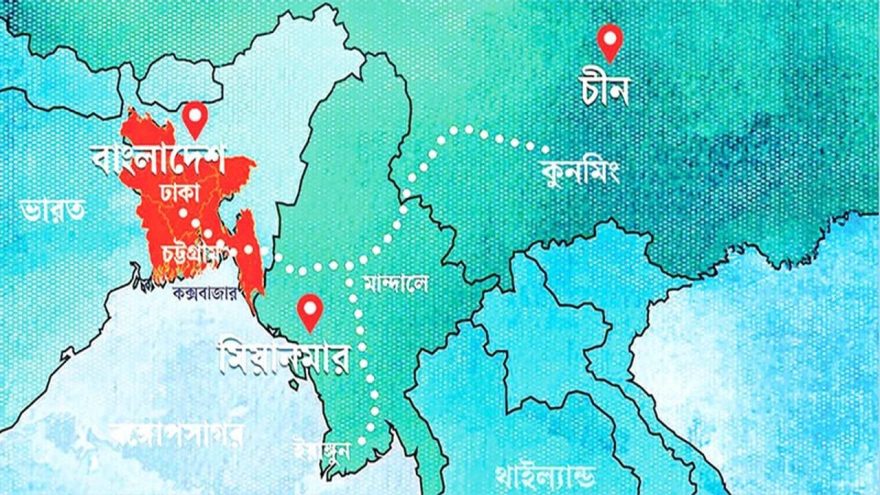
Bangladesh today stands at a turning point where its geographic position is being valued anew. The growing geo economic weight of the Bay of Bengal, the chance of regional connectivity and the changing pattern of world trade have opened a new horizon for us. In this changed reality, Bangladesh has opportunities and also serious policy and institutional challenges.
So the question is not only whether Bangladesh has ports, or how many more it can build. The real question is this. Can we build our ports, corridors and connectivity so that Bangladesh becomes a working bridge between South Asia and Southeast Asia? Can it become a reliable logistics hub for international trade and an important geo economic power?
To reach this goal, we need long range state planning, steady policy, skilled institutions, regional cooperation and the political will to put national interest first. We must also make sure the gains of connectivity do not stop at cargo movement or port use. They must also help Bangladesh’s own industrialisation, jobs, technical ability, export growth and the cut in regional economic inequality.
A country becomes the centre of a regional economy only when others do more than use its land to move cargo. They must also link deeply with its market, industry, services, skills and economic strength. So Bangladesh should aim to do more than become a transit state. It should build a productive and connected economy that plays an active part in creating value from regional trade and investment.
If we show that vision, planning and political will, Bangladesh’s geographic position will no longer be only a feature on the map. It will become a main base for national prosperity, economic strength and new chances for future generations. (End)
Author: Visiting Faculty, University of Roehampton, UK.
Email: mahruf@ymail.com