Poverty, Hardship, Climate Disasters Push Coastal Children’s Education to the Brink
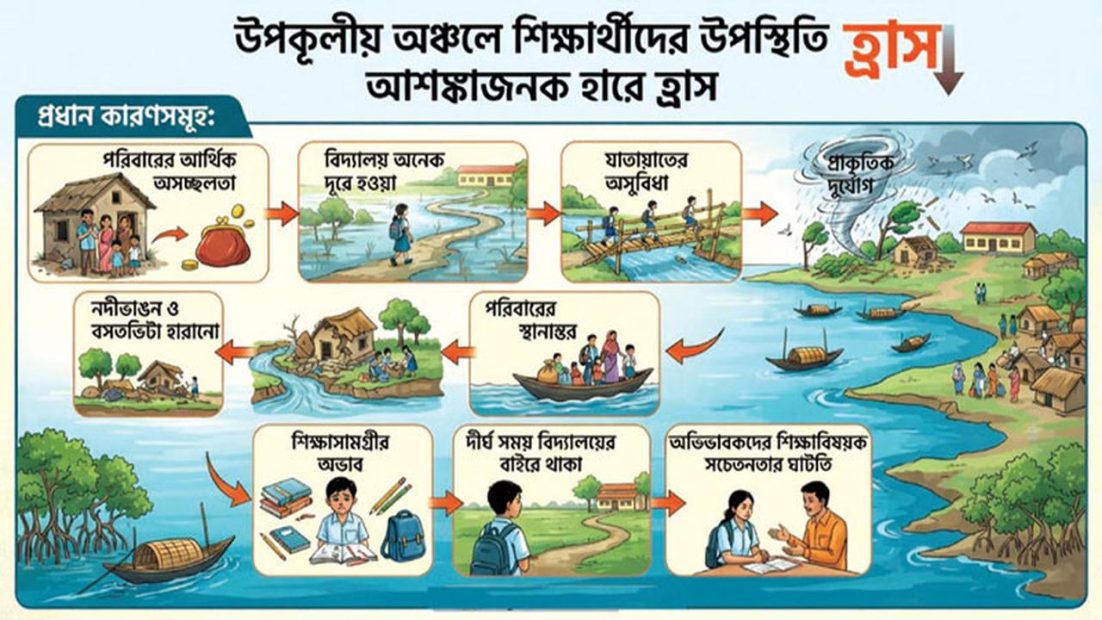
Children’s education in coastal Bangladesh is facing a serious crisis. Climate change, extreme poverty and frequent natural disasters are forcing children to struggle for survival, while school attendance is falling at an alarming rate. The crisis is particularly severe in the coastal areas of Koyra, Dacope, Shyamnagar, Assasuni and Gabura in Khulna and Satkhira. As a result, juvenile gangs are emerging, and the number of children using and supplying drugs is also increasing.
According to local sources, coastal children spend much of their lives struggling against the effects of changing river tides. Instead of carrying books and notebooks, many now carry fishing nets, ropes and tools for catching crabs. Poverty, hardship and climate-related disasters are pushing thousands of children away from education.
Saltwater intrusion has damaged farmland, while river erosion has destroyed homes, leaving families in severe financial distress. To survive, many families are forced to withdraw their children from school and send them to work in fishing, crab collection, salt farming and brick kilns.
In coastal areas bordering the Sundarbans, daily survival is so difficult for many families that education and recreation have become luxuries for children. Cyclones and river erosion destroy homes and sources of income, pushing families deeper into poverty. As a result, children as young as eight or nine are forced to catch fish and fingerlings in rivers, work in salt fields and labour in brick kilns.
Every year, storm surges and floods inundate many coastal schools, while others are lost to river erosion. Schools often remain closed for long periods or are used as cyclone shelters, disrupting children’s formal education. Economic uncertainty and social insecurity caused by climate change also contribute to child marriage. Many girls are married off before completing secondary education, leading to high dropout rates among female students.
High salinity in water and soil exposes children to malnutrition, skin diseases and other health risks. The use of contaminated and saline water can cause diarrhoea and skin conditions, while poor health and long, difficult journeys to school make regular attendance increasingly challenging.
People familiar with the situation say a lack of awareness, early marriage and financial hardship at home force many girls to leave school. Government and non-government initiatives have brought some improvements in recent years. The government has introduced measures such as stipends and free textbooks to increase girls’ participation in education and help them remain in school.
However, boys face a different set of challenges. Local experts believe poverty is the main reason many boys drop out before reaching secondary school. They are often forced into child labour to help support their families. Some also become involved in criminal activities, contributing to the emergence of small juvenile gangs.
Alongside government initiatives, UNICEF and local development organisations are implementing programmes to build climate-resilient schools and bring children who have dropped out back into mainstream education. However, experts say a lasting solution requires coordinated disaster management and sustainable alternative employment for affected families.
Advocate GM Kamruzzaman, president of the Khulna district branch of the Bangladesh Environment and Human Rights Implementation Society, told Inqilab that the southern region is a coastal area surrounded by rivers, the sea and wetlands, where countless families live. “Children in this region have dreams like other children. They want to play, study and build a better future. But because of natural conditions, poverty, transport difficulties and various social and economic problems, many coastal children face obstacles in their education,” he said.
Khulna District Education Officer SM Sayedur Rahman said poverty was the main reason boys dropped out of school in coastal areas, while child marriage was the leading cause among girls. After marriage, it becomes difficult for female students to continue their education.
He said the administration, teachers, non-governmental organisations and concerned members of society were working to prevent child labour and child marriage. Awareness campaigns are being held at schools to explain their harmful consequences. However, poverty and a lack of awareness among families continue to make these problems difficult to eliminate, although the rate of child marriage has declined compared with previous years.
Rahman expressed particular concern over child labour, saying many children travel with their families to brick kilns in different parts of the country during winter, when kiln operations increase. After the work season ends, many do not return to school, resulting in significant numbers of students dropping out.