Production Must Continue to Offset Losses in the Garment Sector

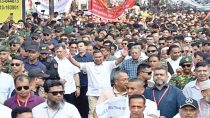
For several days, garment workers have been staging road blockades and protests demanding higher wages and other benefits. During the demonstrations, some protesters have reportedly engaged in arson, vandalism and even attacks on police. This has raised questions among concerned sections of society about whether the protests are solely aimed at increasing wages and benefits or whether a third party, particularly the ousted and banned Awami League, is instigating them.
The government has already alleged that Awami League leaders and activists have infiltrated the workers’ protests and are using them as a cover for sabotage by Awami League supporters. Prime Minister Tarique Rahman has clearly stated that there is a conspiracy originating from across the border behind the continuation of the protests, even after the government formed a wage board for garment workers. BNP Acting Secretary General Ruhul Kabir Rizvi has also alleged that the ousted Awami League is instigating the protests.
Most of those arrested on allegations of involvement in violent activities are reportedly leaders and activists of the banned Jubo League and Chhatra League. Intelligence reports have also pointed to the involvement of former Awami League leaders, former lawmakers and garment business owners sympathetic to the party in instigating the unrest.
These statements and intelligence findings suggest that there may be a conspiracy to destabilise the country through violent activities under the cover of garment workers’ demands. Encouragingly, the protests have gradually subsided following government initiatives and the efforts of law enforcement agencies. Industrial areas are now returning to a peaceful environment.
A report published in the daily Inqilab yesterday said the garment sector was losing around Tk 500 crore every day due to the workers’ protests. According to a report by the daily Manabzamin, production at hundreds of factories remained suspended during nearly a week of protests, severely disrupting export activities. Garment owners have said that the potential financial losses to the apparel sector could exceed Tk 1,000 crore following several days of unrest. However, it may take another week to determine the actual extent of the losses.
Meanwhile, the global economic slowdown has reduced clothing purchases in major export destinations, particularly the United States and European countries, as the rising cost of living has affected consumer spending. Buyers are also cancelling or suspending orders. The unrest caused by the garment workers’ protests has further affected exports.
According to a report in the English-language daily New Age, garment exports to the United States, the sector’s single largest export market, fell by 4.30 per cent between January and September. Similar concerns have emerged over the European market.
The current government inherited a fragile economy. Soon after taking office, the global economy was shaken by the Iran war. Its impact has further weakened Bangladesh’s already vulnerable economy. Gas and electricity shortages, fuel supply problems, sluggish imports and exports, inflation and rising prices of essential goods have made life increasingly difficult for ordinary people.
It goes without saying that when the cost of living becomes unbearable, the government faces public criticism. The ousted Awami League and its allies are allegedly trying to exploit this situation. They are attempting to use the garment workers’ protests as a cover to create instability. Encouragingly, the government has been able to identify this alleged conspiracy.
Ordinary workers must also understand that the government has already formed a wage board, which is expected to benefit them. The government is not ignoring the hardships they face because of rising prices. It is sympathetic to their difficulties. However, if their protests force factories to shut down, they could lose their employment opportunities.
Workers should also remember that people employed in other industries are facing similar hardships, yet they do not have separate wage boards and are not staging protests. The government is giving the garment industry its highest priority.
Workers must also realise that garment owners are under pressure because of declining and cancelled orders. If they cannot export garments, how will they pay workers’ wages? They, too, are in a difficult position. Bangladesh supplies garments to international buyers at some of the lowest prices in the world. Competitor countries such as Sri Lanka, Vietnam and China sell garments at higher prices than Bangladesh. Buyers also bargain with Bangladeshi manufacturers to secure lower prices. As a result, the country has become trapped in a cycle of selling garments at low prices.
If Bangladesh could sell garments at prices comparable to those of its competitors, the sector’s earnings would increase, allowing factory owners to offer workers higher wages and better benefits. Workers would not then need to stage protests demanding higher pay. They should also understand this reality.
However, garment owners should collectively take the initiative to negotiate with international buyers on how to increase garment prices or bring them in line with those of competing countries. It is unfortunate that organisations such as Human Rights Watch and Amnesty International, which claim to defend human rights, speak about the rights of garment workers but do not call on the United States and European countries to increase the prices they pay for garments imported from Bangladesh. This raises questions about the sincerity of their concern for human rights.
The industrial areas are now peaceful, and factories have resumed full-scale production, even on holidays. This is a positive sign. However, observers have warned that the government must remain vigilant to prevent further attempts to create unrest in the sector.
The government must closely monitor the situation to ensure that production is not disrupted and export activities continue to gain momentum. It must prevent those seeking to create instability from doing so again and take strict action against anyone involved.
The government must also remember that, ahead of Sheikh Hasina’s expected return in December, leaders and activists of her party have already begun engaging in various forms of disorder and violent activities. By targeting the garment sector and provoking workers’ protests, they are allegedly trying to create instability and take advantage of the situation.
Observers fear that such violent activities may increase in the coming days. Therefore, the government must maintain a zero-tolerance policy towards any attempt to destabilise the sector.