Renewable Energy Could Transform Industrial Economy and Drive Growth in Bangladesh’s Southwest
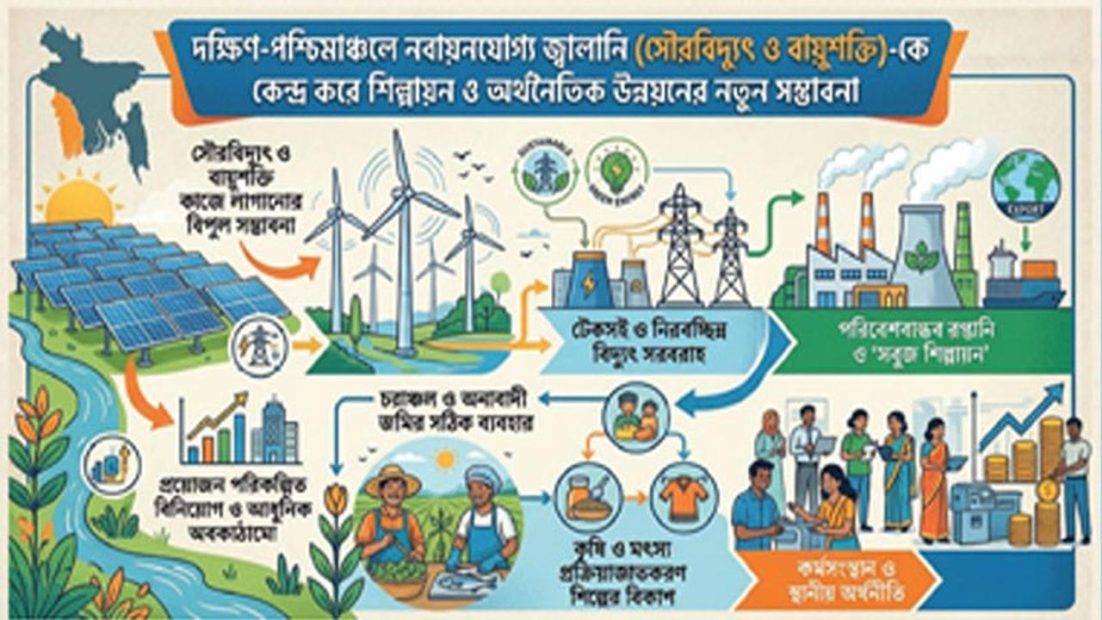
Renewable energy, particularly solar and wind power, could open new opportunities for industrialisation and economic growth in southwestern Bangladesh. The region’s extensive coastline, open land and abundant sunlight offer scope for clean power generation and could boost industry, agriculture and fish processing.
Renewable energy could also improve electricity supply, create jobs and reduce dependence on fossil fuels.
Khulna, Bagerhat, Satkhira, Jashore and nearby coastal areas have scope to expand agriculture, fisheries, shrimp farming, food processing, cold storage, manufacturing and port-related activities. Reliable and affordable electricity could help control production costs and attract investment. Combining solar and wind power with battery storage and the national grid could play an important role.
A major challenge to industrialisation in the southwest is ensuring a reliable energy supply while controlling production costs. Uninterrupted electricity is particularly important for frozen food production, shrimp processing, cold storage, agricultural storage and small and medium-sized industries.
Power disruptions can spoil raw materials, interrupt production and cause financial losses. Solar panels on factory rooftops, solar plants in industrial areas and grid-connected solar projects at suitable locations could provide alternative sources of electricity.
Using solar power directly in factories during the day could reduce pressure on conventional electricity supplies. Battery storage could further improve the use of generated power.
One of the notable renewable energy initiatives proposed for the region is a 442-megawatt solar power project in Rampal, Bagerhat, sources said. Tender documents are being prepared for the project, which the Bangladesh Power Development Board (BPDB) said had received approval from the Executive Committee of the National Economic Council (ECNEC).
According to published project information, the plant is planned on about 918.50 acres of land previously acquired for a coal-fired power plant in Rampal. The estimated cost is Tk 2,498.08 crore. The plan also includes an eight-hour battery storage system.
Dr Md Salahuddin Mina, an associate professor in the Physics Discipline at Khulna University and a renewable energy researcher, told Daily Inqilab that the coastal region’s open terrain and proximity to the sea offered opportunities to assess its wind power potential.
However, he said detailed studies were needed before installing wind power projects in coastal areas. These should examine long-term wind speeds and directions, seasonal variations, cyclone risks, equipment durability in saline environments and environmental impacts.
If suitable locations have sufficient wind resources, wind power could complement solar energy and diversify the region’s energy supply. Combining daytime solar generation with wind power when conditions are favourable could improve electricity supply.
He stressed that technical and economic feasibility studies and environmental clearances were essential before implementing such projects.
Dr Md Rafiqul Islam, a professor in the Electrical and Electronic Engineering Department at Khulna University of Engineering and Technology (KUET) and a renewable energy researcher, told Daily Inqilab that planned renewable energy-based industrial zones could create technical and engineering jobs for young people.
Small and medium-sized entrepreneurs could also find opportunities in solar panel installation and maintenance and in services involving energy-efficient technologies.
He said a reliable electricity supply could encourage new investment. Alternative energy sources could support economic activities along the Khulna-Mongla economic corridor, in port-related businesses and in agricultural and fisheries processing.
However, project-specific studies and post-implementation assessments would be needed to determine the actual scale of investment and job creation, he added.
Expanding solar and wind power could reduce carbon emissions from electricity generation. For the southwest, which faces climate change, rising sea levels, salinity and cyclone risks, clean energy could become part of long-term development planning.
Md Azgar Hossain, divisional secretary-general of the Bangladesh Environment and Human Rights Implementation Society, told Daily Inqilab that agriculture and fisheries were important to the regional economy.
Electricity is essential for storing, processing and marketing locally produced vegetables, fruits, fish, and freshwater and marine shrimp. Solar-powered irrigation, cooling centres, cold storage facilities and modern crop-drying technologies could help reduce post-harvest losses, he said.
He added that suitable renewable energy systems could benefit farmers, fish farmers and small entrepreneurs, particularly in remote coastal areas with limited electricity supplies.
Solar-powered storage facilities for fish and agricultural produce could ease the pressure on producers to sell their goods quickly. This could improve their chances of receiving fair prices and encourage the growth of local value-added industries.