
The History of the Mass Uprising Must Be Presented Accurately
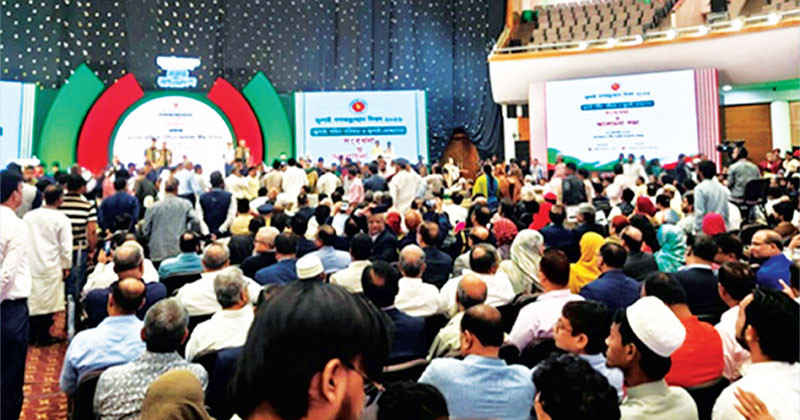
History is not merely a collection of old documents or a record of the distant past. It carries the identity, memories and experiences of a nation. When a nation remembers its painful and glorious past, it also shapes its understanding of the future. The crucial question, therefore, is who gets to shape that history and decide which events will be remembered and which will be forgotten. Recent events at the China Friendship Conference Center have brought this question into sharp focus. A state ceremony meant to honour the families of martyrs and wounded participants of the July Uprising suddenly turned into anger, protest and disorder. The incident deserves serious attention because it raises important questions about state institutions, collective memory and the politics of history.
A documentary on the unprecedented July-August mass uprising was screened at the event. Many members of the audience were directly connected to the movement. Some had lost children, brothers or other relatives. They expected the documentary to honestly reflect the sacrifices that had shaped the uprising. Instead, anger spread through the hall immediately after the screening. The audience began chanting, “Fake, fake,” while pushing and disorder followed. Several foreign guests appeared uncomfortable during the commotion, and some left the venue. The central reason for the protest soon became clear. Many in the audience believed that the documentary had omitted important events and figures from the history of the uprising.
The anti-discrimination student movement, the August 3 announcement that played a major role in the final phase of the movement, and the widely remembered self-sacrifice of young martyr Abu Saeed were among the elements that were reportedly absent. The history of a mass uprising cannot belong to one political group or institution. It is created through the collective sacrifices of ordinary people, including rickshaw pullers, students, homemakers and daily wage workers. When people see their experiences and sacrifices missing from an official account, their reaction cannot simply be dismissed as spontaneous disorder. This demonstration was more than that; it was a cry for a history that would not be deliberately distorted. The memory of a nation can never be perpetually controlled by an institution.
Also, the fact that the President of the country was present at the event made the occurrence very significant because he admitted that certain historical facts had been omitted from the documentary and ordered corrections. His response helped calm the situation, but it also raises a more serious question: How could such omissions occur in a state-sponsored documentary shown at a high-level national ceremony attended by foreign diplomats and families of martyrs? There must be accountability for the process through which such a narrative was produced. Correcting the documentary is necessary, but it is equally important to find out why such omissions took place and whether political or ideological concerns had anything to do with the making of the documentary.
This problem can also be examined through the sociological concept of collective memory. Maurice Halbwachs, a sociologist, argued that collective memory is socially constructed and does not always have a neutral or natural character. State-sponsored documentaries, textbooks and archives can therefore become powerful tools for shaping historical narratives. But the digital age has changed the balance. Citizens now possess photographs, videos and other evidence on their mobile phones. Attempts to erase or rewrite major events are increasingly difficult when those events remain alive in the memories and records of ordinary people.
This results in tension between the state and people’s real memories. The protest outside the conference center may be seen as an external manifestation of such tension. A few individuals from civil society and some political analysts have found fault with the way the protest was conducted, arguing that any differences ought to be resolved through institutionalized processes. They have also pointed out that such conduct in front of foreign visitors could tarnish the nation’s image. The concern over political culture and public conduct is understandable. However, there is another side to the issue.
Democratic institutions can function effectively only when people believe that their concerns will be heard through those institutions. When citizens feel that formal complaints, discussions, media statements or other legitimate channels cannot address their concerns, public protest can become a means of drawing attention to an issue. The disorder at the event should therefore not be viewed merely as an isolated incident. It reflected a deeper anxiety among people who feared that an incomplete version of history could become an official truth. Their anger was directed not simply at a documentary but at the possibility of institutional control over collective memory.
With the dawn of the age of digital communication, people are now capable of preserving and corroborating evidence themselves. Attempts to employ state machinery to create a limited political narrative would only sow seeds of suspicion instead of fostering national unity.The July-August mass uprising has become an important chapter in Bangladesh’s contemporary history. Its story was shaped by the sacrifices of ordinary citizens and participants from different sections of society. That history should therefore be documented with honesty, accuracy and respect. Official versions should never leave out, distort or deliberately omit any significant chapter. The history of a nation belongs to its people, and the truthful preservation of that history is not only an act of honouring the past but also an obligation to posterity.
Author: Journalist and Columnist
Rintu Anwar