University of Global Village invents solar-powered ‘Sun Car’
Nasim Ul Alam
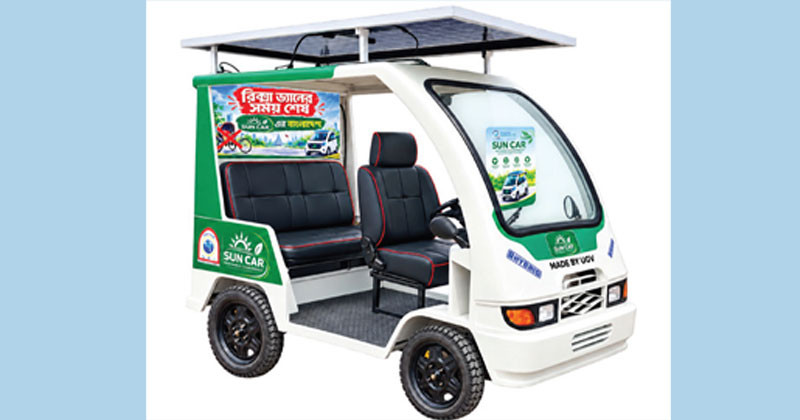
The University of Global Village in Barisal has successfully developed a solar powered vehicle called the “Sun Car” that runs without any operating cost. The invention drew attention from visitors at the Bangladesh Innovation Fair 2026 exhibition. This fully eco friendly vehicle is expected to help curb electricity misuse and theft in the country while also reducing carbon emissions.
According to Mr. Imran Chowdhury, chairman of the university’s board of trustees, a team of students and teachers developed the Sun Car after extensive testing, using sunlight as its power source. The vehicle can be built for only 150,000 taka and is suitable for use on both city and rural roads. He said the car can run for a minimum of 5 hours even without direct sunlight.
Several students involved in developing the vehicle said their new invention offers a fully eco friendly and safe alternative to pedal and battery powered rickshaws. Reducing dependence on fossil fuels, meeting the rising demand for electricity, and building environmentally friendly transport systems are three concerns reshaping transportation technology worldwide today.
In Bangladesh too, the use of battery powered electric vehicles is growing quickly. This is placing uneven strain on electricity demand, adding extra pressure on industry, business and residential power supply. Existing battery powered rickshaws and easy bikes ultimately depend on the national power grid for charging, which abnormally increases demand and adds to public hardship.
With this reality in mind, the project was carried out with the goal of using sunlight directly as a vehicle’s energy source. It was planned and led by Dr. Imran Chowdhury, chairman of the university’s board of trustees, under the overall supervision of Dr. Golam Saleh Ahmed Salem, dean of the engineering faculty.
University officials are hopeful that this newly invented Sun Car will play an important role in reducing extra pressure on the national power grid. The four wheeled solar assisted electric vehicle uses a 1500 watt BLDC motor in its electric propulsion system. This technology was chosen because of the BLDC motor’s relatively high efficiency, low maintenance needs and suitability for electric vehicles.
Solar panels installed on the roof of the vehicle generate electricity from sunlight. This electricity is stored in the battery through a charging and power management system and later used to run the motor and other electrical systems. Since the vehicle is built on a four wheeled platform, there is wide scope for future development in stability, passenger capacity and safety.
Because extra energy generated from the rooftop solar panels adds directly to the battery, the vehicle has the potential to travel a longer effective range than a similar conventional battery powered vehicle under suitable conditions. The vehicle also produces no local tailpipe emissions since it does not require burning fossil fuel directly.
Since solar energy is a free power source, this low cost vehicle has the potential to reduce a portion of external charging costs over the long term if sufficient solar power can be used. Ongoing local modification, testing and development of different parts of the vehicle also creates opportunities to strengthen domestic technological capacity.
Being four wheeled, the vehicle is relatively safer and less accident prone. The developers said this Sun Car, built at a cost of only 150,000 taka, is suitable for short distance passenger transport in both urban and rural areas.
Along with running on solar power, the newly invented Sun Car can also generate power from sunlight while in motion, allowing the battery to charge as it travels. Because of this, Mr. Imran Chowdhury, chairman of the university’s board of trustees, said the vehicle could become a promising option for fully eco friendly public transport in the future.