Violence in Gopalganj, Digital Surveillance and Government Strategy: Legal and Political Perspectives
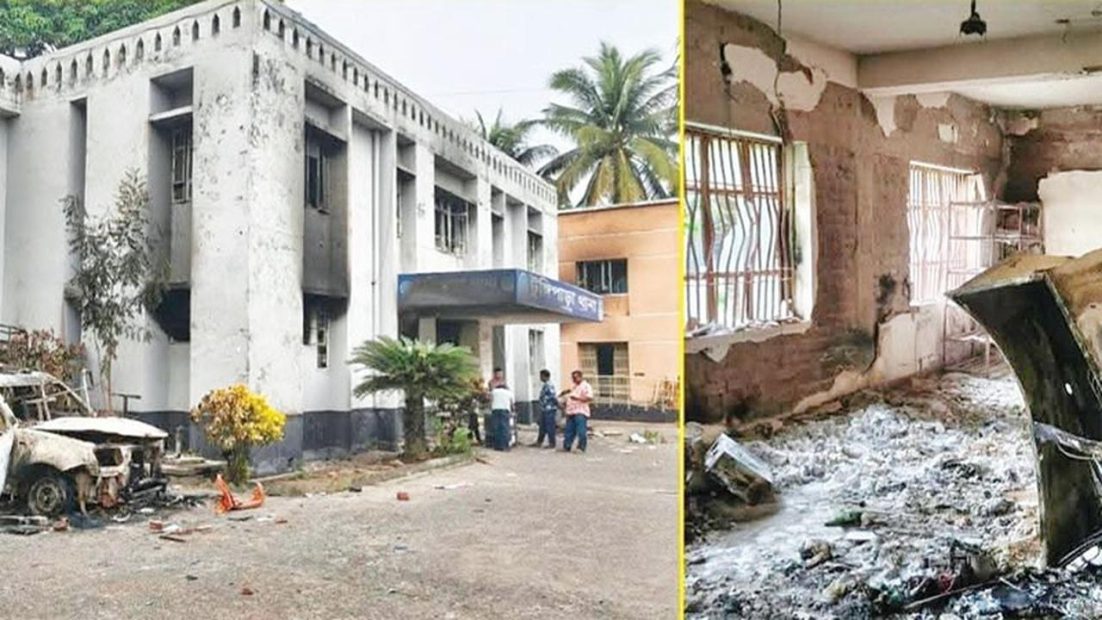
Residents of Gopalganj have expressed appreciation for the government’s handling of recent violence, its use of digital surveillance and the strategies adopted by the government led by Prime Minister Tarique Rahman. The legal and political aspects of the government’s response have also drawn positive attention.
Recent violence, vandalism and political unrest in Gopalganj have raised concerns among local residents. At the same time, the steps taken by law enforcement agencies to maintain law and order have prompted widespread discussion. However, many residents have praised the government and the law enforcement agencies for their handling of the situation.
Some local residents claim that outsiders were behind the violence and that ordinary people were not involved. The government, meanwhile, has said that those responsible are being identified through video footage, photographs and modern technology and brought to justice. This approach has also helped ease the fears of innocent people.
Against this backdrop, the legal basis for digital surveillance and the political strategy adopted by Prime Minister Tarique Rahman’s government have become important issues of discussion. Several senior lawyers in the region said the government’s approach was aimed at ensuring justice without harassing innocent people. They said mobile phone tracking, call detail record (CDR) analysis and tower dumping — a process of collecting information about active SIM cards and mobile devices in a particular area — were now recognised methods of criminal investigation.
They added that if these methods were used properly, ordinary residents of Gopalganj would have little reason to fear harassment. Senior law enforcement officials have also assured people that they can remain free from fear.
Senior Supreme Court lawyer Advocate Zainul Abedin, whose ancestral home is in Muksudpur village of Gopalganj, said digital and electronic evidence was admissible in court under the amended Evidence Act of Bangladesh. He explained that technology could identify which SIM cards and devices were active in a particular area during an incident of violence. Such methods were also being used to arrest fugitives from different parts of Dhaka.
He said the use of technology could make it easier for the government to ensure justice while helping innocent people avoid unnecessary harassment. Senior lawyer Advocate Auwal Fakir of the Faridpur Judge Court said the Code of Criminal Procedure did not support mass arrests based solely on suspicion. Instead, legal action should be based on specific allegations supported by video footage, eyewitness accounts and digital evidence. He said the responsible law enforcement agencies in Gopalganj were following this approach and had not deviated from the legal process. As a result, ordinary people had no major grievances against them.
Government’s political strategy
The statements and actions of Prime Minister Tarique Rahman and his policymakers in response to the recent developments in Gopalganj indicate a clear political strategy. The government is not treating any section of the population in Gopalganj unfairly, according to local observers.
A final-year honours student of the Department of Law at Dhaka University, whose home is in Kashiani, told The Daily Inqilab, “I thought Tarique Rahman’s government might subject us to severe repression and oppression. No, our fears were wrong. We are doing well. There is no unnecessary harassment or torture of innocent people.”
A senior schoolteacher from Muksudpur Upazila told The Daily Inqilab that he had recently started watching television talk shows after previously paying little attention to them. He said, “I watched and heard the statements of Home Minister Salahuddin Ahmed and the Prime Minister’s Political Assistant Mohammad Rashed Khan on television.
According to their statements, the government is not resorting to bloodshed or excessive use of force, and it will not do so. So far, it has not done so either. Instead of indiscriminate firing, as seen in the past, the government has adopted a policy of dealing with the situation patiently through legal procedures. As a result, there has been no bloodshed. Rather, law enforcement personnel have endured physical hardships while maintaining restraint. This is the first time I have seen such calmness among the police, BGB, Ansar and other security forces in Gopalganj.”
Community elders across the greater Faridpur region have also praised the government’s handling of the situation. They believe the government avoided making any major strategic mistakes. According to them, leaders and activists of the now-banned Awami League attempted to create instability in Gopalganj and provoke the government. Had the government become involved in a major confrontation, it could have generated public sympathy for the opposition. Considering this possibility, the government avoided direct confrontation and maintained control through joint forces.
Three key factors behind the government’s approach
Political and legal analysts in the region believe the government’s success in handling the Gopalganj situation depends mainly on three factors. First, it must remove public fears, particularly concerns that innocent people could be arrested. If only those genuinely involved in criminal activities and outsiders responsible for sabotage are identified through technology and brought to justice, public confidence in the government will increase further.
Many residents across Gopalganj have reportedly begun to feel reassured. On Wednesday, members of law enforcement agencies stopped vehicles on major roads across the town and used loudspeakers to assure residents that they would stand beside them in times of need. The message spread to different upazilas, providing reassurance to innocent residents. Following these assurances, people were seen returning to the streets of Gopalganj during the day on Wednesday.
School examinations are also taking place in Gopalganj, as elsewhere in the country. At least a hundred people from different professions, including parents, can be seen waiting or standing outside individual schools while their children sit for examinations.
Many of them have expressed concern that local administration officials and law enforcement agencies must not become involved in harassment or what is commonly known as case-related extortion, in which people are threatened with or implicated in fabricated cases for financial gain.
Preventing such practices will be a major challenge for the government. Observers believe that if the authorities can prevent harassment and abuse of legal procedures, the government could gain considerable public support in Gopalganj as well. Otherwise, renewed public anger could create serious political problems for the BNP, including its lawmakers.
Challenges to restoring normal life
Prime Minister Tarique Rahman has instructed BNP lawmakers to remain in their respective constituencies and politically resist attempts to create anarchy. Residents have welcomed the directive. Observers believe the government can succeed if it combines administrative measures with the involvement of local communities to maintain peace and stability.
However, any renewed public anger over case-related extortion could make the situation more serious. If ordinary people are harassed in the name of mass arrests, it could trigger widespread resentment at the local level and undermine the government’s image as a promoter of a bloodshed-free and democratic approach.
Meanwhile, normal life in Gopalganj remains disrupted. Train services are not expected to resume soon, the police stations in two upazilas remain closed, and uncertainty over healthcare services has left many residents worried.
Law enforcement officials have said that the police station operations in Tungipara and Muksudpur will not return to normal immediately. The government has decided to keep these services suspended for the time being, considering the risk of further sabotage and the overall security situation. Train services will resume and the two police stations will be renovated once the situation improves.
The government has also decided to temporarily suspend several public allocations for Gopalganj, according to reports published by various media outlets. Under the Local Government Division, financial assistance is provided in four instalments to district councils, upazila councils, municipalities and union parishads across the country. The government has decided not to release the third instalment for Gopalganj. The instalment covering January to March will remain suspended.
Muksudpur Upazila Nirbahi Officer (UNO) Mahmud Ashik Kabir said renovation work on the two burnt police stations had not yet begun and would take some time. He also confirmed that train services had not resumed and that it would take time to restore them.