Prime Minister Pledges Support for Waste-to-Fuel Oil Production Project
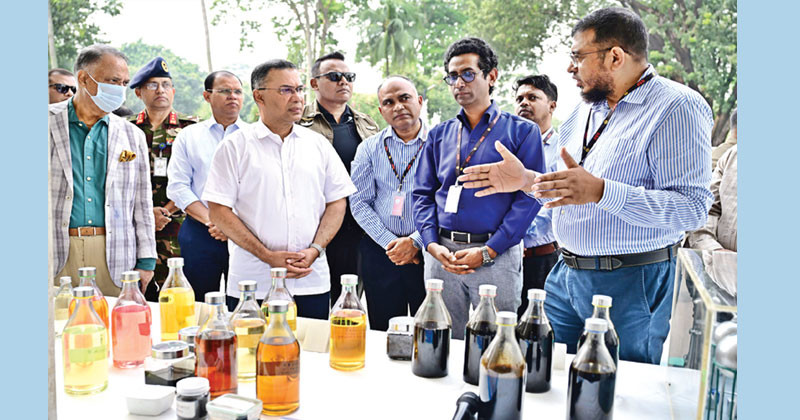
Prime Minister Mr. Tarique Rahman promised all kinds of support to carry out a project that makes fuel oil from human waste and farm residue. He gave this promise when he visited an exhibition of the innovative project at his office. Yesterday, Saturday, the event took place at the Prime Minister’s Office in Tejgaon, Dhaka.
Deputy Press Secretary to the Prime Minister Mr. Md. Shujauddowla (Sujon Mahmud) shared this information later. The researchers showed the Prime Minister their new technology, the progress of their research and the chance to make fuel oil on a commercial scale in the country. The Prime Minister saw the project and learned about its work and plan. He promised all needed support from the government, given the promise the project shows.
Professor Dr. Md. Khalequzzaman of Khulna University of Engineering and Technology (KUET) is a researcher on the project. He briefed the Prime Minister on the technology and the many sides of the research. The technology makes fuel oil from human waste, waste from sewage plants, kitchen waste and farm residue. The research has run for about 10 years.
KUET researchers made notable progress in making biocrude, a bio based crude oil, from waste with Hydrothermal Liquefaction (HTL) technology. Lab tests gave 50 to 55 percent biocrude. The researchers also told the Prime Minister that they succeeded in making biocrude rich in diesel. They said the next step is to set up a pilot plant that can process 1 to 3 tons of waste every day.
The pilot plant will test how well the technology works, its production cost and its commercial chance. The researchers said the proposed project will need about Tk 100 crore to Tk 120 crore. They said that if they can grow the technology on a commercial scale, it may replace about 10 to 15 percent of imported crude oil in future. This could save foreign currency worth about Tk 6,500 crore to Tk 13,000 crore every year.
However, the technology must first prove it works and pays off on a large scale. The researchers hope that with government help they can take the technology to a commercial level. They say it will then play an important role in solving the country’s fuel oil crisis and waste management problem. It will also cut reliance on fuel imports, save foreign currency, reduce pollution and open new chances for the local fuel industry.