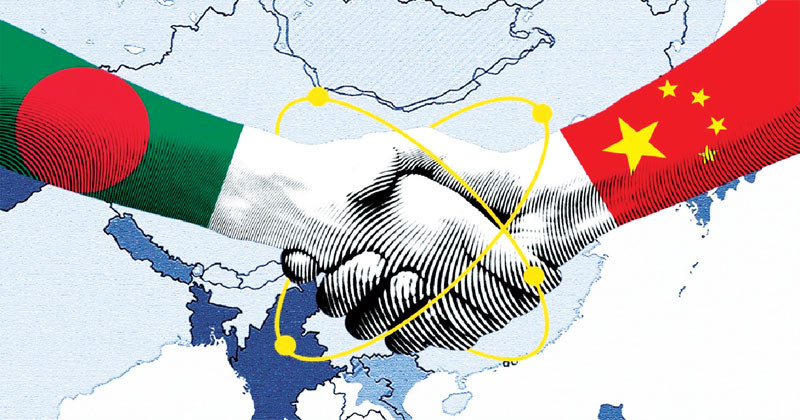
Why Bangladesh-China Defence Ties Matter
On August 1, 2026, the People’s Republic of China celebrated the 99th anniversary of the founding of the People’s Liberation Army (PLA), one of the world’s largest and most modern armed forces. For Chinese people, PLA Day honours officers and soldiers who have safeguarded the country’s sovereignty, territorial integrity, national security and development for generations. For me, however, the day carries a deeper personal meaning, recalling nearly four decades of friendship, professional relationships and unforgettable experiences with PLA officers and soldiers.
My journey with China began on September 15, 1988, when I arrived at Beijing Language and Culture University (BLCU) as a young Bangladesh Army officer to study Chinese. Learning the language became one of the most important decisions of my life. It introduced me to one of the world’s oldest civilisations and opened the door to lifelong friendships with the Chinese people and the PLA.
Over the past four decades, I have visited many provinces and cities across China. I witnessed the country become more modern, prosperous, innovative and confident, while the PLA underwent continuous modernisation and developed into a disciplined, technologically advanced and increasingly professional military.
As a military officer and China scholar, I often reflect on the reasons behind China’s remarkable progress. In my observation, far-sighted leadership, political stability, long-term strategic planning, effective policy implementation, investment in education and scientific research, technological innovation, hard work and patriotism have all contributed to this development. The PLA has also played an important role by helping maintain the secure and stable environment necessary for economic and social progress.
Since the beginning of China’s reform and opening-up, the PLA has transformed alongside the country. Once focused mainly on land forces, it has evolved into a joint military capable of integrated operations across land, sea, air, cyber, space and information domains. This transformation demonstrates China’s commitment to protecting its sovereignty, development interests and regional stability.
My association with the PLA extends beyond academic observation. During my military career, I served as an interpreter at meetings involving senior Bangladeshi and Chinese political and military leaders. In 1993, I met General Zhang Wannian, then Chief of the General Staff of the PLA, during his official visit to Bangladesh. His confidence, humility and professionalism impressed me. He expressed his belief that Bangladesh-China friendship would remain unbreakable, and more than three decades later, I believe history has proved his words true.
I also remember serving as an interpreter at a state dinner for a Chinese military delegation. Bangladesh’s then Chief of Army Staff, Lieutenant General M. Noor Uddin Khan, described the Bangladesh Army as, in many ways, “a small People’s Liberation Army in Bangladesh Army uniform.” His remark reflected the close defence cooperation of that period, when China supported a significant part of Bangladesh’s military modernisation, as well as the mutual trust between the two armed forces.
My understanding of the PLA deepened in 1997 when I attended a one-year course at the Defence Services Command and Staff College in Bangladesh. Three PLA officers from the land, navy and air forces studied and trained alongside me. We exchanged professional experiences and developed friendships that have survived beyond military service. Such relationships provide an important human foundation for long-term cooperation between Bangladesh and China.
Under President Xi Jinping, Chairman of the Central Military Commission, the PLA has undertaken comprehensive reforms. These reforms have modernised its command structure, strengthened joint operations, improved practical training and accelerated scientific and technological innovation. The five-theatre command structure integrates land, naval, air and support capabilities to improve joint operations and enhance military effectiveness.
The PLA’s ground forces now emphasise mobility, rapid deployment and advanced technology. The navy has developed from a coastal defence force into a blue-water navy with destroyers, frigates, submarines, amphibious assault ships and aircraft carriers. The air force has expanded its capabilities through advanced fighters, transport aircraft, early-warning systems, aerial refuelling and unmanned aerial vehicles. The Rocket Force strengthens China’s strategic deterrence, while information support, cyber operations, communications and electronic warfare capabilities continue to expand.
The PLA also invests heavily in military education, research, technological innovation and practical training. Its growing contributions to UN peacekeeping, humanitarian assistance, disaster management, anti-piracy operations and military diplomacy have expanded its international role. China and Bangladesh both make significant contributions to UN peacekeeping, creating an important foundation for closer professional cooperation.
China continues to uphold its One-China policy and support peaceful reunification across the Taiwan Strait while opposing actions that encourage Taiwan independence. Understanding Beijing’s position remains important for analysing the PLA’s modernisation and China’s broader security policies.
For Bangladesh, the PLA’s evolution offers opportunities for greater professional cooperation in military education, command and staff training, peacekeeping preparation, military medicine, engineering, disaster management, cybersecurity, artificial intelligence, logistics, communications and maritime security. Such cooperation can build on decades of engagement and further strengthen the long-standing military-to-military relationship between Bangladesh and China.
Author: Former infantry officer of the Bangladesh Army, graduate in Chinese from Beijing Language and Culture University (BLCU), Secretary General of We Speak Chinese Club Bangladesh Limited, founder of Zhong Meng Chinese Academy, and long-time researcher on Bangladesh-China friendship and people-to-people relations.