Why Should Government Projects Progress at Such a Snail’s Pace?

The government has taken long and medium term plans for the fragile economy. It will take more time to see the results. At the post budget press conference this fiscal year, Finance Minister Mr. Amir Khasru Mahmud Chowdhury said it would take four years to restore the wrecked economy he inherited. That means bringing the economy to a fairly comfortable state will push toward the end of the government’s term. But in this time, a strong effort is needed to carry out the economic plans and projects the government has taken.
A report in Daily Inqilab yesterday said the government is worried about the rate of Annual Development Programme (ADP) implementation. Four months of the current fiscal year have already passed. Prime Minister Mr. Tarique Rahman approves projects quickly at meetings of the Executive Committee of the National Economic Council (ECNEC). Even so, development work has stalled because of long scrutiny, and failures and delays in various ministries, including the Planning Minister and State Minister.
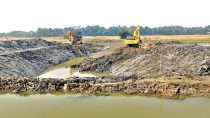
The government’s long process of checking the usefulness and financial gain of new and ongoing projects is causing unprecedented delays. These delays affect tendering and the release of funds. Small and large government works such as roads, bridges, schools and hospitals are stuck. Demand for building materials, transport and labor has hit rock bottom. As a result, the flow of money in the market is hit, pushing the rural and local economy toward deep recession.
In the first quarter (July to September) of the current 2026 27 fiscal year, ADP implementation fell to only 3.89 percent. This is the lowest in the history of Bangladesh’s ADP implementation. Never before has the rate been this low in three months. The Prime Minister has urged and directed fast approval of projects. But ministries, ministers, state ministers and related departments are slow and lack monitoring, and this has caused the stall. This slow pace of ADP implementation is deeply sad. It is hard to reach the mission and vision of the government to revive the economy.
There is no need to say again how bad the economy is. Gas, electricity and fuel crises, rising prices of daily goods, growing unemployment, a deep slump in local and foreign investment, and slow imports and exports have put the economy in a tough spot. Because of this, ordinary people are struggling to breathe. They have no money in hand and find it hard to run their families. We do not want to believe that the government does not know about this pain of ordinary people. It surely knows.
But the quick steps needed to give them some relief in their hard lives are not visible. The global recession caused by the Iran war and other crises is also hurting countries in Europe and America. There is no need to explain the state of developing countries like ours. Even in this global recession, neighboring India, Sri Lanka, Nepal and others have taken some economic steps to ease life for ordinary people. The government should also take some quick and visible steps that give people at least some relief.
It is not that ordinary people do not know the economic situation and the steps the government has taken. But the government must also think about how long they can hold out until they see results. Observers also point to the failure of the Finance Minister, Planning Minister, other ministers and bureaucrats. They say these officials are very slow in carrying out the government’s roadmap to revive the economy. Their drive is not seen. Talking alone will not do. The steps they have taken to ease the pain of ordinary people must be visible.
On the other hand, the Prime Minister orders the quick completion of the government’s own projects, but the orders are not followed properly. If even the Prime Minister’s order is not obeyed, how will the economy gain speed? Private sector investment is stuck and output in existing factories is falling. Garment factories, small and big businesses and markets are closing one after another. There is no need to explain how bad the economy is. People’s buying power has fallen, and they now live hand to mouth.
We have said again and again that economic crisis and public anger at the government are among the main causes of political unrest and the fall of governments. The economic hardship of ordinary people was also a main reason behind the fall of Sheikh Hasina. People came out on the streets in the movement. The governments of Sri Lanka and Nepal also fell for the same reason. In India, the recent youth movement against Mr. Modi has unemployment and economic crisis as a main cause. So the government must take these matters into account and act urgently to ease people’s lives.
Prime Minister Mr. Tarique Rahman works day and night to revive the fragile economy and ensure good governance. But it is clear that many in the cabinet cannot keep pace with him. Otherwise, why would the government’s own project work be slow? What are the ministers, MPs and bureaucrats doing? Observers now ask whether they are still in the government’s honeymoon period.
When they should work day and night to lift the ruined economy, and speed up ADP implementation to raise jobs and money flow, why are they slow? Why is the ADP implementation rate at its lowest? If projects start fast, many people will get jobs and the economy will gain life. The private sector will feel the effect too, and the drought in local and foreign investment will end. Despite the Prime Minister’s order, why do the ministers and bureaucrats follow a go slow policy on ADP implementation? We believe the government’s own projects must start fast to bring speed to the economy. No slackness can be allowed here.