World White Cane Safety Day and the Rights of Persons with Disabilities
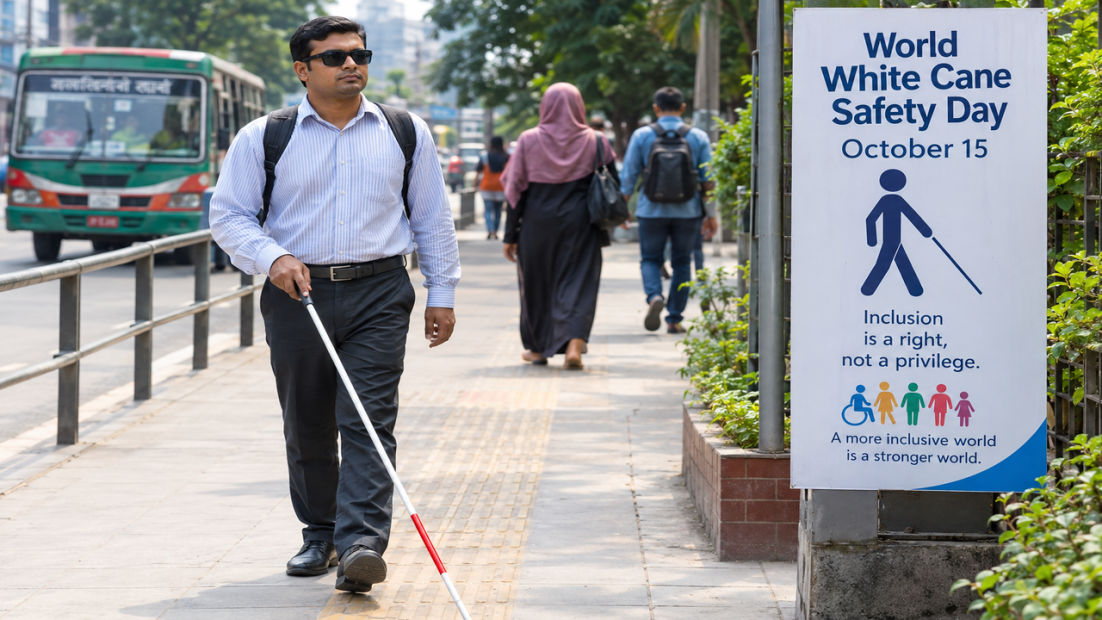
Every year, October 15 is observed worldwide as World White Cane Safety Day. The day raises awareness about people with visual impairments, including those in Bangladesh, and highlights the importance of the white cane in ensuring their safety and independence.
For decades, the proper use of the white cane has helped people with visual impairments navigate their surroundings independently and safely. When people see someone using a white cane, they can recognise that the person has a visual impairment. Families, communities and the state have an important responsibility to treat them with respect, adopt a positive attitude and create an environment where they can move around safely and independently.
The use of the white cane as a symbol of safe mobility for people with visual impairments began in the United States around 1930. In October 1964, the US Congress passed legislation declaring October 15 White Cane Safety Day in the country.
Later, the International Federation of the Blind, now known as the World Blind Union, organised an international conference in Colombo, the capital of Sri Lanka, in 1969. More than 300 people with visual impairments from 68 countries attended the five-day conference, held from September 28 to October 2.
Participants adopted proposals on education, safe mobility and the socioeconomic development of people with visual impairments. One of the key proposals was to observe October 15 every year as World White Cane Safety Day, giving the occasion global recognition.
Inclusive society and sustainable development
One of the main objectives of observing this day internationally is to ensure that persons with disabilities are included in mainstream society. Building an inclusive society is also essential to achieving the Sustainable Development Goals (SDGs).
In 2015, all United Nations member states adopted the SDGs, committing to end poverty, protect the planet and ensure that everyone can enjoy peace and prosperity by 2030. The pledge to “leave no one behind” commits countries to prioritising the development of the most disadvantaged groups.
Despite economic progress, persons with disabilities in Bangladesh continue to face barriers to socioeconomic opportunities and full participation in society. These barriers undermine sustainable development. An inclusive society helps protect fundamental rights and ensures a better standard of living. To make development sustainable, social and economic barriers must be removed so that everyone can participate fully. Inclusion is central to the SDGs, particularly Goal 10, which calls for reducing inequality.
One of Bangladesh’s major challenges is developing the full potential of its citizens. Inclusive policies and positive attitudes are essential to achieving this goal.
Challenges facing persons with disabilities
Although the government has taken several commendable initiatives, including allowances, educational stipends, interest-free bank loans and healthcare support for persons with disabilities, significant challenges remain.
These include access to financial services, effective skills development, suitable employment opportunities and disability-friendly workplaces. Ensuring financial inclusion and integrating persons with disabilities into mainstream society remain major challenges for achieving the SDGs.
If physical infrastructure is developed with their specific needs in mind, alongside appropriate education, training and skills development, persons with disabilities can demonstrate abilities and productivity comparable to those of people without disabilities.
Social and cultural barriers must also be addressed. Government agencies, private organisations and other institutions need to work together to develop accessible infrastructure, provide training and create employment opportunities.
Citing a survey conducted by the World Health Organization, the Blind Education and Rehabilitation Development Organization (BERDO) estimates that around 8–10 per cent of Bangladesh’s population lives with some form of disability.
Since July 17, 1991, BERDO has worked nationally to improve the lives of people with visual impairments and other disabilities. Its activities include residential schools for children with visual impairments, computer training, a Braille library, a Braille book production centre, employment support, social security and community-based rehabilitation programmes.
Gaps in rights and accessibility
Nearly a decade has passed since Bangladesh ratified the Convention on the Rights of Persons with Disabilities, but the lives of persons with disabilities have not improved significantly. Accessibility remains a major problem across the country, partly because building regulations are not properly followed. Public transport is still not adequately accessible to persons with disabilities. Committees established under the Rights and Protection of Persons with Disabilities Act are also not functioning effectively.
Negative attitudes towards disability remain widespread in Bangladesh. Mohammad Saidul Haque, a visually impaired person and executive director of BERDO, believes that establishing a separate ministry for persons with disabilities is essential. Such a ministry could coordinate employment, education, skills training, social protection, emergency assistance during natural disasters and measures to prevent harassment.
He said a dedicated ministry would help protect their rights and improve their access to essential services. The development of persons with disabilities is closely linked to national development. If their socioeconomic conditions improve, they can make significant contributions to the country’s productivity and overall progress.
Haque expressed hope that more rights-based organisations would be established in Bangladesh and that existing development organisations would introduce programmes specifically for persons with disabilities. He also called for stronger national and international initiatives to protect their rights.
Protecting dignity and ensuring equal rights
On December 13, 2006, the United Nations General Assembly adopted the Convention on the Rights of Persons with Disabilities during its 61st session. The convention aims to protect the human rights and fundamental freedoms of persons with disabilities, ensure their rights and promote respect for their inherent dignity.
The Government of Bangladesh ratified the convention on November 30, 2007. Since then, the day has been observed across the country. Integrating persons with disabilities into mainstream development is essential to the broader national interest. All stakeholders must work to build a rights-based society in which everyone can enjoy their rights without discrimination.
Bangladesh’s Constitution also provides guidance on protecting equality and rights. Observing World White Cane Safety Day will be meaningful only when the rights of persons with disabilities are upheld and all stakeholders take action with a positive and inclusive attitude.
The writer is a journalist and columnist.