60,000 People in Sarail Suffer Due to Lack of Connecting Bridge
For the past 20 to 25 years, around 50,000 to 60,000 residents across 20 villages in the Panishwar and Chunta unions of Brahmanbaria’s Sarail upazila have endured severe commuting hardships due to the absence of a permanent bridge over the Zafar Canal. Flowing from the Meghna River into the Titas River, the canal separates communities. It isolates important local educational institutions, including Panishwar School and College, Panishwar Madania Alim Madrasa, and several government primary schools, significantly disrupting daily life and student mobility.
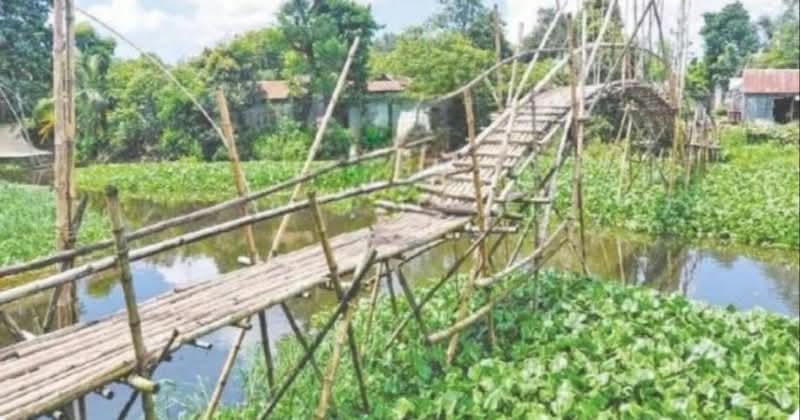
To bridge this critical gap, residents, including Hasan, Momin, Tareq, and Habib, have historically taken matters into their own hands by spending hundreds of thousands of taka annually to construct a makeshift bamboo bridge midway between Nailah and Sholabari villages. Because the structure must be built high to allow boat movement beneath it, crossing presents extreme dangers and daily hardships for women, children, elderly residents, and pregnant mothers who rely on the route.
The precarious crossing exacts a heavy toll, with villagers paying a five-taka toll per crossing while facing frequent accidents, severe injuries, and tragic fatalities from falls. Past casualties include elderly resident Shahjahan from Shakhaiti village and the wife of Khaleq from Nailah village, underscoring the lethal risks posed by the lack of permanent infrastructure for the thousands who commute across Panishwar and Chunta unions for seven to eight months each year.
Addressing the long-standing crisis, Panishwar Union Parishad Acting Chairman Tauhid Mia emphasized that constructing a bridge is a vital public interest necessity. Yet, administrative initiatives have been absent despite tens of thousands of people needing the route to reach upazila and district headquarters. He noted that the persistent lack of official action has forced residents to continually rely on dangerous, self-funded bamboo structures year after year.
Providing a hopeful outlook, the Personal Secretary to the local Member of Parliament and Upazila Engineer Chibgat Ullah of the Local Government Engineering Department confirmed that official action is underway. They stated that the local MP has issued a D.O. letter and the LGED has submitted a formal proposal to higher authorities, with expectations that the project will soon receive approval and construction will begin to alleviate public suffering.