Plot to Destabilise Bangladesh’s Garment Sector
Hasan Sohel
Bangladesh faces a global slowdown and many local problems. In recent times, constant unrest among garment workers and a string of factory closures have deeply worried the whole economy. After the Covid pandemic, the Russia and Ukraine war, the Middle East crisis and global inflation have cut worldwide demand and orders for garments. Inside the country, gas and power shortages and high bank interest rates have raised production costs many times over.
Both factory owners and workers face harsh problems in the current crisis. Rising living costs make it hard for workers to run their homes. Many factories have closed because of fewer orders and higher costs, so owners find it impossible to pay wages. Several owners say it is already hard to run factories on current wages, so a pay rise is not possible. A few days ago, authorities closed five garment factories in the Dakshinkhan area of Uttara in Dhaka for an indefinite period under a “no work, no pay” policy.
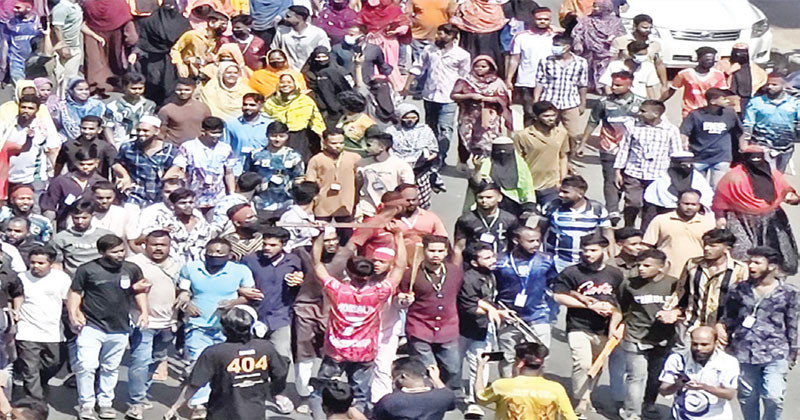
The factories need workers to help them survive, but some workers are spoiling the work environment and creating unrest by shutting factories. Yesterday, garment workers again blocked roads in Uttara without a valid reason and attacked police. Police suspect outsiders are encouraging the protest. Mr. Md. Rezaul Karim, Deputy Commissioner of the Uttara Division of police, said the government has already formed a wage board to set workers’ pay, and worker leaders are part of it.
Mr. Rezaul Karim said some people are forcing other garment factories to close and are adding to the crowd to create instability. He said their main aim was to block the highway to the airport and trouble passengers going abroad. He said outsiders carrying sticks and bricks tried to enter the airport highway in the name of workers, but they ran away when police pushed them back. When police went to talk to the protesters to control the situation, they attacked police with sticks and bricks.
Seven police members were hurt and a vehicle was damaged in the attack. To control the situation, police used water cannons first and then sound grenades to protect themselves. Mr. Rezaul Karim said police did not use direct force on anyone or hurt anyone. He also said no one has been arrested so far.
Factory owners say that even after the move to form a wage board, a self serving group is stirring up workers with false claims to make the situation murky. Observers have advised the government to stay alert about the garment workers’ protest. They say winter is the usual season for protests in the country, and opposition parties and groups take to the streets at this time. They also say the banned Awami League and its allies are plotting to destabilize the political situation, using the announcement that fugitive fascist Ms. Sheikh Hasina will return home in December. They add that signs of this are already visible, and outsiders are leading the protest.
The fascist Hasina government carried out widespread irregularities, corruption, looting and loan fraud over 15 years, and sent thousands of crores of taka abroad. The public now has to bear the burden of it. The World Bank, the International Monetary Fund (IMF), the US Treasury Department and other development partners say Bangladesh inherited its fragile economy. The forecasts from donor agencies for the economy are all bad news. An IMF report published a few days ago says the country’s Gross Domestic Product (GDP) growth will fall further to 3.2 percent. The World Bank and the Asian Development Bank gave the same forecast.
Reports from different local agencies also describe a deep crisis in the economy, and businesspeople are in despair. Despite this, factory owners have demanded that those behind the planned unrest and factory closures in the garment sector be found and punished. Mr. Abdur Rahman Tarafdar, the Labour Secretary, has said the government will talk about workers’ demands and also stay alert so that no self serving outsiders can create disorder. He said a wage board will be formed soon to set new wages for garment workers, and the process of choosing worker and owner representatives is going on. He hopes the gazette can be published this month once the representatives are chosen, and the ministry is looking into why workers still protest.
Allegations of political backing for the unrest have also come up. In Uttara, a fugitive former Member of Parliament of the banned Awami League is accused of being involved. He is accused of using the workers’ unrest to create instability in the industrial area. A state minister’s wife is also accused of stirring up the workers’ protest. Locals say Nipa Garments in Uttara was shut for an indefinite period on purpose in the middle of the protest, and five more factories in Uttara have also been closed. This has raised fears that the protest will spread further.
Workers say they cannot run their homes on current wages because prices of daily essentials have gone up. They say they asked the authorities many times to pay due wages, raise pay and ensure other benefits, but got no solution, so they took to the streets. Mr. Fazle Shamim Ehsan, President of the Bangladesh Employers Federation, said the federation has received a letter from the Labour Ministry. He said they will finalize names after talking with BGMEA and BKMEA and send them to the ministry. He said the government has been positive about forming a wage board from the start, yet a group is trying to fish in troubled waters, and this harms the good name of ordinary workers.
Mr. Mahmud Hasan Khan Babu, President of BGMEA, the garment owners’ organization, told Inqilab that work on forming the wage board is going on. He said owners will accept whatever pay the board sets. He said the workers’ protest at this time points to something else. He said garment owners have received complaints of a conspiracy and of outsiders joining the protest, and they have already told police and other law enforcement agencies. He said the government is working on the matter.
Sources say the garment sector has faced a global crisis for a long time, and local problems are closely tied to it. Countries in Europe and America are in an economic slowdown. Many importing buyers are delaying or canceling orders they already placed, and this cannot be fixed overnight. The government has already announced Tk 60,000 in incentives to restart closed factories. Experts say the government should make it easy for owners to get the incentive money fast, so they can reopen factories. This would give jobs back to those who lost them and create new jobs too.
Another big sector for the economy and jobs, housing, has also stalled for lack of policy support and proper coordination. The Real Estate and Housing Association of Bangladesh (REHAB) and sector experts say about 5 million people depend on this industry directly or indirectly. Recently, high taxes, high bank interest rates and runaway prices of construction materials have pushed the sector into a deep slump. Because of economic uncertainty, flat sales have fallen by about 65 to 70 percent. About 300 linked industries, such as rod, cement, brick and sand, depend on this sector.
When one housing project starts, hundreds of production and service sectors start moving on their own. Since housing has collapsed, new job creation has slowed, and this directly hurts the economy. Inflation has also pushed the prices of daily goods beyond the reach of low and limited income people. They struggle to run their homes on their income. Lower income families and even middle class families are in trouble. Some families cannot stay in the capital and are moving to villages.
In the first eight months of 2026 (January to August), the value of Bangladesh’s garment exports to the European Union (EU) market fell by 11.67 percent compared with the same period last year. Export earnings dropped from 13.50 billion euros to 11.93 billion euros, a fall of about 1.58 billion euros. The fall came not only from lower volume but also from a lower average price per kilogram of garments. Bangladesh’s export volume fell by 4.58 percent, but the drop in unit price had the bigger effect on value. The average export price per kilogram fell by 7.43 percent, from 14.87 euros to 13.76 euros.
In total, the EU imported garments worth 60.29 billion euros from January to August 2026, which is 3.83 percent less than 62.69 billion euros in the same period of 2025. The weight of imported garments fell by 2.57 percent. The average import price per kilogram fell by 1.29 percent, from 19.91 euros to 19.65 euros. The picture for August alone is a little different. Compared with August 2025, the value of garment imports into the EU in August 2026 rose by 0.72 percent. Import volume fell by 0.57 percent, but the average price per kilogram rose by 1.29 percent, so total import value grew slightly.
Among the EU’s big garment suppliers, China’s exports rose in both value and volume. In the first eight months of 2026, China’s garment exports to the EU rose by 2.38 percent to 19.71 billion euros, and volume rose by 3.45 percent. The average price per kilogram fell by 1.04 percent. Vietnam’s garment export value rose by 4.46 percent to 3 billion euros. Its export volume fell by 5.13 percent, but the average price per kilogram rose by 10.11 percent, so its export value grew.
Bangladesh’s garment exports fell not only in Europe. In the first half of this year (January to June), Bangladesh’s garment exports to the US market fell by nearly 6 percent. The figure given for the end of July is 6.5 percent, and garment exports fell by 4.43 percent. In the same period, garment exports to the US from China and India fell by more than 29 and 26 percent.