Food Security in Ancient Bengal: The Remarkable Story of a Prosperous Settlement
Mahasthangarh, the ancient city of Pundranagara, stands on the bank of the Karatoya River. It is not merely a collection of brick and stone ruins. Beneath the site lie the remains of a 2,500-year-old civilisation, holding many untold stories about Bengal’s economy, administration, trade and social life.
Recent archaeological excavations and research have revealed remarkable findings beneath the soil of this ancient settlement. Archaeological excavations conducted jointly by Bangladesh and France at Bairagir Bhita, located north of Mahasthangarh, have uncovered artefacts that provide new insights into the organised economy and food management system of ancient Bengal.
Around 2,500 years ago, the people of this region not only enjoyed prosperous urban life but also maintained well-planned systems for food security and grain storage. The ancient structures and artefacts buried beneath the ground reflect the foresight and capabilities of our ancestors.
Discovery of Eight Wells
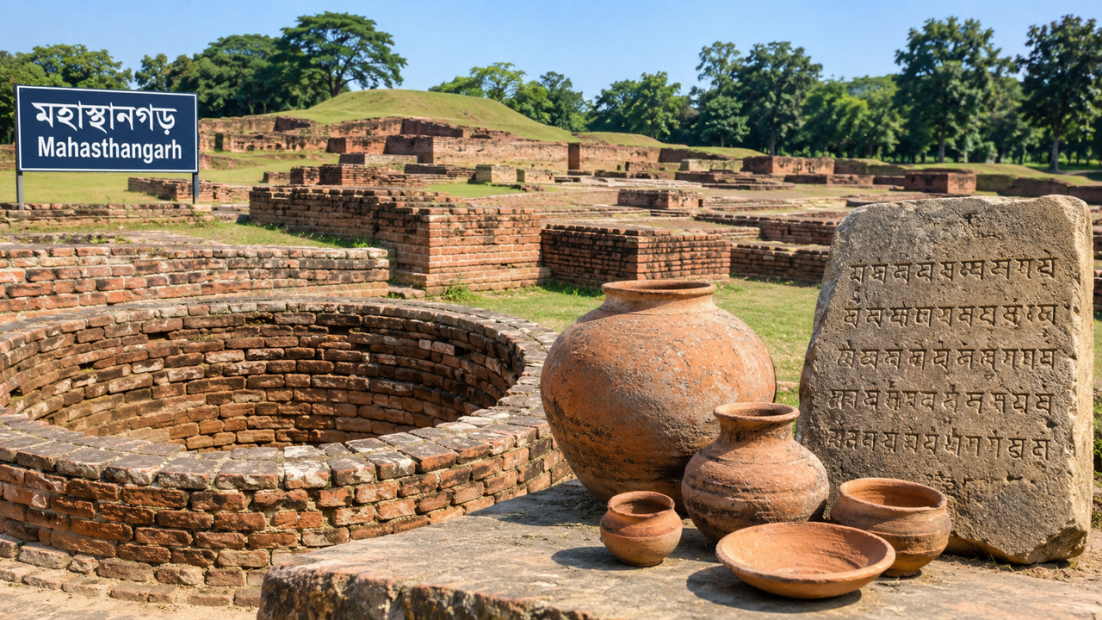
A joint archaeological excavation by Bangladesh and France at Bairagir Bhita, north of the Mahasthangarh fortified city, has uncovered a total of eight wells. One of them had a brick structure consisting of 46 courses. According to the available findings, the well is approximately 1,300 years old. Various types of earthen vessels were also discovered at its bottom.
These archaeological discoveries are significant and have opened new avenues for research. The findings suggest that a facility or centre related to food storage, collection or distribution may once have operated at the site. This indicates that the location may have served purposes beyond being a source of water and could have been connected to the wider urban economy and food supply system.
A Possible Food Supply Centre
Based on archaeological discoveries made at Mahasthangarh since 1928, Bairagir Bhita can be considered a possible food supply or storage centre of the ancient city of Pundranagara. A prosperous urban civilisation requires an effective system not only for producing food but also for collecting, storing, preserving and distributing it. Such infrastructure would have played an important role in meeting the food needs of city residents, traders, artisans and people involved in administrative activities. The artefacts discovered at Bairagir Bhita could therefore provide valuable evidence for understanding the economic organisation and urban management of ancient Bengal.
An Earthen Jar Bearing Memories of the Maurya Period
A large earthen jar discovered during archaeological investigations carries particular historical significance. Archaeologists have linked the artefact to the Maurya period. Dating back to approximately the third century BC, it provides evidence of a history extending nearly 2,500 years.
The presence of artefacts from different periods at the same archaeological site indicates that Mahasthangarh did not develop as a city overnight. Urbanisation, economic activities, religious life and administrative systems evolved there over many centuries. A 2020 excavation report also documented the discovery of artefacts from different periods, ranging from the second century BC to the 15th century AD.
The Inscription Discovered in 1931
An ancient inscription discovered at Mahasthangarh in 1931 is known as the Mahasthan Brahmi Inscription. It is not merely an archaeological artefact but also an important historical document providing insight into ancient Bengal’s state administration, food security and public welfare system.
Archaeological research identifies the inscription as an edict of Mauryan Emperor Ashoka (273–227 BC), engraved in the Brahmi script of the Maurya period. The seven-line inscription, engraved on a limestone tablet, contains instructions from the emperor to the Mahamatra, an administrative officer at Mahasthangarh. It directs the official to provide affected communities with necessary supplies of paddy and financial assistance during disasters or food shortages. It also outlines measures to replenish the food reserves and royal treasury after the crisis had passed.
One particularly significant aspect is that the administrative system of this region had provisions for food storage and financial assistance to address famine, floods and other crises nearly 2,500 years ago. What modern states describe as food security, disaster management, social protection and public food reserves had their historical foundations in practices reflected in this ancient inscription.
Administrative Foresight in Ancient Bengal
The Mahasthangarh inscription raises an important question: How did the rulers and administrators of ancient Bengal plan to protect people’s lives and livelihoods during disasters? The emphasis on storing food grains, distributing them when necessary, providing financial assistance and replenishing the royal treasury and food reserves after a crisis indicates that public welfare and economic stability were important considerations in the administrative system of that period.
This inscription is an important historical asset not only for Bangladesh but also for the study of ancient administration across South Asia. According to experts, numerous archaeological remains are still buried beneath the vast area of Mahasthangarh. Even if excavations continue for another hundred years, it may still be difficult to uncover the entire history of this ancient city. Recent research by the French Archaeological Mission has also called for a fresh assessment of Mahasthangarh’s urban layout and settlement history.
Preserving Our Archaeological Heritage
The wells, earthen vessels, large jars, brick structures and ancient inscriptions discovered at Bairagir Bhita bear witness to the glorious history of our past. These are not merely old objects recovered from beneath the ground. They reflect the knowledge, technology, economic capabilities, administrative skills and social responsibilities of our ancestors.
The government, universities, researchers, historians and international archaeological institutions must play a more active role in preserving this historical heritage. Alongside excavation, it is essential to ensure the proper conservation, research and publication of the recovered artefacts. Informative exhibition facilities should also be developed to help domestic and international visitors understand the historical significance of Mahasthangarh.
In conclusion, a prosperous urban civilisation existed at Mahasthangarh around 2,500 years ago. Great civilisations do not emerge overnight. The foundations of the civilisation that developed at Mahasthangarh must have been laid much earlier.
The history of Bangladesh therefore extends far beyond a few hundred years, with roots reaching thousands of years into the past. Every brick, earthen vessel, well and inscription at Mahasthangarh tells a story of our heritage and introduces us to the intelligence, wisdom and civilisation of our ancestors. Preserving every piece of evidence that reflects our national identity is a collective responsibility.
Author: President, Department of Accounting and Information Systems, Islamic University, Kushtia.