Robberies, Highway Heists Terrorise Dhaka-Chattogram Route; Access-Controlled Expressway Upgrade in the Works
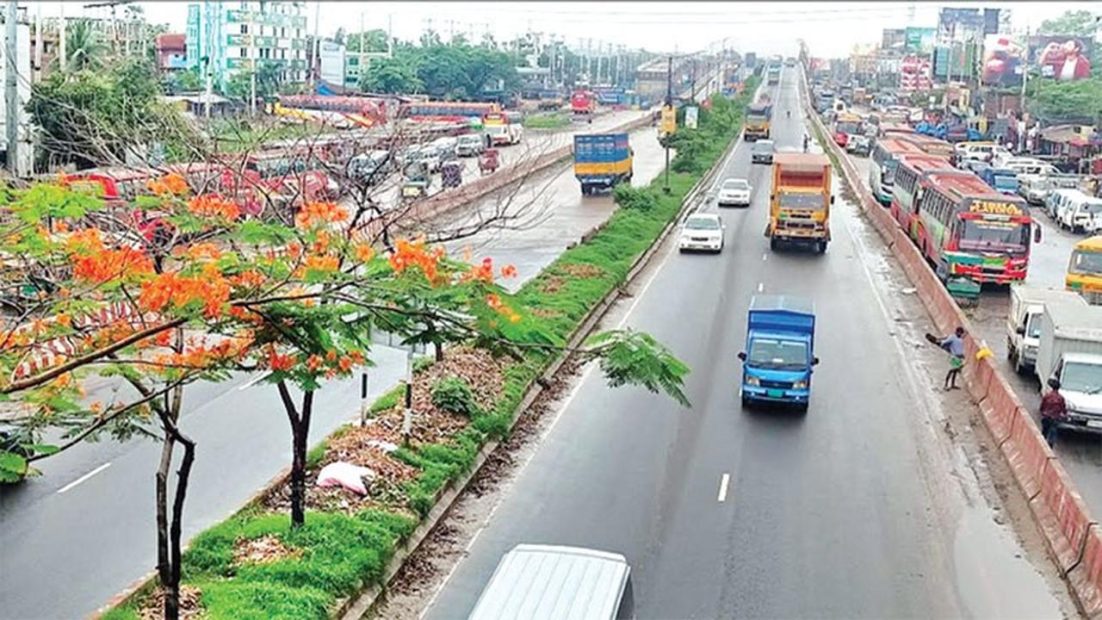
Robberies and snatching incidents along the Dhaka-Chattogram highway have triggered growing fear among passengers and drivers, particularly after dark and during traffic congestion. Amid mounting security concerns along the country’s economic lifeline, the government has taken an initiative to transform the highway into an access-controlled expressway, aiming to ensure faster, safer and uninterrupted connectivity between the capital and Chattogram.
Passengers travelling along the highway, particularly through parts of Feni, Cumilla, Narayanganj and Mirsharai, have increasingly become targets of robbery and snatching. Criminal gangs reportedly attack vehicles caught in traffic congestion, break windows to snatch mobile phones and valuables, and stop vehicles using road obstructions or loud noises before looting passengers.
The stretch from Signboard to Meghna Toll Plaza, covering nearly 21 kilometres, has become a frequent hotspot for robbery and snatching. Signboard, Kachpur Bridge and its surrounding areas, Madanpur bus stand, Langalband Bridge, Mograpara and Meghna Toll Plaza are among the vulnerable points. Passengers are also frequently targeted in Sayedabad, Jatrabari and Kachpur after arriving from long-distance journeys.
A recent incident witnessed by this correspondent at Sayedabad involved a middle-aged passenger returning from Chattogram with his young child. Shortly after getting off a bus, two youths intercepted him, one carrying a sharp knife, and snatched his money, wallet and mobile phone within seconds before fleeing. Similar incidents have reportedly become increasingly common, particularly affecting long-distance passengers.
According to police data, 79 snatching incidents, 238 thefts and 43 robberies were recorded in Narayanganj over the past nine months, most involving highway passengers. On November 1, four members of a snatching gang were arrested in the Siddhirganj section of the Dhaka-Chattogram highway. Earlier, four snatching incidents within an hour in Narayanganj in August sparked panic among residents.
Passengers returning from abroad have also become frequent targets. Criminals reportedly identify private cars and microbuses carrying expatriates returning from Dhaka and attack them during traffic congestion, using weapons to hold passengers hostage and loot cash, foreign currency, jewellery, passports and other valuables. Police say such robberies are often completed within one and a half to two minutes.
Women travelling alone are particularly vulnerable to criminals posing as CNG or small-vehicle drivers. On November 4, private school teacher Jannatul Naima was reportedly held at knifepoint by four men posing as passengers in an autorickshaw after she boarded it from the Lemua-Neyazpur road to travel to Feni town. They took her mobile phone and Tk 15,000 in cash. Another woman, Minu Akter Majumder, was assaulted and robbed on the Feni-Parshuram regional road the same day. She later filed a written complaint with Feni Model Police Station.
Passengers and transport operators have blamed inadequate highway surveillance, insufficient lighting and a lack of effective CCTV monitoring for the growing incidents. Many victims and drivers reportedly avoid filing cases to escape legal complications, allowing criminal gangs to evade accountability. Highway police have distributed awareness leaflets and advised drivers not to stop at isolated locations at night, urging them to head towards police outposts, toll plazas or crowded areas if they encounter suspicious activity.
Highway Police Inspector Nurul Afshar of Mahipal Highway Police Station said manpower and vehicle shortages made patrols along the extensive road difficult. A single vehicle is used to patrol stretches from Lemua to Mohammad Ali and from Mahipal to Daganbhuiyan, while personnel are also insufficient. Cumilla Regional Highway Police Superintendent Manzur Morshed said patrols had been strengthened and joint operations were being conducted in coordination with local police.
Amid the growing security concerns and congestion along the highway, the government has moved forward with plans to transform the Dhaka-Chattogram highway into an access-controlled expressway. The proposed 233-kilometre route will run from Jatrabari in Dhaka to Sagarika intersection in Chattogram, with detailed designs already prepared. The Road Transport and Bridges Ministry plans to construct around 64 kilometres of the route as elevated sections, while the remaining stretch will be built at ground level.
The expressway is expected to ease congestion, reduce transport costs and improve safety along the corridor connecting the capital with Chattogram Port. The highway carries thousands of trucks, covered vans, buses and private vehicles daily and handles around 92 per cent of the country’s international trade and 81 per cent of its export trade, making it a vital economic lifeline.
Road Transport and Bridges State Minister Habibur Rashid said a policy decision had been taken to construct the expressway, although the proportion of elevated and ground-level sections had yet to be finalised. Feasibility studies are underway to determine whether 70 per cent of the route should be elevated and 30 per cent built at ground level, or whether another configuration would be more suitable. Two to three proposals are being considered before a final decision is made.
The project is expected to improve connectivity with industrial zones, export processing zones and garment factories, facilitating industrial production, goods transportation and foreign investment. It is also intended to strengthen regional connectivity with the Asian Highway network, regional cooperation initiatives and the Belt and Road Initiative.
Plans to develop an access-controlled highway along the route date back to 2004. In 2008, the Asian Development Bank expressed interest in providing a loan of around Tk 1 billion for feasibility studies and design preparation. The project was approved under the public-private partnership (PPP) framework in March 2013, with a consultant appointed the following month. China Harbour Engineering Company signed a memorandum of understanding in 2015 to develop the expressway, but the project was cancelled in 2021 amid concerns within the government over the Chinese company’s potential control of the key highway.
The interim government later appointed consultants for a fresh feasibility study. Following the BNP government’s formation in February this year, the project was revived in line with its election manifesto. Implementation is targeted to begin in January 2027 and be completed by December 2032.
Officials said the project is expected to be implemented under a PPP financing model. Under one proposal, 64 kilometres would be elevated and approximately 169 kilometres built at ground level, with construction costs estimated at Tk 71,213 crore. Including 20 years of operation, the total expenditure would reach Tk 1,25,378 crore. The proposal includes Tk 24,700 crore for road construction, Tk 35,000 crore for elevated structures and foundations, Tk 3,591 crore for land acquisition, Tk 126 crore for 104 toll plazas, Tk 1,000 crore for an Intelligent Transport System and another Tk 1,000 crore for utility relocation and rehabilitation.
Another proposal envisages 95 kilometres of elevated road and 138 kilometres at ground level, with total construction and operating costs exceeding Tk 2,05,000 crore. A fully elevated 232.76-kilometre expressway would cost approximately Tk 1,52,000 crore to construct alone, with the total cost including operation estimated at nearly Tk 3,50,000 crore.
Professor Dr Shamsul Hoque of the Civil Engineering Department at Bangladesh University of Engineering and Technology (BUET) said expanding the highway to six, eight or even 10 lanes would not resolve congestion along the corridor. Congestion has already disrupted businesses, caused passengers to miss flights and hindered patient transportation.
He said Bangladesh was generally capable of constructing road infrastructure but often failed to ensure proper long-term maintenance. PPP projects, however, typically include 25 to 30 years of operation and maintenance contracts, encouraging investors to maintain road quality and ensure regular upkeep in their own interests.
With robbery and snatching continuing to threaten passengers along the highway, the proposed expressway is expected to improve connectivity, safety and traffic management. However, commuters and transport operators continue to demand immediate measures to strengthen surveillance and prevent criminal activities before the long-term infrastructure project is completed.