Economy’s Lifelines Choked by Chaos in Transport and Connectivity
Eklash Haque, Kamal Ataturk Misel and Moktar Hossain Mollah
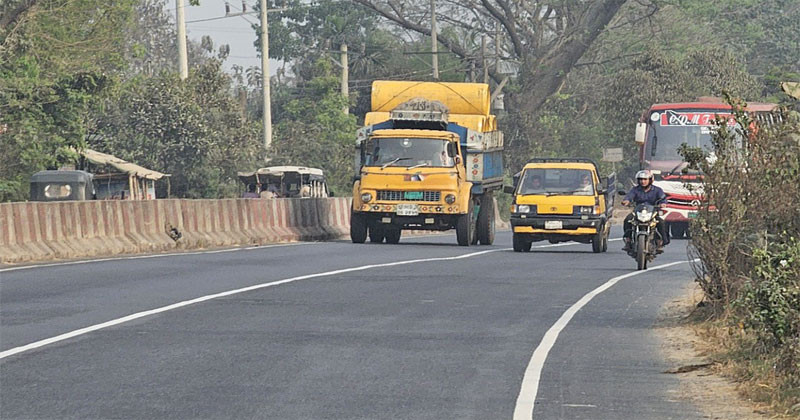
The country’s communication system is one of the driving forces of the economy. Travel, transportation of goods, marketing, supply of raw materials to industries, connection with ports and commercial centers all depend on the public transport system. Specially the Dhaka-Chittagong Highway, which is the most important for transportation of goods, is called the pipeline of the country’s economy. But even after more than six months of the government, the expected changes in the country’s communication and public transport sector, including this important highway, have not come about. The poor condition of the roads, delays in construction work, delay in repairs, traffic jams, chaos in public transport, and investment in the transport sector have turned the communication system into a failure. Those concerned say that due to long-term mismanagement, no clear steps for reform, planning and visible progress are being taken by the government. Despite making various controversial statements in the last six months, Minister for Road Transport and Bridges, Rail and Shipping Sheikh Rabiul Alam could not show any progress in making the road and highway communication system smooth.
When asked, Professor Dr. Hadiuzzaman of the Civil Engineering Department of Bangladesh University of Engineering and Technology (BUET) told Inqilab, it is important to ensure integrated management of road planning, construction standards, maintenance, traffic management and related infrastructure. Considering road maintenance as an emergency service, it is necessary to make arrangements for repairs within a specific standard and time frame. While it is essential to maintain old roads along with building new roads, potholes on important highways are not repaired quickly.
The suffering of passengers and drivers in traffic jams on the Dhaka-Chittagong highway from last Friday to Sunday has not ended. It takes 11 to 12 hours to cover a two to three hour journey. Thousands of vehicles have been stuck for more than 40 hours in a row. Women, children and the elderly are exhausted from being stuck in the scorching heat. The most tragic consequence of this suffering has been death in the ambulance. The ambulance of a heart attack patient, Amirunnesa, got stuck in a traffic jam in Daudkandi on the way to Dhaka for better treatment. She died there after being stuck for four hours.
One of the responsibilities of the minister in charge of the communications sector at the government’s policy-making level is to adopt long-term plans, monitor the pace of project implementation, create coordination between the relevant institutions, and ensure accountability in the public interest. However, even though six months is the time to initiate reforms, the minister in charge is not taking any responsible and effective steps to solve long-standing infrastructure problems. Despite the huge investment by the state in the communications sector, if people’s travel time does not decrease, transportation costs do not decrease, and road safety and quality do not improve, then that investment is ineffective, they say.
Even though buses from multiple companies or owners operate on the same route in the capital’s public transport system, effective route management is not seen. Various plans have been discussed for a long time to restore order in public transport. But no effective measures have been taken for these initiatives. If productive goods-carrying vehicles are stuck in traffic jams, transportation costs increase. At the same time, fuel costs for public transport are increasing. In the case of ongoing important projects that have been pending for a long time, identify the cause of the problem and set a specific deadline and complete them quickly. Along with taking up new projects, give adequate importance to the maintenance of old roads. If raw materials for industries do not arrive on time, production is disrupted. On the other hand, if goods cannot be transported quickly from the port, additional costs are incurred in import-export activities. Due to the failure of the communication system, products produced in industries in Dhaka and its surroundings are not being sent to Chittagong port on time, which raises the possibility of cancellation of product shipments, said people related to communication and public transport.
It has been seen on the ground that there is no end to the road construction and renovation projects that have been going on for years. While the work in road construction is supposed to be completed within the stipulated time, the duration of the project keeps increasing for various reasons. In view of this, the cost also keeps increasing. Huge amounts of money have been spent on the development of the country’s infrastructure in the last few decades. Various projects including highway expansion, regional road development, bridge construction, flyovers, bypasses, and connecting roads have been undertaken. The implementation of many of these projects has also brought about changes in the communication system. People are suffering year after year due to the construction and renovation of roads in various places from the capital Dhaka to the districts, from the districts to the upazilas and regional roads. There is no end to the suffering of the common people due to mud, waterlogging and potholes during the rainy season and dust and sand during the dry season.
In addition, vehicles on the Hanif Flyover in the Jatrabari area, extreme misery has arisen at the junction. Most of the part of the road that has been kept for getting on the flyover is full of potholes. The problem is getting worse when buses and large vehicles get on the flyover. For those who do not use the flyover, the road below needs to be kept normal. But the condition of this road has been the same for many days. Some drivers said that the road below is not repaired due to the manipulation of the flyover toll collection company. They say that if the road below is potholed, the vehicles will be forced to get on the flyover. Large potholes and dilapidated roads in different parts of the Dhaka-Sylhet highway have become death traps. Thousands of vehicles use these risky roads every day, but accidents are increasing due to the lack of effective repairs for a long time. Thousands of passenger buses, trucks, covered vans, motorcycles, CNG and various private vehicles ply on the Dhaka-Sylhet highway, Asian highway, 300-foot road and various regional roads of the upazila every day. But the large potholes and loose carpeting that have formed at various places on the roads have now gone beyond the limits of public suffering and become a direct life-threatening risk. Vehicles are breaking down at various places while moving on these roads. This is instantly creating traffic jams. Development work on the highway is ongoing. The poor condition of this road at the entrance to the capital has become a threat to traffic.
Although the era of the Bus Rapid Transit (BRT) project on the Dhaka-Mymensingh highway has ended, the work is not over. Passengers are constantly suffering due to this. Long traffic jams occur on this road. The government took up the project in December 2012 to introduce a fast, safe and environmentally friendly transport system on a specific lane from Gazipur to Hazrat Shahjalal International Airport. The BRT project is now a failed project. This has also become a cause of suffering for the people.
Kazi Jobayer Masud, office secretary of the Bangladesh Road Transport Owners Association, told Inqilab, “If the road communication system is bad or the country’s roads are dilapidated for a long time, passengers have to suffer. This is a natural phenomenon. And our transportation business also increases costs. Vehicle parts wear out quickly, fuel costs increase. It is seen that it takes more time to cover the same distance. The government should improve the communication system on a priority basis. Improving the communication system leads to development in the country’s economic infrastructure.”
Bridge renovation work is underway on the Dhaka-Chittagong highway. And that has brought a highway to a standstill. The traffic jam situation has not returned to normal since last Friday until Sunday. Traffic jams have been seen at various points including Sonargaon, Meghna, Gazaria, Daudkandi and Chandina.
As a result, the suffering of passengers and drivers has not ended. It takes 11 to 12 hours to cover a two to three hour journey. This traffic jam has spread from Sonargaon in Narayanganj to Chandina in Comilla. Thousands of vehicles have been stuck for more than 40 hours. Women, children and the elderly are exhausted from being stuck in the scorching heat without drinking water. Some of the cars run out of fuel. A huge expenditure of Tk 4,610 crore has been made on the Dhaka-Chittagong highway in just 9 years on the 192 km of the highway. On the same day, Dr. Mozammel Haque died while stuck in traffic. After the deaths of two people on the same day, the question in the public mind is – why is there an incident like road renovation after spending thousands of crores of Tk on road construction and renovation? The lifeline of the economy, the Dhaka-Chittagong highway, has been stuck in traffic jams for a long time, causing extreme suffering to passengers and drivers, as well as the transport of goods in trouble. Transport stakeholders are fearing major financial losses as perishable raw materials, industrial products and emergency supplies fail to reach their destinations on time. Leaders of the Bangladesh Road Transport Owners Association fear that the overall loss could be up to billions of taka.
More than 1,600 passenger buses, including approximately 800 ups and downs, heading towards Dhaka, were stranded on this road. Considering the 50 percent passenger capacity of the buses, about 20,000 passengers are affected by this deadlock, said Kafil Uddin Ahmed, president of the Bangladesh Road Transport Owners Association.
Anwar Hossain, a passenger travelling from Feni to Dhaka, said that the Dhaka-Chittagong highway is returning to its old form day by day. While lessons should be learned from previous mistakes in terms of highway management, renovation, etc., these areas are actually deteriorating. Whenever there is a big holiday, the repair of these roads and bridges comes to mind. And it causes suffering to thousands of passengers. Who will pay for the time lost by the passengers who are stuck on the route today, including my extra 11 hours?
According to transport owners, the number of damaged goods vehicles could be from five to 20,000. Assuming a minimum direct transport-related loss of Tk 10,000 per vehicle, the loss would be Tk 50 million for 5,000 vehicles, Tk 100 million for 10,000, Tk 150 million for 15,000 and Tk 200 million for 20,000 vehicles. However, this amount is not the final loss estimate, said Chowdhury Zafar Ahmed, Secretary General of Bangladesh Covered Van-Truck-Prime Mover Goods Transport Owners Association. The actual loss would include additional fuel, driver-helper wages and allowances, trip cancellation or delay, vehicle operating costs, delay in delivery of goods and additional delay charges at ports and off-docks.
Bangladesh Covered Van-Truck-Prime Mover Goods Transport Owners Association Secretary General Chowdhury Zafar Ahmed and Bangladesh Road Transport Owners Association President Kafil Uddin Ahmed have demanded government initiatives for the affected transport owners. They demand that the number of damaged goods vehicles and the actual damage should be quickly determined through a survey, a minimum compensation of Tk 10,000 should be paid for each damaged vehicle as an initial estimate, and the indirect damage caused to the Chittagong Port and supply chain should also be assessed.
Kafil Uddin Ahmed said, “If the traffic pressure, alternative routes and effective traffic management are not considered before the renovation work on the country’s main economic corridor, the Dhaka-Chittagong Highway, such a deadlock could cause even greater economic losses in the future.” Passengers and drivers stuck in long traffic jams on the highway said they are suffering due to being suddenly stuck in traffic jams.
Star Line Paribahan passenger Tofail Ahmed said, “While the Prime Minister of the ruling government is constantly fighting against corruption and irregularities by announcing a zero tolerance policy against corruption, what is Road Transport and Bridges Minister Sheikh Rabiul Alam doing sitting in an AC room?” At this time, he expressed his anger and said, “If this is the condition of the country’s national highways, how will the country move forward? What is the job of the Roads and Communications Ministry? It is the minister’s job only to sit inside the AC. And the people of the country will be stuck on the roads for hours.” He demanded the resignation of the Communications Minister.
Amir Hossain, a Saudi Arabian expatriate in Elliotganj area, said, “My flight is at 3:30 pm. I left for Dhaka at 5 am. I covered 8-10 kilometers in seven hours. Now I left my luggage and took my passport and set off on a motorcycle. Such anarchy cannot be accepted on one of the country’s major highways.” Jahangir Alam, a passenger of Asia Line Paribahan from Comilla to Dhaka, said, “It is illegal to carry out renovation work like this without prior notification. If I had known in advance, I would not have set off like this.” BNP’s Qatar Central Committee President MM Noor, who was stuck in a long traffic jam, said, “It took more than seven hours to travel just 10 minutes from Daudkandi to the Meghna Bridge area.”
Mr. Sukumar, a freight truck driver, said he has been suffering from traffic jams in the Alekharchar area of Comilla for about 15 days. Now he is facing the same situation again on this part of the highway. Drivers are wasting their time, fuel and money by getting stuck in traffic jams day after day. He demanded the immediate resignation of the Communications Minister.
Alraji Rion, sub-divisional engineer of the Narayanganj office of the SAO, said that the hole formed on the bridge due to rain was repaired with micro-concrete. The lane had to be closed during this time as the concrete needed about 24 hours to harden and become suitable for traffic. The Highway Police said that vehicles are moving slowly in Sonargaon, Meghna Toll Plaza, Gazaria, Old Baushia, Daudkandi Toll Plaza, Gouripur Bus Stand and Chandina areas and there are traffic jams in some places. Traffic is continuing.
Minister of Road Transport and Bridges, Railways and Shipping Sheikh Rabiul Alam said that the government is able to use whatever can be used in the interest of the country to expand the country’s economy and trade. International acceptance is increasing. Every taka of the World Bank loan assistance and government-funded projects must be spent effectively on establishing safe roads. A comprehensive new safe road law will be formulated by December 2027. Initiatives are being taken to relocate markets adjacent to highways, construct necessary diversions at the junctions of regional roads, and install clear markings and signage on the roads.