Parliament Passes Bills on Human Rights Commission, Enforced Disappearances and Property Transfer
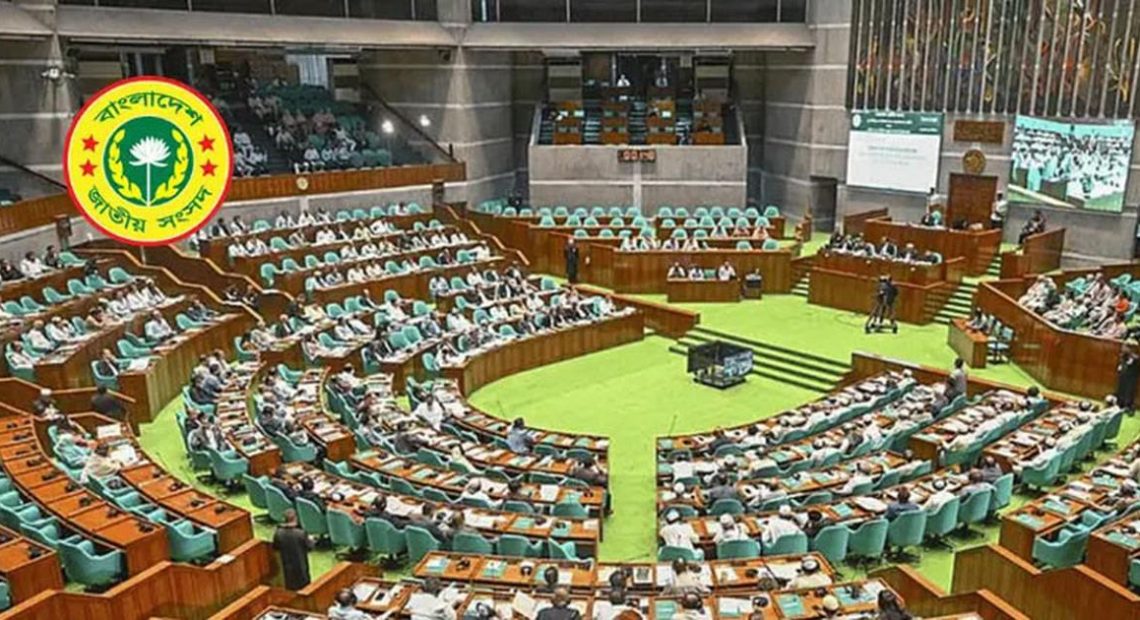
Parliament passed three bills yesterday to strengthen human rights protection, prevent enforced disappearances and provide legal recognition of lifetime usufruct rights following property transfers.
The bills are the National Human Rights Commission Bill, 2026, Prevention and Redress of Enforced Disappearances Bill, 2026, and Transfer of Property (Amendment) Bill, 2026.
Opposition lawmakers walked out of Parliament during the passage of the Transfer of Property (Amendment) Bill, 2026, which recognises parents’ lifetime right to use and possess property even after donating it. They were also absent when the National Human Rights Commission Bill was passed.
The National Human Rights Commission Bill, 2026 repeals the National Human Rights Commission Act, 2009 and establishes a new legal framework for an effective and independent human rights commission.
Under the bill, the commission will consist of a chairperson and four commissioners. At least one member must be a woman and at least one must come from a national minority community or a disadvantaged group.
Eligible candidates from national minority and disadvantaged communities will be given priority based on recommendations from a selection committee comprising a university professor, a civil society representative and representatives of the relevant communities.
The bill clarifies the commission’s jurisdiction and simplifies the process of filing complaints. It also empowers the commission to issue interim orders to protect victims from immediate threats and prevent further harm during investigations.
In line with the Optional Protocol to the UN Convention Against Torture, the bill provides for establishing a National Preventive Mechanism unit to prevent torture, deaths in custody and enforced disappearances.
The Prevention and Redress of Enforced Disappearances Bill defines enforced disappearance as a cognisable, non-bailable and non-compoundable offence. It establishes a comprehensive legal framework for preventing and prosecuting the crime, locating missing persons and protecting victims and their families.
Under the bill, an enforced disappearance will occur when a government employee or law enforcement member, with the authorisation, support or consent of a government authority or force, arrests, detains, abducts or otherwise deprives a person of liberty and subsequently denies the deprivation or conceals the person’s whereabouts, condition or fate, thereby denying them legal protection.
Courts will be able to issue search warrants to locate missing persons. The bill also provides for trials in absentia, the admission of digital evidence and protection for witnesses, complainants, whistleblowers and victims.
Victims and their families will have the right to receive information about the progress of investigations, learn the truth about the incident and know the whereabouts or fate of the missing person.
A special fund will provide state-funded legal assistance, medical treatment, rehabilitation and compensation. Compensation will first be recovered from the convicted person’s assets; if that is not possible, the state will bear the cost.
The bill allows the spouse and dependent family members of a missing person to use the person’s property for their livelihood and necessary expenses. A missing-person certificate may be issued after five years to facilitate the settlement of inheritance-related matters.
It also provides for establishing a central database on enforced disappearance cases and arrangements for international cooperation. Both investigations and trials must be completed within a maximum of 120 days.
However, the bill does not establish an independent investigative agency. The responsibility for investigating enforced disappearance cases remains with the police.
Meanwhile, the Transfer of Property (Amendment) Bill amends the Transfer of Property Act, 1882 to provide legal recognition to lifetime usufruct rights. Under the amended law, parents, grandparents and other eligible donors may transfer property to specified blood relatives or spouses while retaining the legal right to use and enjoy the property during their lifetime.
New Sections 122A and 122B have been added for this purpose. These provisions recognise property donations that reserve lifetime usufruct rights as a separate form of property transfer. The provision will apply equally to people of all religions.
The new system will not affect conventional gifts, hiba under Muslim law or other recognised legal methods of property transfer, nor will it conflict with existing arrangements.
The three bills were introduced in Parliament on August 27. They were subsequently sent to the relevant parliamentary standing committees, which were instructed to submit reports within two working days. The parliamentary standing committees on the Law and Home Ministries later recommended changes to certain provisions of two of the bills.
The bills were passed as the validity of several ordinances issued by the interim government expired. As 20 ordinances, including those concerning human rights, referendums and enforced disappearances, did not receive parliamentary approval within the constitutionally prescribed period, their legal validity has already expired.