Fuel oil to reach Patenga from Maheshkhali through pipeline
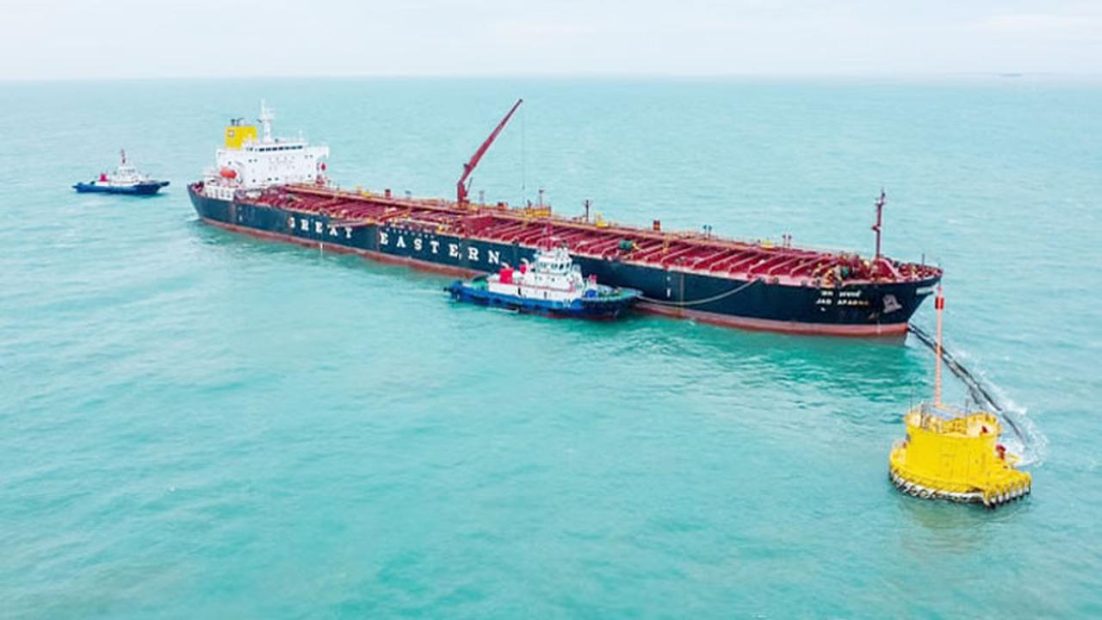
Fuel oil will be transported by pipeline from Maheshkhali in Cox’s Bazar to Patenga in Chittagong through the seabed of the Bay of Bengal. Officials of Bangladesh Petroleum Corporation (BPC) said the Installation of Single Point Mooring (SPM) project will begin operations soon as the appointment of an operator has been finalised.
Once operational, the facility is expected to save around Tk 1,000-1,200 crore in the cost of unloading fuel oil from large tankers at the deep-sea outer anchorage and transporting it to the Guptakhal depot in Patenga. It will also reduce the 11-day process of unloading oil from large tankers to 48 hours.
Officials said the Maheshkhali SPM is becoming an important part of the country’s energy security infrastructure. The facility was developed to quickly unload imported crude and refined fuel oil arriving by sea and transport it to onshore storage facilities through pipelines.
However, although the installation of the Single Point Mooring and dual pipelines has been completed, the facility could not be put into regular operation as the process of appointing an operator for its operation and maintenance had not been completed.
Finally, last week, final approval was given to appoint Indonesia’s PT Pertamina Trans Kontinental as the operator for five years. Following the tender process, the Cabinet Committee on Government Purchase approved a recommendation to appoint the company as the lowest bidder.
The five-year contract will cost around Tk 1,946.22 crore, including VAT and taxes. The amount will be paid from BPC’s own funds.
According to BPC sources, three companies participated in the tender and two were found technically qualified. BPC General Manager (Planning and Development) AKM Naim Ullah told Inqilab that the facility would be launched soon following the appointment of the operator. Its benefits would then begin to be realised.
A 110-kilometre pipeline has been laid through the seabed of the Bay of Bengal from Maheshkhali in Cox’s Bazar. Oil will be unloaded from large vessels and transported through the pipeline to storage facilities onshore.
The BPC facility cost Tk 8,298 crore. It is the country’s first integrated sea- and land-based oil storage and transportation system. BPC began work on it in August 2018 to replace the slow and costly process of transferring oil from large vessels to smaller ones.
Under the SPM system, large tankers can moor at a floating buoy in the sea. From there, crude oil and diesel are transferred directly through pipelines laid under the seabed. This is expected to reduce unloading time to around 48 hours.
The facility has one floating buoy and two parallel pipelines with a combined length of 110 kilometres across sea and land. One pipeline transports crude oil and the other diesel. The pipelines are connected to six tanks at Kalarmarchhara in Maheshkhali, three for crude oil and three for diesel.
The fuel is later transported through another pipeline to Eastern Refinery Limited (ERL) in Chittagong.
The facility was implemented under the Belt and Road Initiative with concessional Chinese loans, government funds and BPC financing. Construction was carried out by China Petroleum Pipeline Engineering Company Limited (CPPEC).
One of its main objectives is to strengthen the country’s energy security by creating the capacity to store large quantities of crude and refined fuel oil. After four extensions to the deadline, the work was completed in March 2024, with the cost rising from around Tk 5,000 crore to Tk 8,298 crore.
Trial operations began that month. Crude oil and diesel were unloaded from vessels in the deep sea and transported through the pipeline to the Eastern Refinery.
In August 2024, BPC issued a handover certificate to CPPEC.
The country’s annual demand for fuel oil is around 70-75 metric tons, and the demand is rising rapidly. Almost all of it has to be imported. The unloading and transportation of imported fuel oil costs a substantial amount of money every year.
The pipeline facility is expected to help reduce these costs and make the fuel supply system safer and more sustainable.
A pipeline for transporting fuel oil from Chittagong to Dhaka has already been commissioned. A 241-kilometre, 16-inch-diameter pipeline was installed from Patenga to Godnail in Narayanganj. The pipeline has been operational since last year.
Its use is saving at least Tk 236 crore annually in fuel transportation costs.