Bangladesh Moves Closer to China on Political Chessboard to Balance Ties with India
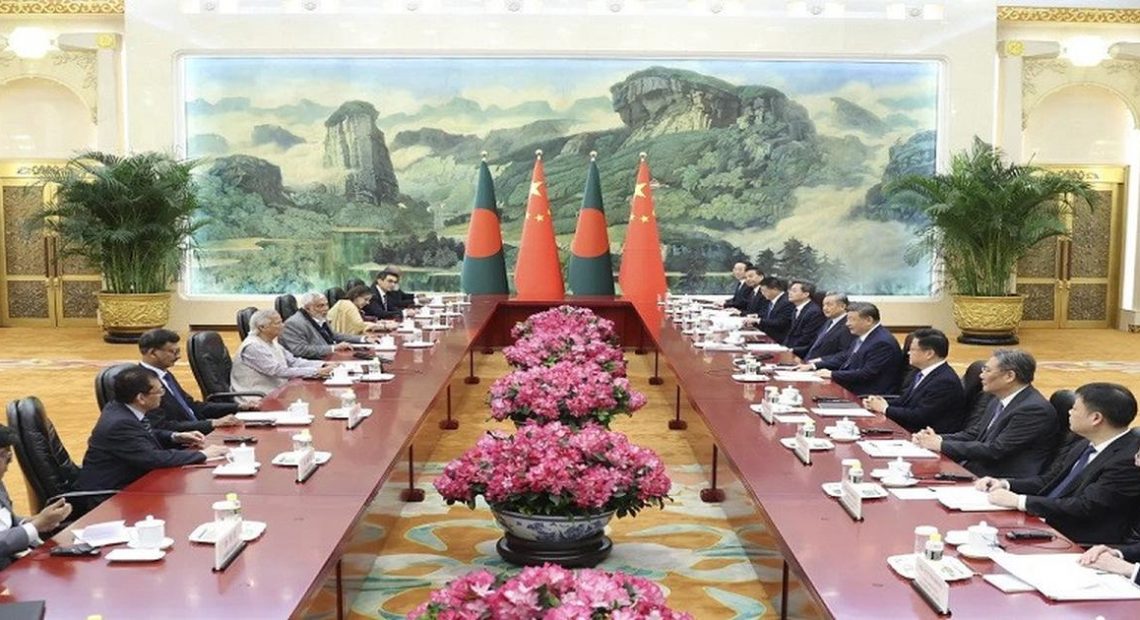
Bangladesh’s growing tilt towards China has added a new dimension to security and trade in South Asia. Analysts say Dhaka is seeking to project itself as an independent and strategic power in regional politics while reducing excessive dependence on India.
In 2024, the Awami League government led by Sheikh Hasina fell following a student-led mass uprising. Since then, under the interim government led by Nobel laureate Dr Muhammad Yunus and later under the Bangladesh Nationalist Party (BNP), which came to power in February 2026, Dhaka’s diplomatic, economic and strategic ties with Beijing have deepened further.
Alongside infrastructure development and trade, Dhaka and Beijing are set to launch a diplomatic and defence-focused “2+2” dialogue to further strengthen existing bilateral relations. Bangladesh’s Foreign Affairs State Minister Humayun Kabir announced the initiative after meeting Chinese Ambassador Yao Wen on August 30.
Shafi Md Mostafa, associate professor of South Asian foreign policy at the University of Dhaka, believes the dialogue has far-reaching regional diplomatic significance and indicates a well-planned effort by Dhaka to diversify its external partnerships.
Mostafa said, “China’s role in infrastructure, trade and defence modernisation is indispensable, although Bangladesh is also engaged with India and other partners. This policy of strategic balance allows Dhaka to gain economic benefits and advanced technology from Beijing while avoiding excessive dependence on any single power.”
He also noted that the move clearly highlights China’s growing presence in South Asia, which could reshape the regional balance of power and compel India, the United States and other countries to reconsider their foreign policies.
“There is no denying India’s role as Bangladesh’s closest neighbour. Dhaka continues to cooperate with New Delhi in connectivity, energy and security,” Mostafa said. “However, purchasing fighter jets from China and deepening strategic defence ties will undoubtedly increase India’s sensitivities.”
A Complex Balancing Game
Bangladesh has finalised an agreement to purchase 20 to 24 J-10CE multirole fighter jets from China, valued at around $2.3 billion.
Mostafa believes Bangladesh’s main challenge is to maintain a parallel balance by leveraging economic and defence cooperation with China while maintaining practical and realistic relations with India.
“For any conscious Bangladesh government, economic interests come first. Therefore, China’s role in trade, investment and infrastructure has made Beijing a highly important partner,” he said.
Mostafa added that despite the new dimension in relations with China, a major diplomatic rupture with India overnight is unlikely. Rather, Bangladesh is entering a deeper “politics of balance”.
“Dhaka will continue to maintain a balance between the two powers so that relations with either country do not undermine the country’s sovereignty or development priorities,” he said.
Since the fall of the Hasina government, Dhaka and Beijing have rapidly expanded their relations, signing at least 15 new memorandums of understanding and agreements in various areas, including trade and investment.
During Prime Minister Tarique Rahman’s visit to Beijing in June, 11 Chinese companies proposed investments worth $9.21 billion in Bangladesh.
Omer Karim, a researcher in political science and international affairs at the University of Birmingham in the UK, said the development in Dhaka-Beijing relations clearly reflects Bangladesh’s aspiration to emerge as an independent strategic power in South Asia.
Karim said, “Dhaka wants to establish its own strategic autonomy and emerge as an independent player on the political chessboard of South Asia.”
“Strengthening defence and economic ties with China is a safe move for Dhaka. The traditional dependence on India for security is beginning to change, and Dhaka is now demonstrating a new strategic balancing approach vis-à-vis India.”
A Multi-Directional Foreign Policy
According to Omer Karim, India’s concerns over defence cooperation could lead New Delhi to view the “2+2” dialogue as a Chinese attempt to encircle India, further complicating Dhaka-Delhi relations.
Diplomatic relations between Bangladesh and India became somewhat strained after India gave shelter to Sheikh Hasina. Bangladesh’s new government is seeking her extradition to face judicial proceedings.
John Danilovich, a retired US diplomat who served in Bangladesh, believes China played its political cards very effectively following Sheikh Hasina’s fall.
He said, “Throughout the interim government period, China maintained good relations with Bangladesh’s major political parties and invited representatives of the three major parties to visit China. As a result, there is now a strong national political consensus in Bangladesh on maintaining close relations with China.”
He added that as the current BNP government is pursuing a “Bangladesh First” foreign policy, strong ties with China will remain an important pillar of its diversified international relations.
“Undoubtedly, this is further strengthening China’s position in the overall politics of Myanmar and the Indian Ocean region,” he said.
Mr. Danilovich noted that India’s economic, security and geopolitical influence remains strong. However, the perception that Bangladesh has strong Chinese support helps Dhaka resist any unwanted pressure from India.
“The decision is now in India’s hands whether it will continue trying to maintain its previous influence over Bangladesh or adapt to an independent and self-reliant neighbour,” he said.
Mr. Danilovich also said Bangladesh is seeking to improve relations with the United States, Europe, Asia and countries in the Middle East.
Nilanti Samaranayake, an associate researcher at Washington’s East-West Center and a security analyst, noted that China had already been Bangladesh’s leading supplier of military equipment before Sheikh Hasina’s fall.
Nevertheless, she said antagonising India would not serve Bangladesh’s interests. Even during Sheikh Hasina’s tenure, Bangladesh’s close relations with China were a source of concern for New Delhi, she noted.
Ms. Samaranayake said, “Following the political turmoil of 2024, Bangladesh now needs as many reliable partners as possible to stabilise its economy and domestic politics and to strengthen its diplomatic and military presence on the international stage.”