Bangladesh Ranks 106th Among the World’s Most Innovative Countries
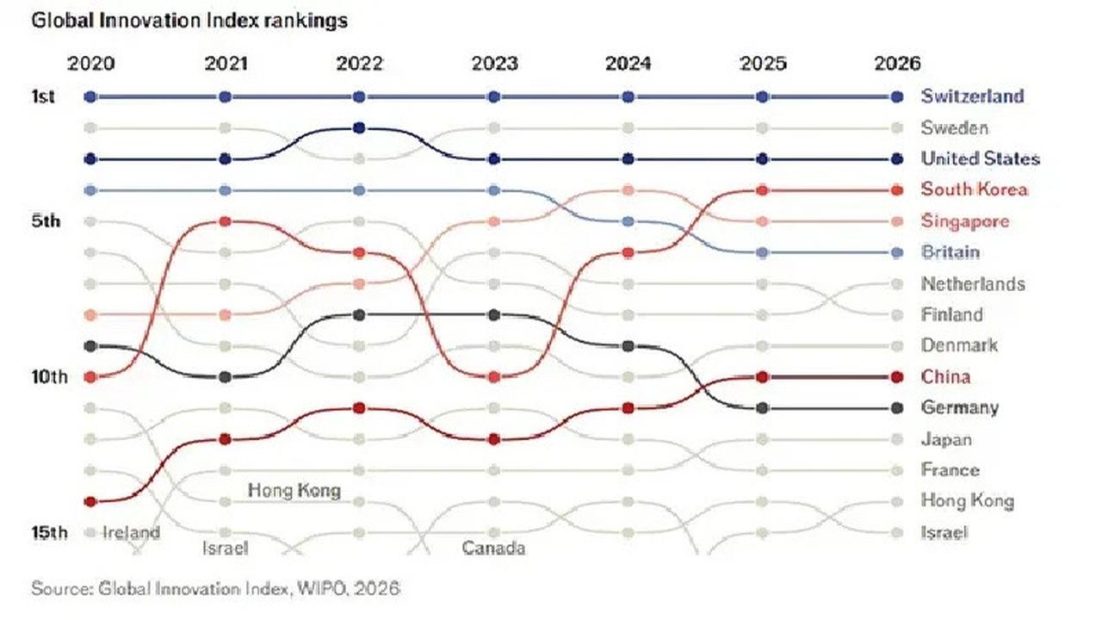
Bangladesh ranks 106th among 139 countries in the Global Innovation Index 2026, published by the World Intellectual Property Organization (WIPO). Due to shortcomings in education and research and poor performance across several indicators, the country remains near the bottom of the ranking.
WIPO assesses a country’s overall innovation capacity using 79 indicators across two broad dimensions: inputs and outputs. Input indicators include the institutional environment, such as political stability, the rule of law and government policies; human capital and research, including the education system, university quality and public and private spending on research; infrastructure, including information technology facilities, green energy and logistics; market sophistication, including access to credit and investment and the availability of venture capital; and business sophistication, including knowledge-intensive workers, high-tech imports and corporate research.
Output indicators measure tangible results of innovation, including patent applications, scientific publications, high-tech exports, digital services and the production of creative goods and services. A country’s overall ranking is determined by combining these indicators.
According to WIPO’s 2026 index, Switzerland retains the top position in global innovation, having ranked first consecutively since 2011. Sweden ranks second, while the United States remains third, a position it has held since 2023. South Korea ranks fourth and Singapore fifth. The other countries in the top 10 are the United Kingdom (sixth), the Netherlands (seventh), Finland (eighth), Denmark (ninth) and China (10th). Germany ranks 11th, Japan 12th, France 13th, Hong Kong 14th and Canada 15th.
Although the United States ranks third overall, a closer examination shows deterioration in some domestic indicators since Donald Trump took office. In particular, the innovation gap between the United States and South Korea, which ranks fourth, has narrowed. The United States also fell from 23rd place last year to 36th this year in an indicator measuring political, legal and operational risks in doing business.
The United States is also facing stiff competition in advanced technology and research. It remains the leader in deep-science startups, which focus on scientific and technological breakthroughs, with 12,752 companies. However, China is advancing rapidly. In 2025, China had 3,466 deep-science startups, more than double its total five years earlier. This sustained progress has raised renewed concerns among US policymakers.
Meanwhile, Saudi Arabia has made significant progress in the innovation rankings. Through extensive administrative and bureaucratic reforms, a business-friendly environment and efforts to reduce red tape, the country has risen from 68th place in 2019 to 42nd in 2026. Over the same period, it improved its ranking in institutional capacity from 104th to 25th.
Source: The Economist