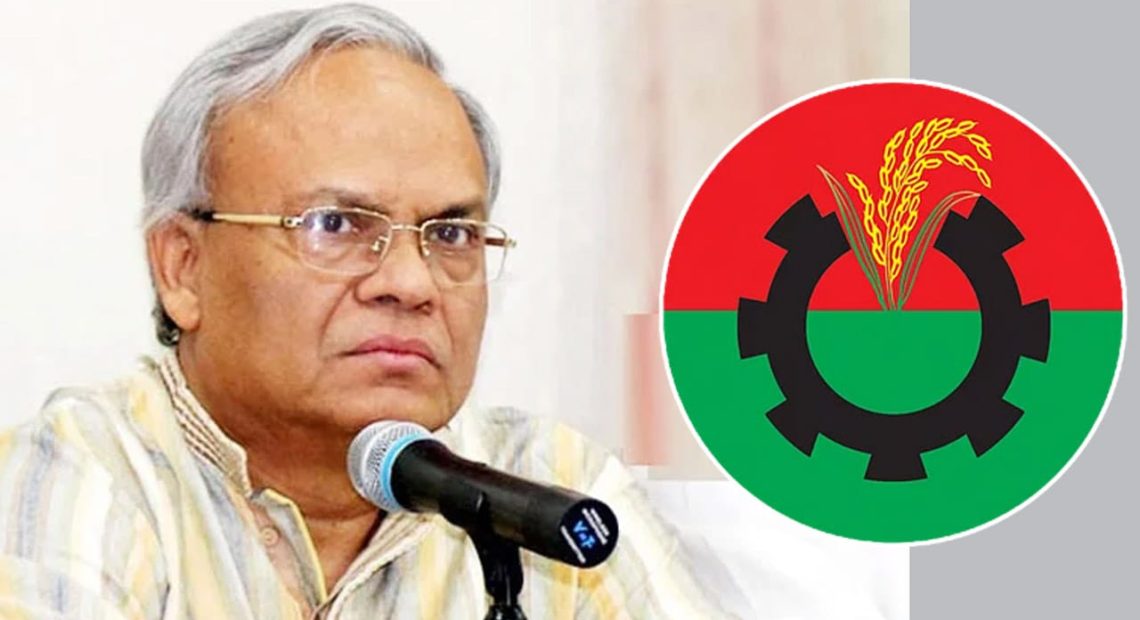
BNP Appoints Ruhul Kabir Rizvi as Acting Secretary General
Faruq Hossain
Ruhul Kabir Rizvi, a key leader in the Bangladesh Nationalist Party (BNP), has been named Acting Secretary General. After surviving a gunshot wound during the 1988 anti-autocracy campaign against military ruler Hussain Muhammad Ershad, experienced politician Rizvi assumes the second-highest administrative position in the party. His appointment comes after Mirza Fakhrul Islam Alamgir resigned after winning the presidency, ending a significant period in Fakhrul’s tenure since taking on the interim position in 2011.
Mr. Rizvi was nominated under Clause 7(b)(6) of the party constitution, with immediate effect, according to a news statement issued by BNP Assistant Office Secretary Mohammad Munir Hossain. He has also been admitted into the National Standing Committee, the party’s top decision-making body. Party officials had been debating Mirza Fakhrul’s replacement, but in the end, the party chose Mr. Rizvi, noting his vast organisational expertise, long-standing commitment, and devotion to party leadership under times of intense political pressure.
In the 1980s, Rizvi started his political career in student politics in the country’s northern area. He was born in Kurigram and attended Rajshahi University for his undergraduate and graduate studies in geography and environmental studies before graduating with a law degree. He was chosen Vise President of the Rajshahi University Central Students’ Union (RUCSU) and head of the Bangladesh Jatiyatabadi Chhatra Dal (JCD) at Rajshahi University during Ershad’s military rule. He then united student action across the country as JCD’s first elected central president.
He was injured in the abdomen by police during anti-Ershad demonstrations at Rajshahi University in 1988, which marked a significant turning point in his life. After emergency surgery, he survived after being left for dead on the street, but the injuries left him with long-term health issues. Despite these physical obstacles, he continued to be involved in street politics for the following forty years until moving into national party positions, such as Assistant Office Secretary of the BNP and President of the Jatiyatabadi Swechhasebak Dal in 1996.
To preserve organisational continuity during the 1/11 political crisis, Mr. Rizvi sided with party faithful. At the party’s sixth national council in 2016, he was promoted to Senior Joint Secretary General after being named Joint Secretary General in 2011 with oversight of the central office. He oversaw activities from the party’s Nayapaltan headquarters for the previous 17 years, acting as a crucial bridge between the central leadership and grassroots activists despite severe political crackdowns and administrative limitations.
Rizvi encountered several legal issues during his tenure, including hundreds of accusations related to special powers acts and political protests. He was in prison several times, including in 2013, 2015, 2018, 2022, and 2023. Because of his prior injuries and long-term medical difficulties, he frequently experienced severe health problems while in detention. He remained dedicated to public communications and central office activities despite extended detentions and physical dangers.
His decades of experience in the party’s core operations and organisational structure are reflected in his ascension to Acting Secretary General. The BNP strengthens its internal stability and continuity by putting its faith in a leader with decades of administrative experience and strong roots in student movements. Mr. Rizvi’s rise from a wounded student activist to the party’s second-highest position is evidence of his pivotal role in modern Bangladeshi politics.