Concerns Over Leasing Chittagong Port’s NCT-CCT to Foreign Firms
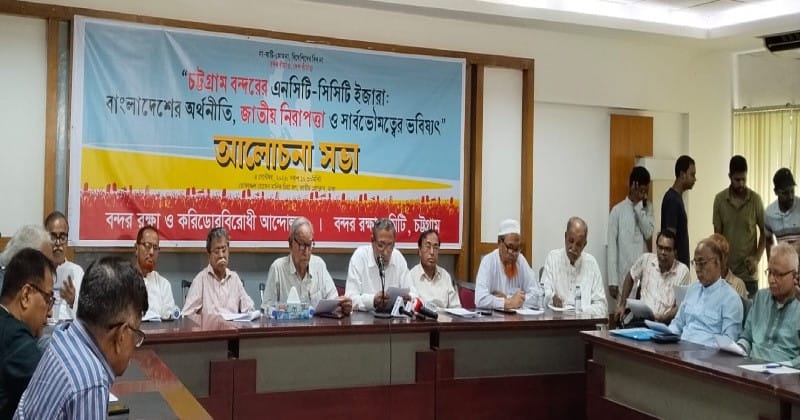
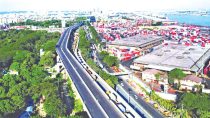
The government’s ongoing initiative to lease out Chittagong Port’s New Mooring Container Terminal (NCT) and Chittagong Container Terminal (CCT) to foreign companies has drawn severe criticism from leaders of the Port Protection Committee, who define the move as a threat to economic sovereignty and national interest. During a significant press conference on Friday, September 4, at the National News Club, the committee members expressed deep worries about transferring important state infrastructure to foreign companies. They emphasized that Chittagong Port is the main hub of Bangladesh’s foreign commerce, industry, employment, energy security, and general national security, rather than just a commercial facility.
The controversial process to lease out the NCT terminal started during the previous Awami League administration, according to the event’s speakers. They expressed total surprise that the present government had somehow preserved policy consistency and continued advancing the leasing plan while canceling or reconsidering several controversial actions of the previous regime. The committee remembered that the Chittagong Workers-Employees Unity Council, port workers, several political parties, and civil society organizations across the country had previously forced the government to withdraw due to relentless opposition and mobilization.
The leaders questioned the justification for speeding this deal, pointing out that the government should rather focus on pressing domestic issues, including inflation, jobs, health, education, and industrial growth. They said that the administration’s own stated ‘Bangladesh First’ slogan is in contradiction with such a program. The committee claims that NCT and CCT are wholly state-owned properties that were constructed with local funding and have long been effectively run by domestic workers. They questioned the wisdom of giving foreign organizations operational duties when local management is already capable of managing them.
The pre-lease financial modifications, particularly the sudden 37% increase in container handling fees that was put into place even before the deal was finalized, were another source of great concern. This false price increase, according to port-affiliated sources, was intentionally planned to create a high-income framework for future operators, which will ultimately raise import-export costs, fuel industrial production costs, and spike commodity prices at the consumer level. The committee also cautioned that income collection under proposed foreign operators like DP World would transfer huge financial benefits abroad and risk a net decline in public revenue by transferring funds through external channels rather than straight into the port authority’s treasury.
In response to popular criticisms, the speakers denied the idea that foreign operators are a certain solution to corruption, claiming that systemic corruption comes from flaws in monitoring, administrative weakness, and lack of accountability within the port structure. They maintained that corruption may be effectively eradicated by improving efficiency and transparency under home management. Additionally, they explained that customs paperwork, detailed clearance processes, transportation restrictions, and inter-agency approvals all contribute significantly to the logistical bottlenecks, so port operations cannot be held entirely responsible for port delays and container backlog.
The committee advised authorities to draw key findings from the Patenga Container Terminal’s (PCT) operational experience. With assurances of significant foreign investments, the former government transferred PCT’s operations to Saudi Arabia’s Red Sea Gateway Terminal in December 2023. However, the speakers pointed out that those expected investments were initially invisible and that the machinery that was recently added was mostly purchased with money made directly from the terminal’s internal operations, showing that foreign management does not always ensure new investment or quick capacity growth.
The committee concluded by highlighting the region’s extreme strategic vulnerability, noting that Chittagong Port is surrounded by important national sites such as the Eastern Refinery, air force facilities, navy bases, and essential energy infrastructure. The leaders cautioned that outsourcing vital assets threatens state sovereignty and the ability to make decisions during national emergencies since commercial data, shipping surveillance, supply chains, and critical infrastructure security are closely linked to daily operations. They strongly asked that the foreign leasing process be stopped right away to safeguard Bangladesh’s long-term strategic security and economic independence.