
Confusion Continues in Malaysia’s Labor Market
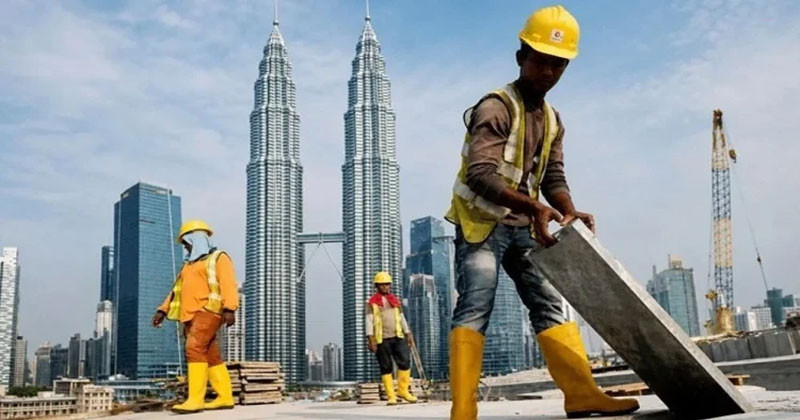
More than 700,000 Bangladeshi workers work hard in Malaysia, the country of their dreams, and send home a large amount of remittance. These migrants make a great contribution to the development of both countries. But confusion over the closed Malaysian labor market has not cleared yet. Sources at the Bangladesh High Commission in Kuala Lumpur say the promising market has reopened without any formal announcement from either country.
Meanwhile, mass arrests of illegal migrants continue in Malaysia. Last Monday, the Bangladesh High Commission attested a demand letter for 28 Bangladeshi workers. The demand came from NSK Trade City, a well known supermarket chain in Malaysia. The High Commission said it attested the demand letter of the Bangladeshi recruiting agency Goodness Services Limited (RL-2068) for 28 workers.
This attestation practically restarts the sending of Bangladeshi workers to the long closed Malaysian market. Recruitment from Bangladesh should begin once Malaysia’s FWCMS system approves these demand letters. But the market has opened without a formal announcement, and this raises many questions. On 31 May 2023, Malaysia closed its doors to new Bangladeshi workers.
During the Awami League government, workers were hired through a syndicate, and there were irregularities, extra costs and many complaints. So the Malaysian government stopped new workers from entering. The matter even reached court. Mr. Imran Ahmed, the then Expatriates’ Welfare Minister, was arrested in the case, and he is still in prison.
Police keep arresting illegal migrants in many parts of Malaysia. Immigration police have arrested hundreds of illegal Bangladeshi workers. They now live in terrible conditions in Malaysian jails. Mr. Md. Ruhul Amin, director of Vest Marketing Sdn Bhd, told Inqilab this from Kuala Lumpur on Tuesday.
Mr. Amin said Malaysia needs many Bangladeshi workers. He said Bangladesh must send workers in the way the Malaysian government wants. He said worker hiring is falling at an alarming rate in most countries because of the unstable situation in the Middle East. So it has become urgent to open the Malaysian labor market quickly.
Mr. Amin said the government must watch closely to protect workers and keep migration costs low. He asked Prime Minister Mr. Tarique Rahman to step in at once. He wants a general amnesty so that many illegal Bangladeshis who work in hiding can become legal. He also asked the High Commission to help detained workers use the amnesty offer. Under it, they can go home until next April by paying a fine of 500 ringgit.
After the present BNP government came to power, it started work to reopen the market. This followed long talks and diplomatic efforts. After he took office, Prime Minister Mr. Tarique Rahman held a special meeting on overseas jobs. He stressed reopening the closed and shrinking labor markets. His first foreign trip was also to Malaysia.
During that trip, Mr. Tarique Rahman talked with Malaysian Prime Minister Mr. Anwar Ibrahim about restarting worker hiring from Bangladesh. Several manpower exporters say Malaysia is reopening the path for Bangladeshi workers as a result of that effort. But neither country has formally announced the reopening yet. The biggest question is whether workers can go through a clear and safe system. Or will brokers, middlemen and so called syndicates become active again because of missing information and a complex process?
Malaysia published the hiring process and steps for foreign workers, including Bangladeshis, about a month ago. But Bangladesh did not spread this information well. So many job seekers still do not know how, by which process and through whom they can go to Malaysia. Some recruiting agencies, travel agencies, brokers and middlemen are reportedly using this gap. They attract job seekers on social media with ads, job offers and promises of a quick trip to Malaysia.
So people may trust the brokers’ ads more than official information. To control the situation, the government issued a warning notice. It advised people not to submit passports, pay money or take medical tests until further notice. But the process began with the attestation of the demand letter for 28 workers. Still, the government has not shared the full process, the likely cost or the next steps.
In the past, people say recruiters took 500,000 to 700,000 taka from workers to send them to Malaysia. This time, people talk of 700,000 to 800,000 taka in the market. Manpower exporters fear a big gap between the government fixed cost and the real cost. This could happen if the government cannot stop the brokers and middlemen. The government had announced a special plan to send 10,000 Bangladeshi workers to Malaysia free of cost through BOESL. But there is no sign that it will happen.
Several manpower exporters say the government can greatly reduce the brokers’ control. It can do so by sending workers through a low cost and clear government system. Complaints of irregularities in sending workers to Malaysia are not new. Over the past few years, the Malaysian labor market has closed several times over such complaints. Each time it reopened after diplomatic efforts by the government.
Those involved fear a new crisis if the old irregularities repeat after this reopening. The Bangladesh government has launched the Overseas Employment Platform (OEP) to pick and send workers in a clear and quick way. Stakeholders say migration costs can fall if the new system uses the government database to pick workers. Under Section 19 of the Overseas Employment and Migrants Act, recruiters must first pick suitable workers from the BMET database.
If they find no suitable workers there, the law lets them pick workers openly through a public notice. But they need the government’s permission first. Stakeholders allege that recruiters did not fully follow this rule in the past. There were even claims that recruiters collected workers and took money before they got the demand letter. So stakeholders say it is urgent to ensure the legal framework and database based selection from the very start. The future of the Malaysian labor market depends largely on how clear and safe it stays this time.
Mr. Md. Fakhrul Islam, former joint secretary general of BAIRA, spoke to Inqilab at night. He said the confusion over the Malaysian labor market has not cleared. He said neither country has formally announced the reopening. He said the Bangladesh High Commission in Kuala Lumpur attested the demand letter for 28 workers. But it has not announced the migration cost, the job term or the salary.
Mr. Fakhrul Islam said the migration cost will soar if the labor market again falls into the hands of a syndicate, as under the past fascist government. He said workers who want to go to Malaysia will then be crushed. He strongly demanded that all legal recruiting agencies get a chance to send workers. The reporter called Mr. Siddiqur Rahman, Minister (Labor) at the High Commission in Kuala Lumpur, several times at night. He did not pick up the phone.
The reporter also called the owner of Goodness Services Ltd, the recruiting agency that got the attestation for 28 workers. The reporter got no response.