Diplomatic Foresight and Success of Prime Minister Tarique Rahman
Prime Minister Tarique Rahman has initiated positive changes through diplomatic foresight, international relations and economic prospects. Within seven months of taking office, he has succeeded in placing national interests and sovereignty at the centre of diplomacy. Establishing cordial, high-level engagement with US President Donald Trump on the occasion of the United Nations General Assembly and highlighting Bangladesh’s prospects before international investors were among his notable achievements. In addition, by initiating discussions with the European Union on a long-term economic partnership and a free-trade agreement, while creating effective prospects for continued duty-free trade access to the UK market after graduation, he has laid a strong foundation for the country’s economic progress.
In a changing global order, the principal strengths of Bangladesh’s diplomacy are clarity of national interests, trusted relations with international partners and the ability to harness economic opportunities. Amid geopolitical competition, trade uncertainty and climate risks, the leadership of a developing country must address both immediate challenges and future opportunities. Prime Minister Tarique Rahman’s recent diplomatic engagements demonstrate this integrated approach. Efforts to deepen relations with the United States and European Union, expand cooperation with the United Kingdom and highlight Bangladesh’s economic potential internationally have given his diplomacy particular significance.
National interest first: The headline of the report published on October 4, 2026, reflects the central position of the Prime Minister’s foreign policy. A day earlier, while inaugurating the ‘Bay of Bengal Conversation-2026’ in Dhaka, he called for cooperation based on dialogue, partnership and mutual respect. At the same time, he pledged to prioritise national interests and sovereignty. His call to transform Bangladesh’s strategic position in the Bay of Bengal into economic opportunities through trade, energy, technology and maritime cooperation gave his remarks a pragmatic foundation. This position is consistent with the realist understanding of international relations, which emphasises state interests, security and independent decision-making. For Bangladesh, this means assessing every cooperative initiative in light of the country’s long-term needs. The objective of maintaining strong relations with the United States and European Union is likewise linked to these national priorities. Such relations can benefit people by expanding access to international markets, attracting investment, strengthening technological capabilities and creating opportunities for skilled employment.
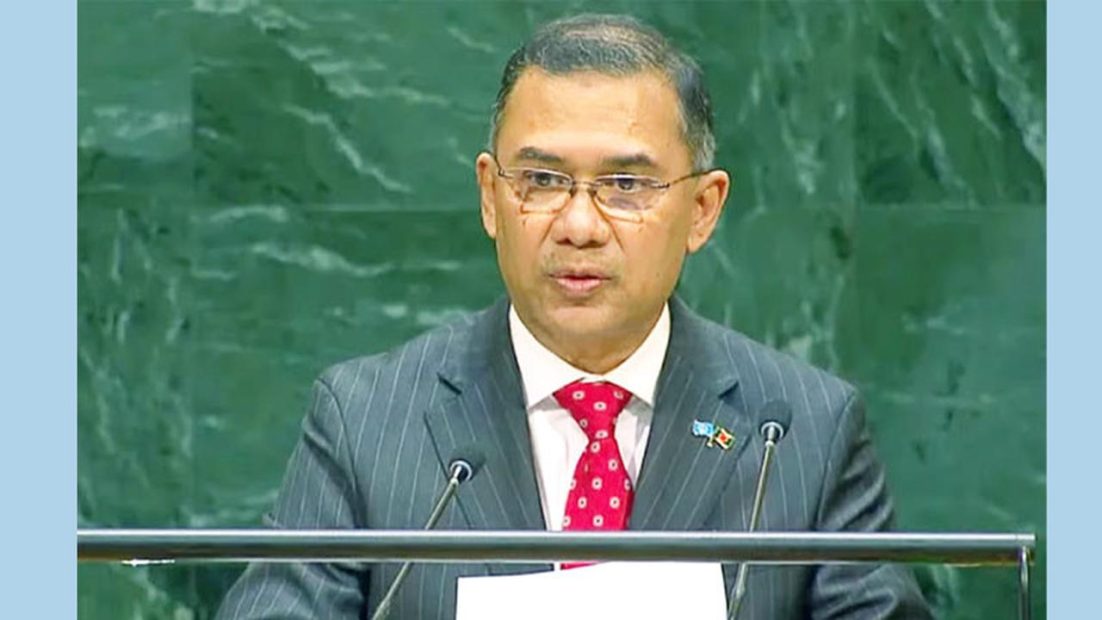
A notable recent development in relations with the United States was the participation of Prime Minister Tarique Rahman and Dr Zubaida Rahman in a dinner hosted by US President Donald Trump and First Lady Melania Trump. The event was held in New York on September 22 on the occasion of the 81st session of the United Nations General Assembly. A photograph released by the Prime Minister’s Office was later shared by the US Embassy in Dhaka through its official channels. The event is significant as a visible demonstration of cordial engagement between Bangladesh’s leadership and the US leadership. Such high-level contact can create a favourable environment for subsequent dialogue. From a constructivist perspective, interaction between states contributes to shaping identities, perceptions and trust. The Prime Minister’s international presence can be assessed in this context. In New York, his remarks to investors also highlighted the importance of deepening Bangladesh’s connections with the world’s major economies. By highlighting the existing trade arrangements with the United States and initiatives for partnership with the European Union, he brought Bangladesh’s economic potential to the forefront of international discussion.
Deeper cooperation with the European Union is also increasingly evident. On September 16, the two sides exchanged views on moving towards the formal launch of negotiations for a free-trade agreement to strengthen long-term economic relations. Later, on October 4, EU Ambassador Michael Miller said the bloc was exploring the possibility of a free-trade agreement with Bangladesh. He also expressed an interest in continuing cooperation as Bangladesh prepares to graduate from the least developed country category. This progress has created an important avenue for early preparation for future market relations.
Positive assessments of Bangladesh’s economy by international representatives have made this diplomatic context even more meaningful. In a report published on October 4, EU Ambassador Michael Miller was quoted as saying that Bangladesh could become one of the world’s top 30 economies. The phrase “could become” is important. It represents a positive assessment of Bangladesh’s future capacity, whose realisation will depend on productivity, investment and institutional development. The effectiveness of economic diplomacy lies in connecting this potential with international partnerships.
The significance of Miller’s assessment lies in viewing Bangladesh through the lens of its long-term economic potential. Such a position can create a favourable environment for business and investment discussions. However, effective institutions are essential to sustaining that confidence. Miller also stressed the importance of strong institutions and effective oversight to attract investment and create employment. His positive assessment should therefore be viewed alongside the need to strengthen Bangladesh’s domestic capacity. When diplomatic engagement and institutional development reinforce each other, economic partnerships become more sustainable.
The economic importance of relations with the United Kingdom was also clear in the same report. According to British High Commissioner Sarah Cook, 92 percent of Bangladesh’s products will continue to receive duty-free access to the UK market after graduation from the least developed country category. The report also noted that existing benefits would continue during a three-year transition period. This message is important for Bangladeshi exporters because predictability over the post-graduation market regime supports business planning. Such benefits are significant in preparing to maintain the competitiveness of garments and other products.
The United Kingdom is no longer a member of the European Union, meaning the two partners’ trade regimes must be considered separately. For Bangladesh, strong relations with both expand opportunities for markets and cooperation. Sarah Cook’s remarks provide a positive message on the continuity of existing trade benefits. Rather than portraying these benefits as a newly secured agreement by the Prime Minister, it is appropriate to assess them as an effective opportunity for his government’s economic diplomacy. To capitalise on this opportunity, product quality, supply reliability and production capacity will play crucial roles.
Another notable piece of information concerning Bangladesh’s economic future is a forecast cited on the basis of IMF data that the country’s GDP could reach $677 billion by 2030. This is a projection of the future economy, not an account of current achievements. Likewise, the prospect of becoming a top-30 economy and the $677 billion forecast should be treated as separate assessments. Nevertheless, both highlight the positive dimension of international discussion surrounding Bangladesh’s economic potential. Realising that potential will require a combination of investment, skills, technology and stable policies.
The significance of these relationships can be understood through Robert Keohane and Joseph Nye’s concept of “complex interdependence.” Contemporary diplomacy operates through multilayered connections involving trade, technology, education and institutional cooperation. These areas can mutually reinforce Bangladesh’s relations with the United States, European Union and United Kingdom. International engagement creates opportunities for markets and investment; efficient institutions and a productive economy at home turn those opportunities into tangible outcomes. The lasting value of the Prime Minister’s diplomatic initiatives will ultimately be determined by this coordination.
The positive aspects of Prime Minister Tarique Rahman’s recent diplomacy include a clear declaration of national interests, high-level cordial engagement with the United States and substantive discussions on deeper economic relations with the European Union. Michael Miller’s assessment of Bangladesh’s potential, Sarah Cook’s message on duty-free market access and the IMF-based forecast all highlight the multifaceted economic significance of these initiatives. Together, they indicate a highly promising international environment for Bangladesh. Turning this favourable environment into sustainable growth in exports, employment, technological advancement and living standards will transform his diplomatic foresight into a solid national success, with one principle at the centre of every decision: Bangladesh first.
Author: Political analyst and teacher, University of Dhaka.