Disciplined Vehicles at Traffic Signals
Eklas Haque
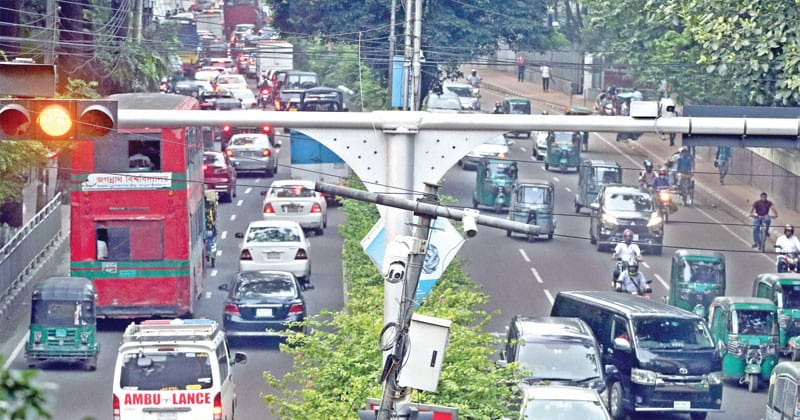
Artificial Intelligence (AI) cameras are changing the traditional chaotic image of drivers in Dhaka disobeying traffic signals. These devices were first used to reduce traffic congestion. They identify signal violations and automatically file complaints against those who do so. The DMP’s Additional Police Commissioner, Md. Anisur Rahman, highlighted this change by saying, ‘It’s difficult to break individuals out of old habits and bring them into discipline. Nonetheless, this approach has been well welcomed and widely accepted by the people. Nobody is opposed to it’.
Visits to important crossroads, such as Bangla Motor, Matsya Bhaban, and Kakrail, show that drivers, including private vehicle owners and motorcyclists, now follow traffic signals and stop at stop lines. Arafat Hossain Bhuiyan, a private vehicle driver, echoed this shift, saying, ‘Drivers driving on highways equipped with these sophisticated cameras are altering their thinking. Drivers are paying attention to AI signals out of concern about penalties and an increasing feeling of alertness. Dhaka’s traffic congestion would be reduced, and vehicle mobility would be more controllable if this technology is extended to all roadways’.
Following orders from the Prime Minister’s Office, high-tech AI automated traffic lights and cameras are being installed at 50 important traffic crossings throughout Dhaka’s two city corporations with a budget of 100 crore BDT to scale up these activities. Manik Miah Avenue, Mirpur-10, and Gulshan-1 are only a few of the 28 signals in the Dhaka North City Corporation (DNCC) region, which has a total value of almost 55 crore BDT. The DNCC area places a strong emphasis on modernising civil works and software integration.
In the meanwhile, 22 signals total around 44 crore BDT, are included in the Dhaka South City Corporation (DSCC) region, which includes places like Science Laboratory, New Market, and Paltan Mor. BUET offers critical technological and civil works assistance for this modernisation project across both zones, ensuring a smooth installation, server connectivity, and automated data processing at each junction.
Smaller unregistered cars continue to be a significant problem despite these advancements. Easy-bikes and autorickshaws that run on batteries often avoid automatic ticketing since they don’t have formal registration information, making it challenging to enforce the law. Addressing this backlog, Dr. Hadiuzzaman, a Professor at BUET, noted that Dhaka’s traffic lights are undergoing a digital transformation. Driver compliance is essential to these signals’ modernity and efficacy. Battery-powered autorickshaws continue to be a significant obstacle to traffic discipline, and it is challenging to take legal action against them. No advanced technology will function if drivers disregard signals.”
To fully benefit from Dhaka’s AI-driven traffic management system, it is ultimately necessary to guarantee thorough road discipline, increase network coverage, and bring unregistered cars under digital registration. To permanently alleviate the capital’s traffic problems, stakeholders emphasise that technology must be integrated holistically with strict road control, car registration, and driver licensing.