
Electric Trains to Run on Dhaka-Chattogram Route: PM in Parliament
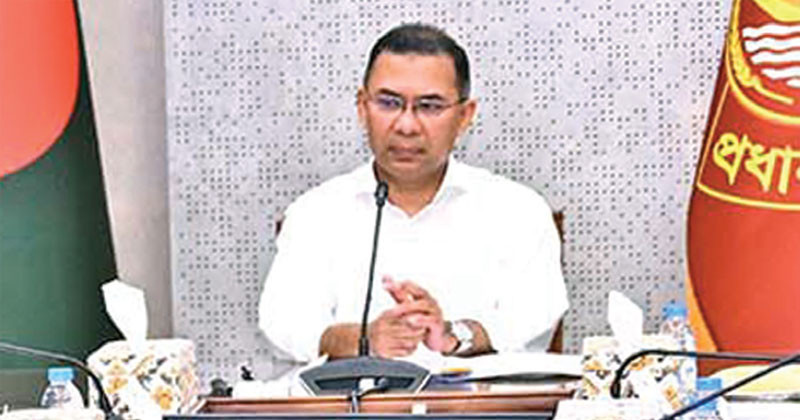
The government has taken an integrated initiative to reduce travel time and distance on the Dhaka-Chattogram route, considered the lifeline of the country’s economy. As part of the initiative, the government plans to convert the entire railway route into a dual-gauge double line, construct the Dhaka-Cumilla chord line and introduce electric trains. The design for installing electric traction has already been finalised.
Prime Minister Tarique Rahman said this in response to a question from Chattogram-12 MP Mohammad Enamul Haque during the question-answer session of Parliament yesterday. Speaker Hafiz Uddin Ahmed presided over the session. In his question, Mohammad Enamul Haque asked whether the government had any plan to introduce an electric (bullet) train service between Dhaka and Chattogram to reduce travel time and distance, and if so, when the plan would be implemented.
In reply, Prime Minister Tarique Rahman outlined the government’s three-level master plan for the Dhaka-Chattogram corridor. Regarding the operation of electric trains on the Dhaka-Chattogram route, the prime minister said the feasibility study and detailed design for installing electric traction on the corridor have already been completed.
Asked when the service would be launched, he said a detailed action plan and schedule would be prepared after securing the necessary funding for the project. The project will be implemented once funding is secured. Once completed, the project will make it possible to operate electric trains on the route. This will increase the average speed of trains and significantly reduce travel time.
Dhaka-Cumilla Chord Line
Regarding reducing the railway distance, the Leader of the House said an initiative has been taken to construct a direct “chord line” from Dhaka to Cumilla to reduce the distance of the Dhaka-Chattogram corridor. The feasibility study and detailed design for the chord line are currently underway. Once implemented, the project will reduce the distance between the two cities and increase the average speed of trains. As a result, people will be able to travel between Dhaka and Chattogram in less time.
New LNG Terminal in Deep Sea, Oil and Gas Exploration in 26 Blocks
Meanwhile, in response to separate questions from reserved women’s seat-17 MP Sultana Ahmed and Meherpur-1 MP Tajuddin Khan, Prime Minister Tarique Rahman said the government has taken a major plan to establish a new LNG terminal in the deep sea and drill 150 new wells by 2030-31.
At the same time, an international bidding round was invited on May 24 to appoint international companies for oil and gas exploration and extraction in 26 offshore blocks. The deadline for submitting bids has been set for November 2026. In addition, steps have been taken to formulate the “Bangladesh Onshore Model PSC 2026” to attract international investment in oil and gas exploration onshore.
The prime minister also outlined the government’s short- and long-term master plan for energy security, which combines alternative sources and renewable energy to ensure emergency energy security and uninterrupted industrial production. Sultana Ahmed, in her question, pointed out that the temporary closure of an LNG terminal in July 2026 caused a daily shortage of around 450 million cubic feet in the national gas supply and disrupted industrial production.
She asked whether the government would take measures to ensure alternative sources of gas supply, LNG reserve capacity, priority supply based on industrial areas and emergency energy planning so that the industrial sector does not face major losses during such sudden crises in the future.
In reply, the Prime Minister said the government has planned to drill 150 wells by 2030-31 to ensure that the industrial sector does not face gas shortages during sudden or temporary crises. At the same time, a total of 4,500 line kilometres of two-dimensional (2D) and 4,200 square kilometres of three-dimensional (3D) seismic surveys are being conducted to explore domestic gas sources.
Regarding meeting future gas shortages and strengthening LNG infrastructure, the Prime Minister said the country’s two existing floating LNG terminals can currently supply an average of around 935 million cubic feet of gas per day. To deal with sudden shortages in the future, work is underway to establish a new floating LNG terminal at Kutubjom in Maheshkhali and a land-based LNG terminal at Matarbari.
Government Takes Tough Stance to Prevent Extension of Development Projects
In response to a question from Cumilla-10 MP Md Mobasher Alam Bhuiyan, Prime Minister Tarique Rahman said the government has taken a strict position to prevent repeated extensions of the duration and cost of government development projects. To address the problem, the government has taken several major measures, including close monitoring from project formulation to implementation, ensuring accountability and taking disciplinary action against those responsible.
During the session, Cumilla-10 MP Md Mobasher Alam Bhuiyan asked the prime minister whether the government had issued any directives to prevent repeated increases in project duration and cost and, if so, what plans were in place to monitor their implementation.
In reply, Prime Minister Tarique Rahman said extensions in the duration and cost of government development projects in Bangladesh are generally not caused by a single factor. Rather, several weaknesses in project formulation, approval, land acquisition, financing, procurement and management are interconnected and create the problem. He said after these issues came to the attention of the current government, the specific reasons behind the increase in project duration and cost were identified. The prime minister also outlined 13 measures taken by the government to resolve the problem.
20% of Electricity to Come from Renewable Energy by 2030
In response to a question from Meherpur-1 MP Md Tajuddin Khan, Prime Minister Tarique Rahman said the government is reducing dependence on imported fuel to meet the country’s growing electricity demand and ensure energy security. As an alternative, renewable energy has been identified as a priority sector. The government has set a target of generating at least 20 percent of the country’s total electricity from renewable sources by 2030 and 30 percent by 2040.
He said the government has already formulated the “National Renewable Energy Development Strategy” for the 2026-2030 period. Based on potential and practical considerations, specific targets have been set for the power sector up to 2030. These include generating 5,500 megawatts from rooftop solar power, 4,500 megawatts from ground-based solar power and 450-550 megawatts from wind, waste, hydropower, floating solar and other technologies.