
Empowering Ordinary People Is Essential for Peace in the Hills
(Part Two)
Securing the Border
The Chittagong Hill Tracts share borders with Myanmar’s Rakhine and Chin states. The Myanmar government has no control over Rakhine, most of which is controlled by the Arakan Army, an armed rebel group. Most of Chin State is controlled by the Chin National Front.
The Myanmar military has repeatedly launched operations to regain control of the two states, while rebel groups have continued armed attacks against the military. As a result of these clashes, large quantities of advanced weapons and ammunition from the Myanmar military have fallen into the hands of rebel groups.
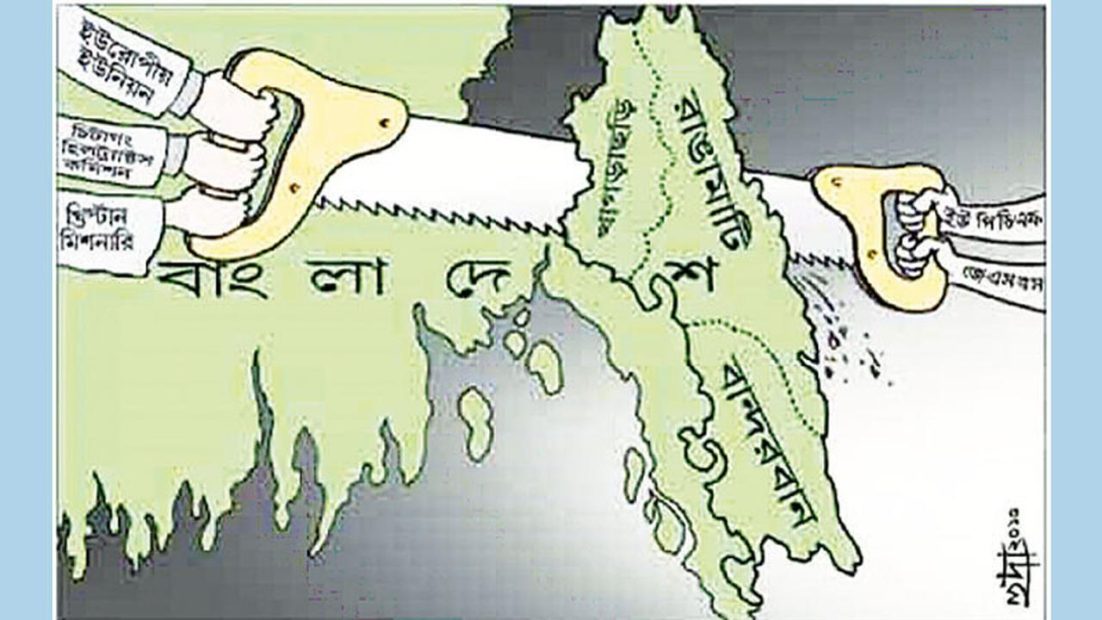
Much of Bangladesh’s border with these two states is remote and difficult to access. Taking advantage of this, armed groups on both sides allegedly engage in smuggling weapons, drugs and other illegal goods. After the fall of the former government in Bangladesh during the July 2024 mass uprising, the chief minister of Mizoram reportedly proposed during a visit to the United States in September that a larger Kuki-Chin state be formed covering adjoining areas of India, Myanmar and Bangladesh.
Earlier, the Kuki-Chin National Front (KNF), an armed organisation of the Kuki-Chin community, was formed in Bandarban. Its violent activities have already been witnessed by people across the country. Meanwhile, a senior member of the Tripura royal family has reportedly threatened from across the northwestern border of the Chittagong Hill Tracts to establish a “Greater Tipraland” by taking control of the Chittagong Hill Tracts, as well as Chattogram and Cox’s Bazar.
The author also alleges that leaders of India’s ruling BJP and its parent organisation, the RSS, have repeatedly threatened to cut off the “Feni Chicken Neck” and take control of Chattogram, the Chittagong Hill Tracts and Cox’s Bazar.
Leaders of different communities, including Chakma and Tripura people living in India, also frequently allegedly encourage instability in the Chittagong Hill Tracts. The author claims that after an incident occurs in the region, they exaggerate it and raise complaints with the Indian central government and spread allegations against Bangladesh at international forums, including the United Nations.
To keep the Chittagong Hill Tracts safe from these challenges, border security must be strengthened. Border roads should be completed as quickly as possible, while communication networks within the three hill districts should also be improved.
The number of Border Guard Bangladesh (BGB) Border Outposts should be increased. As the Chittagong Hill Tracts are remote and various armed groups operate both inside and outside the region, a permanent army presence should be maintained in difficult-to-reach areas. Continuous surveillance along the border should also be maintained using drones and other advanced technologies.
Sovereignty Must Come First
The author says reactionary groups have remained active in the Chittagong Hill Tracts for centuries, including during the Sultanate, Mughal and British periods. During the partition of India and Pakistan in 1947, Indian flags were raised in Rangamati and Myanmar flags in Bandarban. Pakistani troops removed the flags on August 17. The author says August 17 is still observed as a “Black Day” in parts of India, including Tripura.
Most people in the region did not support Bangladesh’s Liberation War in 1971. Although a small number took part in the war, a large section of the Chakma community, led by Chakma Circle Chief Tridiv Roy, sided with the Pakistani army. A few days after Bangladesh became independent, regional leaders came to Dhaka demanding autonomy. Later, they secretly formed the armed Shanti Bahini, while publicly joining the Baksal political system.
After the political change of 1975, when General Ziaur Rahman came to power following the Sipahi-Janata uprising, they again demanded autonomy. Ziaur Rahman reportedly asked them for time, saying that he would discuss the matter with all concerned once the country’s situation became stable. However, the author says they did not wait and instead began an armed campaign against the state.
At the beginning of the Liberation War, Ziaur Rahman declared independence from Chattogram Radio Station. He then travelled through difficult hill routes via Rangamati, Naniarchar and Mahalchhari to Ramgarh before crossing the Feni River into Tripura.
The Chittagong Hill Tracts was also part of Sector 1 during the Liberation War, and Ziaur Rahman was the sector commander. The author says he was therefore fully familiar with the region’s geography, difficult terrain, communities and border situation. Following the political change of August 15, he also understood the position of neighbouring India.
For these reasons, the author argues, Ziaur Rahman gave priority to ensuring state sovereignty in the Chittagong Hill Tracts. He also focused on the region’s demographic situation and reorganised the army to strengthen security.
At the same time, he undertook various development programmes for local communities, including the establishment of a Tribal Convention, a development board and cultural institutes. He also frequently visited remote areas of the Chittagong Hill Tracts and established direct contact with people from different professions and social groups.
While Santu Larma was in prison on charges of treason, Ziaur Rahman appointed his wife to a government job as an example of humanitarian consideration. In the hope of resolving the crisis through dialogue, he also released Santu Larma from prison as a gesture of sincerity. However, according to the author, Larma did not maintain contact with the government after his release.
The author argues that anyone experienced and committed to the country would give one answer to the question of how Bangladesh’s sovereignty has remained intact in the Chittagong Hill Tracts: the initiatives taken by President Ziaur Rahman. He says that even today, establishing peace in the hills requires policies and strategies similar to those adopted by the late President Ziaur Rahman.
Ending Ethnic Discrimination
Under existing laws, two broad categories of people live in the Chittagong Hill Tracts: indigenous people and non-indigenous people. According to the 2022 census, the three hill districts have a combined population of 1,842,815. Of them, 922,598, or 50.06 percent, are Bengali or non-indigenous people, while 920,217, or 49.94 percent, are non-Bengali or members of small ethnic groups.
Under the law, the chairmen of the three hill district councils must be from indigenous communities. Of the 33 members of each council, 22 must be from indigenous communities and only 11 can be non-indigenous. The situation is similar in the Regional Council. Indigenous students receive quotas in universities, medical colleges and other higher education institutions across Bangladesh, including institutions in the Chittagong Hill Tracts. After completing higher education, they also receive priority in government recruitment in the hill tracts and quotas in government recruitment across the country.
The author argues that non-indigenous Bengali people living in the same difficult environment and studying in the same educational institutions do not receive similar quotas in higher education or recruitment. He claims they are also denied what he considers fair representation in the district and regional councils. The author further claims that indigenous people are exempt from income tax, giving them an advantage in contracting and other businesses, while Bengali people are required to pay income tax. As a result, he says, some Bengali businesspeople have to operate under licences rented from members of indigenous communities to remain competitive.
The author says the list of alleged ethnic inequalities between indigenous and non-indigenous people in the Chittagong Hill Tracts is extensive. He also argues that discrimination exists within indigenous communities themselves. The term “indigenous” does not refer to a single group but encompasses around 12 to 13 different communities.
According to the author, the Chakma are the largest and most influential group. They have a relatively large number of highly educated people and a strong presence across government ministries and departments.
The Marma and Tripura communities come next in terms of influence, although the author says they remain far behind the Chakma. Other communities, including Khyang, Tanchangya, Murong, Khumi, Bom, Pangkho and Lusai, remain largely marginalised.
The author argues that the benefits of indigenous quotas and preferential treatment in higher education and government recruitment often do not reach these smaller communities because members of the more advanced Chakma community take advantage of the opportunities first.
He concludes that expecting communal harmony in the Chittagong Hill Tracts while such discrimination exists between indigenous and non-indigenous people, as well as between relatively advanced and marginalised indigenous communities, is unrealistic. These forms of ethnic discrimination must be eliminated, he argues, and everyone should receive equal status, opportunities and benefits as citizens of the state.
(To be continued)
Author: Researcher and Journalist on Chittagong Hill Tracts Affairs
Email: sayedibnrahmat@gmail.com










