
If BNP says ‘Bangladesh first,’ why hand ports to foreigners?
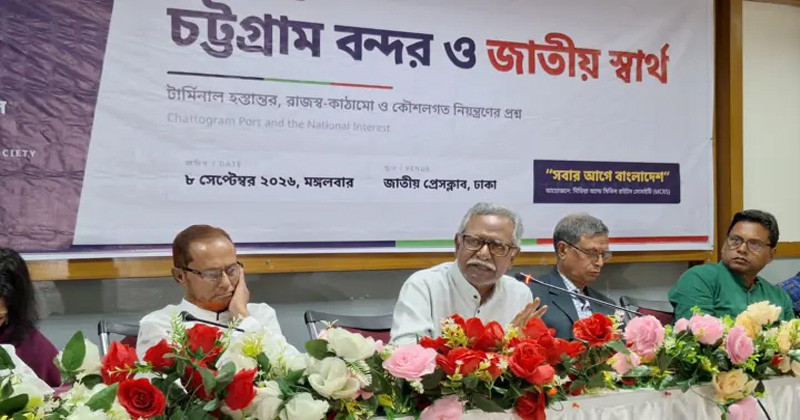
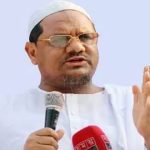
Professor Mr. Anu Muhammad, Member Secretary of the National Committee to Protect Oil, Gas, Mineral Resources, Power and Ports, has said that handing over the country’s ports — the main driving force or “heart” of keeping the national economy running — to foreign companies in any way poses a major threat to national sovereignty and the economy. He said there could be no comparison to handing over to others a sector on which the entire economy depends.
He made these remarks at a roundtable discussion titled “Chittagong Port and National Interest,” organized by the Media and Civil Rights Society at the National Press Club on Tuesday (September 8).
Professor Mr. Anu Muhammad said the country’s navy and private companies have a proven national capability to successfully operate ports. With proper planning, he said, it would be possible to build a complete foundation of national capability by operating ports at the state level — something no government has implemented effectively in the past.
Criticizing the government’s policy stance, he said that in Bangladesh, they always hear the government say “Bangladesh First,” but in practice, it appears to be “Bangladesh Last.” He said it seems that imperialist interests, or U.S. interests, come first. He warned that if this trend continues without giving importance to the minimum expectations of the people and national interest after the long struggle and mass uprising, it would bring extreme ruin upon the nation.
Noting that bringing in foreign companies carries deep political and military dimensions, Professor Mr. Anu Muhammad said that to make the port more efficient and capable, reforms in customs, bureaucracy, and infrastructure are needed rather than dependence on foreign powers. He called for the kind of resistance and movement led in the past by Chittagong Port’s workers and employees — which had saved the country from ruin — to continue in the future to protect national interest.
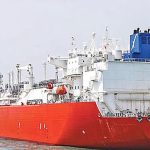
In the discussion, Dhaka University teacher, economist, and researcher Dr. Moshahida Sultana Ritu said that Bangladesh is continuously developing new ports and terminals one after another, including the Matarbari deep-sea port, Bay Terminal, and the APM Terminals at Newmooring and Laldia. She said the country’s current container-handling capacity is about 4 million TEUs, with a plan to raise it to 8.6 million TEUs by 2035. However, she questioned how much of this massive capacity would actually be needed, since due to COVID, the Ukraine war, and the current global crisis, expected economic growth and import-export volumes are not increasing. At the same time, she said, it must also be considered that handing new terminals over to foreign operators means future profits will flow out of the country.
She said the core problem is not merely a shortage of port capacity; delays in customs clearance, congestion of containers and trucks, and limitations in rail connectivity are also major crises. She said that building new terminals without solving these problems would only increase capacity while the backlog remains. Similarly, she said, increasing dependence on LNG amid the energy crisis would raise production costs, reduce export competitiveness, and could also lower import-export demand. She said that, taking past experience into account, it is essential to thoroughly review — in coordination with the country’s future import-export, energy, customs, and transport infrastructure — whether such a large capacity is actually needed before expanding port capacity.
Mr. Abdullah Al Kafi Ratan, General Secretary of the Communist Party of Bangladesh (CPB), said that protecting the port’s interests cannot be viewed merely through income-expenditure calculations; it also involves questions of national interest and public ownership of resources. He said initiatives are being taken to transfer various national assets, including profitable terminals, to foreign and private ownership. He said national interest means the interest of the people, so it is essential to resist the tendency seen in both past and present governments to transfer public assets to foreign entities or private ownership.
He said the Communist Party, the Democratic United Front, and the anti-imperialist, anti-war alliance are campaigning against handing over the country’s resources to foreigners and against decisions harmful to national interest made in the name of trade agreements. He said this movement, led for a long time by Professor Mr. Anu Muhammad, will continue in the days ahead.
Mr. Harun Or Rashid, General Secretary of the Maulana Bhashani Parishad, said that opposition to handing Chittagong Port over to a foreign entity is not merely a political position but also involves questions of national security and public ownership of resources. He said various countries have set limits on foreign participation in port operation and ownership, and that even in the United States, initiatives to hand over several ports to foreign operators were blocked in the face of Congressional opposition. Yet in Bangladesh, various terms of the agreement are not even being disclosed before public assets are handed over to foreigners. He said the public has the right to know to whom, and under what conditions, public assets are being given.
Highlighting the long history of Chittagong Port, he said the port has existed in this region for nearly two thousand years, and the foundation of the modern port system was laid in 1887. He said that since the port has operated for such a long time without foreign investment, the government must answer why foreign investors are needed now.