
Lack of service coordination causes public suffering
Eklas Haque
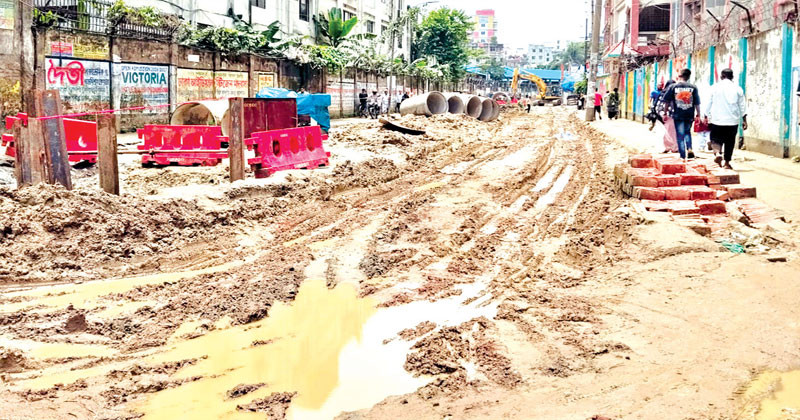
Uncoordinated development efforts and fragmented service delivery by public agencies continue to increase public suffering in Dhaka. Important companies that deal with trash management, road upkeep, public transit, water supply, sewage, and telecommunications run separately without coordinated planning. Shortly after large building projects are finished, this persistent misalignment results in frequent road excavations, extreme traffic congestion, misappropriation of public funds, and impaired infrastructure quality.
Due to this operational mismatch, city inhabitants’ main complaints are waterlogging and disorganised traffic management. Widespread canal encroachments, drain obstructions, and rapid, unplanned urbanisation exacerbate urban floods during the monsoon, while poorly coordinated project execution harms recently enhanced drainage systems. Experts stress that coordinated design spanning subsurface utility lines that supply water, gas, electricity, and telecommunications as well as surface infrastructure, such as roads, walkways, and transportation networks, is necessary to permanently address these problems.
Municipal governance, financial efficiency, and public perception are all severely impacted by agency decoupling, as local authorities recognise. Dhaka South City Corporation (DSCC) Administrator Md. Abdus Salam addressed the issue by emphasising the necessity of coordinated execution, saying: ‘Coordination among Dhaka’s service providers is essential; when agencies like WASA dig up roads, the liability and public criticism ultimately fall on the City Corporation. We are thus working to carry out these tasks in a cohesive way’.
Experts in planning and disgruntled locals need swift institutional change to ensure interagency coordination and get rid of redundant, damaging projects. The Institute for Planning and Development (IPD) Executive Director, Prof. Dr. Adil Muhammad Khan, emphasised the need for stringent synchronisation and quality control, saying, ‘Electricity, gas, water, and telecommunications agencies must be synchronised so that the same street is not dug up repeatedly. Redundant road cuttings will be greatly decreased by fostering efficient collaboration among utility providers’.