MRT Line-1 Set to Transform Dhaka with Underground Metro Network
Dhaka is a city of daily rush and traffic jams. When morning comes, crowds of people fill the roads. People are stuck on the roads for hours on the way to offices, schools and businesses. Even short trips take a long time. Work hours are lost, economic damage grows and city dwellers suffer.
In this city of suffering, a new and modern chapter is being added to public transport. Metro Rail Line 1 is being built as a mix of underground and elevated tracks. Project people say that once it is done, Dhaka’s transport system will change. Pressure on the roads will fall, travel time will be saved and public transport capacity will grow.
Road Transport and Highways Division Secretary Dr. Mohammad Ziaul Haque said a new horizon will open in the capital’s public transport with MRT Line 1, the country’s first underground metro rail. He called the signing of contracts for four key packages a significant milestone for the project. He said easing traffic jams, cutting travel time and giving citizens modern and quality public transport are top priorities of the government. To reach this goal, steps have been taken to expand the metro rail network and build a safe, eco friendly and timely urban transport system.
He said construction will follow the labor law and other relevant laws of the country, with top safety and quality. The focus is on finishing the work on time. The temporary suffering of ordinary people from construction must not be prolonged. Environmental protection must be ensured, and the welfare of people living near the project area must get top priority. He said clear, steady and effective coordination and communication among the employer, engineers and contractors is needed for success.
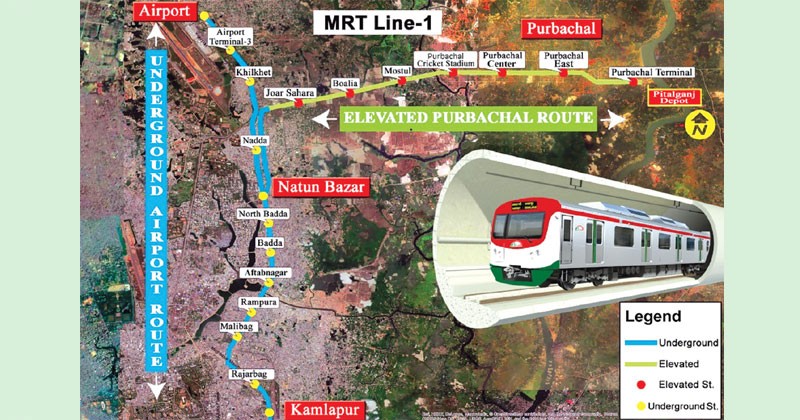
Project sources say MRT Line 1 will have an airport route and a Purbachal route. The airport route starts at Hazrat Shahjalal International Airport. It then goes through Airport Terminal 3, Khilkhet, Jamuna Future Park, Notun Bazar, North Badda, Badda, Hatirjheel, Rampura, Malibagh and Rajarbagh, and ends at Kamalapur. This fully underground route is 16.5 kilometers long and will have 12 stations. At Notun Bazar station, it will connect with MRT 5.
The Purbachal route of MRT 1 runs from Notun Bazar through Jamuna Future Park and Bashundhara. It then passes Police Officers Housing Society, Mastul, Purbachal West, Purbachal Center and Purbachal Sector 7, and reaches Purbachal Terminal. This route is about 10 kilometers long. It has 9 stations in total, including the underground stations at Notun Bazar and Jamuna Future Park that are part of the airport route. Seven stations, from Bashundhara to Purbachal Terminal, will be elevated.
Contracts for four packages of the capital’s first underground metro rail project, MRT Line 1, have already been signed. The contracts cover tunnel and station building, track laying, electrical infrastructure, signaling and telecommunication. The project is funded jointly by the Bangladesh government and the Japan International Cooperation Agency (JICA). The contract signing is seen as an important step for the infrastructure of the country’s first underground metro rail.
Two of the four packages cover tunnels and stations for the underground rail. Under Contract Package CP 04, a 4.447 kilometer underground track will be built from the north end of Rampura Underground Station to Notun Bazar station. Under CP 06, a 5.182 kilometer underground track will be built from the north end of Nadda Underground Station to the airport station. Together, these two packages will build 9.629 kilometers of underground route.
Under CP 09, the track works of MRT Line 1 will be done. This covers rails, turnouts, points and crossings, along with electrical infrastructure. Under the fourth package, CP 10, the signaling and telecommunication systems needed to run trains will be set up. These include a Communication Based Automatic Train Control System, a fiber optic transmission network and an LTE radio communication system. Platform screen doors and an Enterprise Resource Management System (ERMS) will also be installed.
DMTCL Managing Director Mr. Md. Shawgatul Alam said moving utility lines is a very important step to keep the main construction on schedule. To finish it fast and in a planned way, service providers and project offices must work closely together in the field. He said traffic must keep moving normally and civic services must stay on during the utility shifting.
Japan’s Ambassador to Bangladesh, Mr. Saida Shinichi, said the long friendship, mutual trust and development cooperation between Bangladesh and Japan will continue. He gave special thanks to the Bangladesh government for ending the stall in the metro rail project and restarting and speeding up work. He said cooperation between the two countries will continue in future. Japan is keen to stand by Bangladesh in its infrastructure development through mutual cooperation and partnership.
Professor Dr. Hadiuzzaman of the Department of Civil Engineering at Bangladesh University of Engineering and Technology (BUET) said a road based transport system cannot meet future travel demand in a crowded city. So the metro rail network needs to expand. When MRT 1 starts running, this corridor will get a fast public transport option. Large numbers of passengers can travel in less time by metro rail. It may also reduce dependence on private cars.
He said the benefits will come only when the project is finished on time and at the set quality. When MRT Line 1 opens, it will give a new chance to handle this pressure. The line may become especially important for working people, students, businesspeople and airport passengers.