Necessity of Basin-Based Water Management
Jamaluddin Bari
A massive glacier broke away from Himalayan gorges last Tuesday, leaving thousands of tons of rock and debris rushing at breakneck speed, causing a sudden and catastrophic landslide and flood that left hundreds dead and foreign tourists missing in the mountainous border region between Nepal and Tibet. The Trishuli, Bhotekoshi, and Lende Khola rivers swelled by 20 to 30 feet due to glacier-melt water, burying nearby communities under several feet of mud and sweeping away homes, bridges, and infrastructure on both sides. Images of the event rapidly went viral on social media across the globe.
Along with the Nepalese army and foreign rescue workers, nearby countries and the international community, including China, India, and Bangladesh, quickly offered assistance for rescue operations, relief distribution, and the rehabilitation of displaced populations, emphasizing the unavoidable reality of transboundary geographical interconnection in the geomorphology of the South Asian subcontinent. The primary source of major rivers in Nepal, China, India, Pakistan, Bangladesh, and Myanmar is the underground springs that come from glaciers and glacial lakes along the Nepal-Tibet border. This shows that denying any group of people or territory access to freshwater sources purely through political borders could end up in disastrous regional calamities.
Since the 1970s, environmental activists and geologists have warned about the threat of Himalayan glacier collapses due to global warming and greenhouse gas emissions. However, leaders such as Mr. Donald Trump in the United States condemned climate change as a scam due to shortsighted capitalist views, and industrialized nations’ failure to implement Kyoto Protocol proposals placed regional stability in danger. The United States first committed $500,000 in aid to the devastated people of Nepal, then increased it to $3.5 million, which is less than the cost of a single Tomahawk missile and no more than 10% of its daily costs in the Iran war.
Critical regional challenges, such as the lack of effective regional security and water management initiatives in opposition to hegemonic control regimes over shared rivers, have been neglected for decades under a facade of Sino-Indian conflict and Indo-Pacific geopolitics. While the growing number of industrial factories, dams, hydroelectric plants, and military installations around the Himalayas has negatively impacted ecological stability, India’s centralized control over the water flows of international rivers has caused serious ecological disasters for downstream nations like Bangladesh and India.
The Himalayan, Alpine, and Andean mountain ranges, as well as major global rivers, are not governed by monopolistic hegemony by a single country; however, rivers flowing through India are uniquely subject to hegemonic control and unilateral water withdrawal, making Bangladesh the most cruel victim of this water dominance. Bangladesh’s rivers have lost half of their accessibility over the past 50 years, and the construction of upstream dams has reduced the water-holding capacity. As a result, hundreds of distributaries and wetlands are drying up, threatening the country’s long-term population survival, food security, and environmental stability.
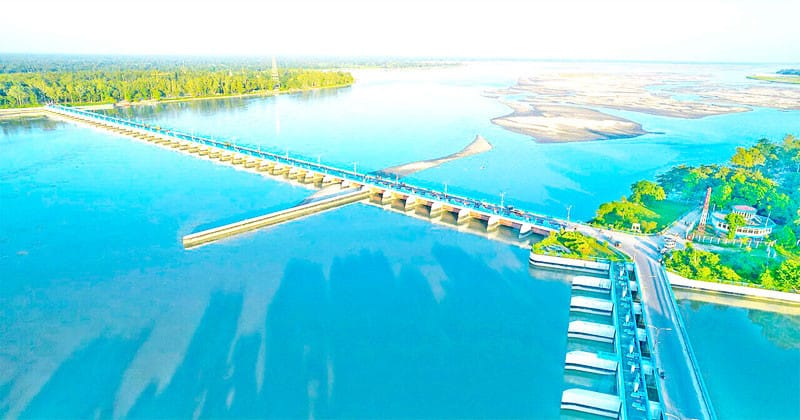
The Teesta and Ganges water treaties are not a choice for India, but for decades, India utilized internal political issues to deprive Bangladesh of its essential water share, in contrast to the Indus Waters Treaty, which, despite several wars and recent political shifts following Pakistan’s defeat in Operation Sindhur, has never been harmed by India or Pakistan. The Bangladesh Liberation War offered India the chance to officially open the upstream Farakka Barrage in April 1975 under a 40-day trial run without turning back, dismissing rumors that had been going around the world since the barrage’s beginnings.
After taking office, President Ziaur Rahman pressured India to sign a Ganges water treaty with a guarantee clause by establishing fair discussions on bilateral issues and being the first to internationalize the Ganges water-sharing issue at the UN. However, the following governments were unable to sustain this progress until Ms. Sheikh Hasina signed a 30-year treaty in 1996 that ultimately failed to include a guarantee provision. Water was used as a pressure tool when Ms. Sheikh Hasina fled to India. On August 5, one week after the July Revolution, the Dumbur Barrage on the Gomati River in Tripura was opened, causing record floods in Feni, Noakhali, Comilla, and the neighboring regions.
When Indian High Commissioner Mr. Dinesh Trivedi arrived in Bangladesh, he made a coercive suggestion about unifying the soil, sky, and atmosphere of both countries. Given that India builds barbed-wire fences, suspends visas, erects trade barriers, and cuts off water supplies while promising mutually beneficial ties, the public views this as a dishonest statement. Pressures after August 2024 have failed, and the independent foreign policy announced by the Dr. Muhammad Yunus-led interim government reflects the desires of 90% of Bangladeshis. PM Tarique Rahman’s elected government is determined to fulfill people’s expectations through an India First policy that follows Shaheed President Zia’s path.
Historically, while Mr. Sheikh Mujib failed to understand that the Farakka Barrage was a death trap for Bangladesh, 94-year-old Mawlana Abdul Hamid Khan Bhashani realized it deeply and successfully brought the issue to international media attention in May 1976 through the historic Farakka Long March, demonstrating that had a water-sharing agreement been concluded in light of the 1977 Memorandum of Understanding signed with Shaheed President Ziaur Rahman, Bangladesh’s rivers would not have reached where they are now. It is crucial to start discussions and complete a draft of a much-needed new water treaty before the 30-year Ganges Water Treaty comes to an end in December. This would go beyond traditional water flow concepts at the Farakka point and move toward a trilateral basin-wide water management framework involving Nepal, India, and Bangladesh.
Just as China’s Yarlung Tsangpo project concerns India about the Brahmaputra and Jamuna rivers, basin-wide management is still essential. China’s interest in and capacity to carry out Bangladesh’s Delta Plan and Teesta Mega Project indicate a huge potential. Bangladesh’s geopolitical security and water management are purely domestic issues. In the same way that India has strategic security agreements with Israel, Bangladesh will choose where to buy military hardware and establish strategic connections with China, Pakistan, or Turkey without compromising the flow and equal distribution of Ganges and Teesta waters.
To ensure that Bangladesh is never again a dependent neighboring state, compensation applications must be made in international forums for the decades of damage caused by India through illegal upstream barrages and water extraction over the previous 50 years, as well as the losses from illegal gas pipelines placed in the Bay of Bengal. As an independent riverine delta nation, Bangladesh will seek fair solutions and uphold its sovereign rights, clearly showing that transboundary water sharing and regional stability depend on mutual respect, international law, and unconditional collaboration rather than hegemonic supremacy.
bari_zamal@yahoo.com