Crisis of a New Political-Cultural Narrative at a Critical Juncture
Jamaluddin Bari, Daily Inqilab
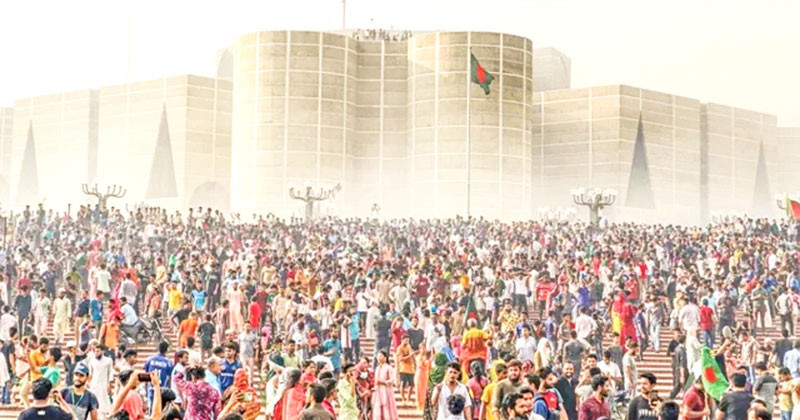
Over 54 years, institutional corruption, the ruling class’s distrust of democracy and the criminalisation of politics built the ground for the July uprising in Bangladesh. The roots of the political and cultural spirit of the July uprising of 2024 go deeper into state and society. Our July revolution lies hidden in two earlier events. One is the spirit of 1905, when Bengal had an administrative reform that Brahmanical Hindus called the “partition of Bengal”. The other is the spirit of 1947, when India and Bengal were divided on the basis of religion.
Every revolution has an ideological and political plan and preparation behind it. But the July revolution of 2024 was a spontaneous revolt by ordinary people against an all consuming, corrupt and fragile state system. In such a revolt the ruler falls, but the existing system of rule stays intact. This is why people debate whether the uprising of July and August 2024 was a revolution at all.
After the uprising, the whole cabinet, almost all members of parliament and the top leaders of the ruling party fled the country. Yet posts such as the president, the army chief and the chief justice, which the old government had filled, saw no immediate change. The police force was the main enforcer of the autocrat. Several layers of officers left behind by the fallen autocrat kept their seats comfortably in the police and in key posts of the bureaucracy.
The dream of a new Bangladesh cost the lives of nearly 1,500 students and people. It also left about 30 thousand people disabled or blind. That dream collapsed at the very start. Behind this were plots by the aides of the fallen autocrat, who hid inside the administration and politics. The aides of the dominating foreign power that backed the autocrat also took part.
State forces have stopped enforced disappearances and killings. State backed destruction of the banking sector and financial institutions, and the laundering of money, have also slowed a lot. But these changes do little for the economy, investment and stability. The economy and political stability always move hand in hand.
Those who want to defeat and dominate Bangladesh will naturally target its politics and economy. To make this control last, the dominating forces first targeted the education system and the cultural field. A government or a ruling party may fall or change through a mass uprising or the ballot. But without a change in education, culture and political narrative, the country cannot build the state people expect. The work of the interim government after the July uprising has proved this again. So has the work of the political government set up through the 13th national election.
Our state still sits in deep instability and uncertainty. This is partly the result of planned sabotage by the players of the old order. It is also partly the result of regional and international geopolitics and a war driven economy. The war in Iran and the Middle East directly hits the economy of the whole subcontinent, including Bangladesh. Energy and food security, price rises in daily goods, and uncertainty in farming, industry and export trade are enough to shake any country. Bangladesh now faces almost all these challenges at once.
To meet the international and regional political and economic challenges and move the country toward its promise, Bangladesh must keep internal stability, production and security strong and intact. Agents of the fifth column, hiding inside the country, are working on many fronts to take the country back to the old system and keep their dominance. They shelter and encourage the fallen autocrat. They make the autocrat speak in the media. They spread talk and provocation about a return to the country to keep the leaders and workers at home in good spirits. This sends a clear message that the old politics of revenge will go on whenever they get a chance.
War has brought a big crisis and uncertainty to energy security around the world. At this time, some people are trying to make everything fail and stall. In the past, an economic system and energy structure grew under the political shelter of Indian dominance. Indian interests hold a share in that structure. These people want to use that share to take control of Bangladesh’s power and energy sector.
After independence, the jute industry was the backbone of Bangladesh’s economy. To make Bangladesh fail and bow down, one must first hit the backbone of its economy. After that, such forces want to spread their influence on the political and cultural narrative and make their control permanent. In the past, they wrecked the education system. This destroyed the chance of building a skilled and ethical workforce.
They also wrecked, by plan, the democratic political climate, education, research and the room for different views and paths in the universities. This work harmed the larger national interest. They turned university campuses and halls into grazing grounds for Awami fascism, torture cells and an underworld of crime. The situation grew so terrible that Chhatra League beat Mr. Abrar Fahad, a bright student of BUET, to death in a BUET hall. He had posted on Facebook against India’s water aggression, in the context of the Feni River water deal.
From 1972 until the July uprising, the Awami League, the BNP and the Jatiya Party ran the country in turn, under military and civil administrations. Yet the Indian dominating narrative kept its place in the universities and the cultural field. After the July uprising, Inqilab Mancha, led by Mr. Sharif Osman Hadi, and representatives of the July fighters called for their own narrative and resistance against cultural aggression.
The BJP administration had sheltered the killers of Ms. Sheikh Hasina’s rule and fell into an awkward spot. It softened its tone and dropped threats and provocation to build good ties with Bangladesh. Even so, 15 months after Ms. Sheikh Hasina left the country, it kept giving safe shelter to the killers of Mr. Sharif Osman Hadi. This shows how firm and reckless the position of the Hindutva supporters is against Bangladesh’s own cultural narrative.
A democratic government now runs the country under Prime Minister Mr. Tarique Rahman, who won a credible election. For a long time, the economic sectors had fallen down in investment, jobs and promise. The IMF, the World Bank and other international bodies had said that the lack of democracy, political uncertainty and the lack of good governance were the main barriers to foreign direct investment. People naturally expected this to change through the reforms of the interim government and then under the democratic government.
But the planned kleptocracy of the aides of the fallen autocrat made the way out hard and thorny. They laundered lakhs of crores of taka out of the country and collapsed the banking sector and the whole economic strength from inside. The interim government of Dr. Muhammad Yunus faced great odds. It tried to repair the broken boat of the economy and set its sail, and it raised some hope. People expected that speed to grow under the elected government.
Prime Minister Mr. Tarique Rahman’s firm stand against corruption has raised hope in the nation. So has his plan to turn the country into a trillion dollar economy within the next five years. But the energy crisis and the power crisis have created a new reality. So has the unwanted instability and some sabotage in garment factories and other sectors.
Several fires have broken out in different places in recent weeks. The fires took place in Ashulia, Narayanganj, Savar, Gazipur and a resort in the tourist city of Cox’s Bazar. At least 18 people died and losses ran into crores of taka. Some people pushed garment workers onto the streets to create instability. There was also a fire at the Ibn Sina pharmaceutical factory in Gazipur, and fires at a garment warehouse and a jute mill warehouse in Narayanganj. We cannot treat these events as mere accidents. We cannot dismiss the suspicion that the fifth column is behind sabotage meant to destabilise the country and ruin its economic promise.
After independence, one jute mill after another faced labour unrest, sabotage and repeated fires. This sank the whole sector. The mills closed after losses of hundreds of crores of taka. Then new jute mills rose on the bank of the Hooghly River in India, using raw jute from Bangladesh. India took over the world market for Bangladesh’s jute.
After the garment industry, the pharmaceutical industry is the most promising industry in Bangladesh. The country exports medicine to more than 160 countries, including Europe and America. The United States recently removed tariff barriers on some categories of Bangladeshi medicine, and this has raised the trade promise of the sector a lot.
A hundred years ago, the Italian philosopher Mr. Antonio Gramsci wrote his theory of cultural and economic hegemony of great powers while sitting in jail. One of his famous lines reads: “The crisis consists precisely in the fact that the old is dying and the new cannot be born; in this interregnum a great variety of morbid symptoms appear.” This means that in such a time of transition, the old system dies but the new does not take birth, and many serious crises arise.
At the start of the twentieth century, the First World War broke the old monarchies of Europe and gave birth to a new reality under a colonial system. Even so, no sign of lasting change appeared. Mr. Gramsci died before the Second World War began, but his observation was very accurate. The new capitalist world order built after the Second World War had no power of its own except war. Soviet socialism also failed to leave any lasting mark on the world order. It fell in the Cold War against Western capitalism, as one would expect.
Meanwhile, the unwise effect of the piling up of capital also shook the shell of the consumerist economy. War seems to be its last controller and ruler. The Arab Revolt of 1916 and the secret Sykes Picot deal, in which the West broke up the Ottoman Empire and shared its lands, stayed in force in practice until the end of the Cold War. In the unipolar world led by the United States, no power can take the world back to its old stable position.
The plan of Zionism influenced dominance named Islam as the main rival, along with Soviet socialism. So it treated the revolutionary regime of Iran and the narrative of Islamic belief and way of life as the main enemy. Muslims who stood against the consumerist system became jihadists, fundamentalists and terrorists. The West took the field with a military budget of trillions of dollars, but it achieved nothing in three decades. The Iran war is its last attempt.
Western imperialism now looks at the 20 crore Muslims of Bangladesh with suspicion, under a magnifying glass. Hindutva in India is far more fanatic and destructive, so the world community must give new recognition to our own cultural narrative. We can no longer indulge those who add colour to a cultural divide in the country over the graffiti of Mr. Rabindranath. We will read the literature of Mr. Rabindranath. But the people of this country have the right to worship him or not. They have the right to raise any question about his role and place in our national history. They also have the right to accept or reject him socially and politically.