
Trade War Deepens As China Broadens U.S. Sanctions
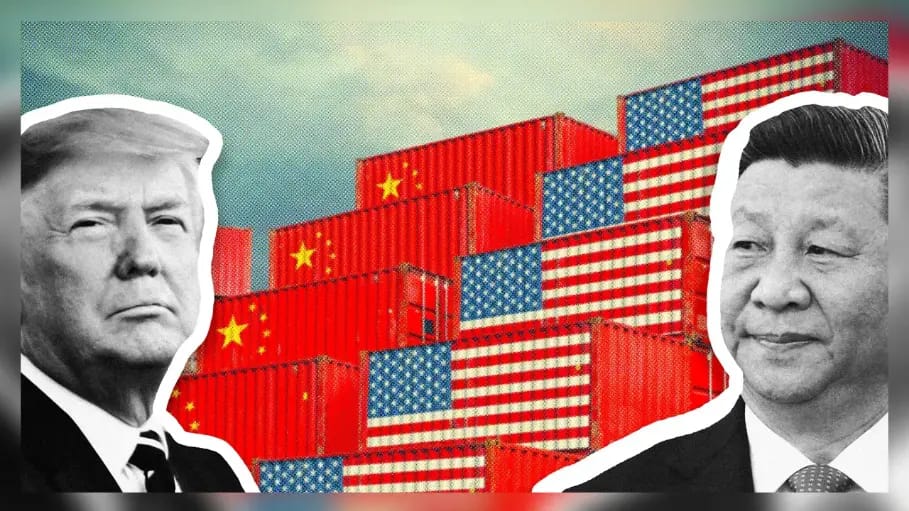
Analysts say China’s latest export restrictions and sanctions against American companies, imposed in response to recent U.S. measures, demonstrate Beijing’s expanding economic toolkit and growing willingness to use it. Wendy Cutler, vice president of the Asia Society Policy Institute, said, “China’s array of adopted measures highlights the breadth and depth of its strategic toolkit for retaliation.” She added, “Compared to the U.S. President Donald Trump’s first term, Beijing’s capacity and willingness to respond are now much more pronounced.”
China’s Ministry of Commerce announced countermeasures on Wednesday, including sanctions against seven American industrial companies, stringent export restrictions on drones and related technologies, and the launch of the country’s first national security investigation into international trade. The ministry said, “China’s countermeasures are generally restrained. The hard-won stability of commercial and economic ties between China and the United States is valued by China. We expect that China and the United States will cooperate to achieve the same objective.”
According to the ministry, the measures respond to earlier U.S. actions, including Federal Communications Commission (FCC) restrictions on imports of new Chinese drones, robots and power inverters, as well as penalties against 43 Chinese companies under the Uyghur Forced Labor Prevention Act. Beijing’s legal framework includes the Foreign Trade Law, the Anti-Foreign Sanctions Law, the Unreliable Entity List and the Export Control Law. Sourabh Gupta, a senior fellow at the Institute for China-America Studies, said, “These steps demonstrate that the structure and instruments of China’s countermeasures have now matured.”
China’s restrictions on seven rare-earth minerals in April 2025 disrupted global supply chains and temporarily forced companies around the world to halt operations, marking one of Beijing’s most significant uses of export controls. A deal between the United States and China in October last year prevented a wider escalation. Kyle Sullivan, vice president of the U.S.-China Business Council, wrote on social media that “Beijing is signalling that it possesses a growing arsenal and is prepared to use it, while simultaneously keeping avenues open for de-escalation.”
Sullivan added, “Compared to some previous responses, this larger bundle of activities is more planned and organised. It shows that rather than depending solely on snap decisions, China is creating more varied tactics in response to America’s security and economic policies.”
The latest measures by both countries, as Washington and Beijing raise tariffs, expand export restrictions and impose limits on companies, mark another round of tit-for-tat escalation. Despite the tensions, both sides have avoided disrupting plans for Chinese President Xi Jinping’s planned September visit to the United States. Gupta said China’s strategic economic tools are no longer merely symbolic and can achieve concrete objectives. “Decades from now, the past half-decade will be remembered as a landmark era marking the dawn of modern Chinese economic statecraft,” he said.