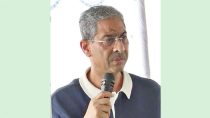
We will return home only after establishing the people’s rights: Dr. Shafiqur Rahman

- 11-party alliance’s peaceful Dhaka-Chattogram long march
- Crowds line 250km route from Shapla to Laldighi
- Long march convoy had more than 2,000 vehicles
- demand to accept the six-point charter, including the referendum verdict
Rafiq Muhammad, Rafiqul Islam Selim, Sadik Mamun, Md. Omar Faruk & Md. Belal Hossain
The 11-party alliance’s Dhaka-Chattogram long march, held over six demands, drew a spontaneous flood of people. The disciplined and peaceful program gave the Dhaka-Chattogram highway a festive mood throughout the day. Yesterday, Saturday morning, after a rally at Shapla Chattar in the capital, the Chattogram-bound long march set off in a large, orderly motorcade led by Jamaat-e-Islami Ameer and Leader of the Opposition Dr. Shafiqur Rahman along with other top leaders of the 11-party alliance. Along the way, after street rallies at Kachpur Bridge on Chattogram Road in Narayanganj, Paduar Bazar and Chauddagram in Cumilla, Mohipal in Feni, and Mirsharai at the entrance to Chattogram, the march ended that night with a rally at Chattogram’s historic Laldighi Maidan.
Along the roughly 250-kilometer route from Shapla Chattar to Laldighi Maidan, people of all classes, professions, and ages turned out in huge numbers to welcome the march. Crowds stood on both sides of the road holding slogans, placards, banners, and festoons, welcoming the marchers and expressing solidarity with the six-point demands. Some handed out food packets and water bottles to the marchers, while others joined the motorcade themselves. The march grew longer and longer as more people joined along the way, and the convoy struggled at times to make its way through the crowds, with particularly dense clusters of leaders and activists around the vehicles of top leaders, who stood in open-top cars waving to greet the public.
Less than seven months into the elected government’s term, this long political program by the opposition faced no obstruction anywhere. Rather, police were seen cooperating with the program, especially in managing traffic and maintaining order. Normal traffic movement was disrupted because of the long march and the roadside rallies, causing hardship for commuters. The 11-party alliance’s rallies and street meetings effectively turned into seas of people, and the closing rally at Laldighi was the largest public gathering to date. Amid the thunderous slogans of hundreds of thousands, the top leaders of the 11-party alliance demanded immediate acceptance of the six-point charter, including the referendum verdict.
The long march from Dhaka to Chattogram was organized around demands including implementation of the referendum verdict, trial over the July killings, resolution of the electricity, oil, gas, and fertilizer crises, curbing the rising prices of essential goods, ending extortion and corruption, improving law-and-order conditions, and stopping narrow partisan politicization. Starting at 8:15 AM from Shapla Chattar — stained, they said, with the blood of countless martyrs — the long march entered Chattogram, the city associated with the historic declaration of independence and the liberation struggle, at 8:00 PM after 13 hours. It took nearly two more hours for the convoy to push through the crowds from Sitakunda and reach Laldighi Maidan.
At the rallies, Leader of the Opposition and Jamaat-e-Islami Ameer Dr. Shafiqur Rahman said their long march represented 180 million people, adding that their demand was clear: people are suffering from gas, electricity, and water shortages, yet still have to pay their bills. He said their movement will continue until the rights of this country’s 180 million people are secured. He said they had taken up the fight to establish people’s rights, warning that if anyone toys with the people’s rights, the people will not spare them either. He said the movement would continue in parallel, both in parliament and on the streets, until every one of the 180 million people’s rights is established, adding that they had not taken to the streets for any party, individual, or group, but for the people, and that, God willing, they would return home only after securing the people’s rights.
Jamaat Ameer Dr. Shafiqur Rahman said a seventh point would be added to the six-point charter: “We will not tolerate the existence of any extortionist or corrupt person in Bangladesh.” He said corruption and extortion must stop, that people are fed up with extortionists, and that their rights are being plundered by the corrupt. He said there is no gas, no electricity, no water, yet gas bills and “ghost” electricity bills still arrive as usual. He referred to a young man named Sifat, who, out of frustration, said something that could turn Bangladesh upside down; Sifat was arrested, he said, and party-affiliated thugs mistreated him at the police station. He said that while Sifat’s language may not have been appropriate, the issue he protested is one that all 180 million people of Bangladesh would roar about if needed. He warned the government to release him for the sake of goodwill, cautioning that failing to do so should recall how figures like Noor Hossain, Yasmin, and Dr. Milon had once overturned many a throne.
LDP Chairman, former minister, and freedom fighter Colonel (Retd.) Mr. Oli Ahmed, Bir Bikrom, said that no other political party in Bangladesh could bring leaders, activists, and the public onto the streets so early in the morning as the 11-party alliance had done. He challenged Mr. Tarique Rahman to call a similarly early rally if he wished. He said the current government is proof that voting for extortionists and thugs does not lead the country well, and that honest and competent people must be elected to run the country properly. He warned the government that the 11-party alliance had completed its first round and was signaling a second round of movement, adding that they believe in peaceful struggle since they do not run their party through criminals, and that the people’s demands will be achieved through peaceful, democratic movement, God willing.
Deputy Leader of the Opposition in Parliament and Jamaat Naeb-e-Ameer Dr. Syed Abdullah Mohammad Taher said the purpose of their movement is to ease the suffering of the people of Bangladesh, describing it as a “wake-up call” to the government. He said the government must act responsibly in fulfilling the people’s legitimate demands and taking the necessary steps for state reform, or else the people would make their decision known.
National Citizen Party (NCP) Convenor and Opposition Chief Whip Mr. Nahid Islam said the long march belongs to the common people and that this movement of the people would accept no obstruction, and that the government would be forced to accept the 11-party alliance’s six-point demands despite all barriers — failing which, the six points would turn into a single-point demand. He said the march was against those attempting to become new autocrats, and against those who did not honor the referendum verdict and implement the July Charter.
Bangladesh Khelafat Majlis Ameer Allama Mr. Mamunul Haque said he wanted to tell the head of government, in the language of the Quran, to beware, or else, even without their wanting it, the government would not be able to remain in power. He said that when asked why they are protesting against the government less than six months in, his answer is that the government betrayed the nation within six minutes of taking power. He added that if the government fails to understand the message being sent through this peaceful long march, the consequences could be far more severe.
Nezam-e-Islam Party Ameer Mr. Abdul Kaiyum Sobhani said that after the fall of the fascist government, people had a natural expectation of living in peace, free from persecution, but instead the country is going through a nightmarish situation, with people in extreme insecurity and the government unable to guarantee safety of life and property.
Jamaat Secretary General and former MP Mr. Mia Golam Parwar said the government has failed to ease people’s suffering, which is worsening by the day, and that by not implementing the referendum verdict, it has deceived the people and broken all its promises to them. He said the government must admit its mistakes in parliament and take the initiative for constitutional reform, adding that government ministers have lost their footing and cannot even decide what to say. He noted that the government was supposed to accept the referendum verdict and form a constitutional reform council within 30 days of the parliamentary session, but failed to do so, missing that opportunity.
NCP Member Secretary Mr. Akhtar Hossain MP said the government has gone against 70 percent of the population by failing to implement the referendum verdict, and has earned the displeasure of virtually the entire population by failing to provide oil, gas, and electricity. He said holding a two-thirds majority in parliament does not guarantee staying in power — the people who can vote can also take power away.
AB Party Chairman Mr. Mujibur Rahman Manju said that when ruling party leaders ask why they are protesting less than six months in, the answer is that they are pointing out the government’s mistakes to give it a chance to correct them, since they are not the government’s enemies — rather, the government’s inability to distinguish friend from foe is why it keeps losing its footing. He said that in six months, the government has no story to tell except 150-taka lunches and 50,000 family cards, with no real achievement, and that despite promising to implement the July Charter to the letter, it failed to do so — and could meet the same fate as its predecessor.