
Concerns Over Rising Project Construction Costs
Eklach Haque
A technical committee reviewing cost increases has deemed the nearly doubling of construction costs for two major metro rail projects in the capital, MRT Line-1 and MRT Line-5 (Northern Route) acceptable in light of global economic conditions, rising construction material prices and the increase in the US dollar exchange rate. At the same time, the committee has expressed concern that construction costs could rise further if work on the two projects is not started quickly.
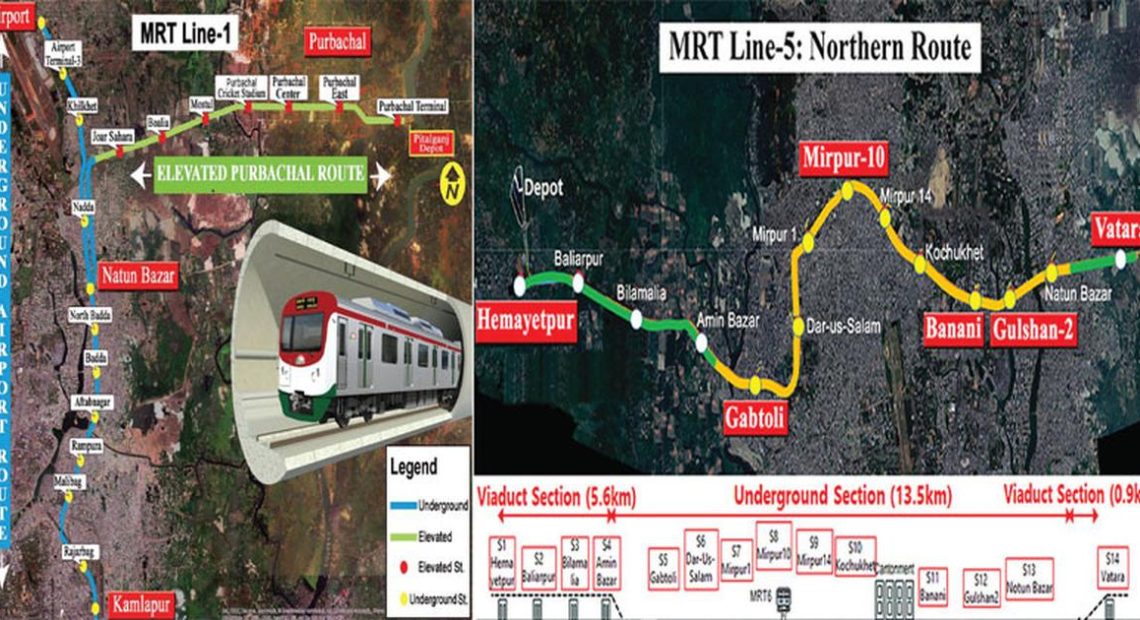
According to project sources, the Dhaka Mass Rapid Transit Development Project Line-5 (Northern Route), a 20-kilometre metro rail line from Hemayetpur to Bhatara combining underground and elevated sections: 13.50 kilometres underground and 6.50 kilometres elevated with 14 stations, including nine underground and five elevated, has completed the basic and detailed route design and land acquisition for the Hemayetpur depot. The construction work is being implemented through a total of 10 packages.
A contract has been signed with the contractor for CP-01, the package for land development at the Hemayetpur depot. Land development work at the depot is ongoing, with physical progress reaching 84.19 percent as of August. Tenders for other packages are at various stages of processing. Land acquisition required for the construction of the 14 stations between Hemayetpur and Bhatara and transition sections at both ends of the underground portion is also ongoing at various stages.
The MRT Line-5 Northern Route project is a 20 kilometre line running from Hemayetpur to Bhatara through underground and elevated sections. The project was initially estimated to cost Tk 41,238 crore, while the proposed revised cost has been set at Tk 93,190 crore. The project was scheduled to continue until December 2028.
The government formed a technical committee, whose report said the combined cost of MRT Line-1 and MRT Line-5 (Northern Route) could eventually reach Tk 200,000 crore.
The two metro rail projects, undertaken to ease the capital’s growing traffic congestion, increase public transport capacity and modernise Dhaka’s transport system, are considered important components of the city’s long-term urban transport plan. However, the significant increase in project costs has raised questions. In particular, the gap between the estimated costs at the planning stage and the current revised costs has renewed debate over the economic rationale for implementing the projects.
According to the technical committee’s observations, the increase in costs was not caused solely by weaknesses in project management or internal factors. Since the projects were approved, the prices of construction materials, machinery and various equipment in international markets have increased. At the same time, the significant rise in the value of the US dollar against the Bangladeshi currency has placed additional pressure on project costs payable in foreign currency. The committee believes that the projects can no longer be implemented based on the previous cost estimates.
In recent years, international prices of steel, cement, construction machinery, electrical equipment, railway materials and other infrastructure products have been volatile. The Russia-Ukraine war also caused instability in international energy and raw material markets. Rising transportation costs further increased the prices of imported construction materials.
As technology-intensive projects, metro rail systems require large quantities of imported equipment, meaning changes in international markets directly affect project costs. This has been compounded by changes in the country’s foreign exchange market. The exchange rate used to estimate project costs initially has changed significantly, with the value of the dollar subsequently rising much further. As a result, more taka is now required to make payments for the same amount of dollars.
In addition, the prices of construction materials, workers’ wages, land, consultancy services, transportation and machinery all change over time. The technical committee has therefore emphasised the need to start the projects quickly. Those concerned say that if work is not started at the current stage and is delayed for several more years, the prices of construction materials in international markets or the dollar exchange rate in the country may rise further.
Professor Dr Hadiuzzaman of the Department of Civil Engineering at Bangladesh University of Engineering and Technology (BUET) told Inqilab that it would not be possible to meet future travel demand in a densely populated city through a road-based transport system alone. Therefore, there is a need to expand the metro rail network.
He said the launch of MRT Line-1 and MRT Line-5 (Northern Route) would create a faster public transport alternative along these corridors. A large number of passengers would be able to travel in relatively less time by metro rail, while dependence on private cars could also decrease.
However, he said the benefits would only be achieved if the projects were completed on schedule and maintained the required standards. Prolonged construction could simultaneously increase traffic congestion, construction-related public inconvenience and economic losses on the roads.
He said that although global price increases and the rise in the dollar exchange rate were factors behind the higher project costs, the entire issue could not be explained solely by international conditions. The feasibility assessment, cost estimates, land acquisition, design changes, delays in project implementation and management efficiency at the time the projects were undertaken should also be reviewed equally.
He stressed that it is essential to maintain a balance among the cost, time and expected benefits of each project.